Couleur de fond de la photo d’identité : les règles pays par pays
La couleur de fond est la première cause de refus d’une photo d’identité pourtant techniquement correcte, au consulat ou au poste-frontière. Les règles varient selon le pays et le type de document — même au sein de l’espace Schengen, l’interprétation pratique n’est pas toujours identique.
Dans cet article · 7 sections
Réponse rapide
La plupart des pays exigent un blanc uni ou un gris clair
Le blanc uni est l’exigence la plus répandue dans le monde. Les États Schengen acceptent une gamme allant du blanc cassé au gris clair. L’Inde, le Vietnam et plusieurs pays d’Asie du Sud-Est exigent explicitement du blanc pur uniquement.
Pourquoi la couleur de fond est si importante
La couleur de fond d’une photo d’identité est contrôlée au moment du dépôt par des systèmes automatiques de segmentation des couleurs. Une photo qui paraît blanc uni à l’écran peut être détectée comme blanc cassé, crème, beige ou gris une fois imprimée et numérisée, ce qui déclenche un refus automatique bien avant qu’un agent n’examine le dossier.
La teinte exacte compte moins que l’homogénéité : le système biométrique a besoin d’un fond uniforme, sans dégradé, sans ombre et sans texture. De nombreux refus dans des studios facturant une « photo d’identité » viennent du fait que le studio applique un fond gris standard qui échoue au contrôle automatique de blancheur.
Couleur de fond exigée selon la démarche
| Pays / démarche | Fond exigé | Remarques |
|---|---|---|
| Passeport / visa États-Unis | Blanc uni | Le Département d’État exige un blanc uni ; le blanc cassé est refusé. |
| Passeport Royaume-Uni | Gris clair ou crème | Le HM Passport Office préfère le gris clair ; le blanc uni est aussi accepté. |
| Visa Schengen | Gris clair uni ou blanc cassé | Norme du Conseil de l’UE. Le blanc pur est accepté dans la pratique. |
| Passeport Allemagne | Gris clair uni | Le ministère fédéral des Affaires étrangères utilise un gabarit (Passbildschablone) de référence gris clair. |
| Passeport / visa France | Gris clair uni ou blanc cassé | France-Visas accepte les deux teintes. |
| Passeport / visa Chine | Blanc uni | Administration nationale de l’immigration : blanc ou bleu clair. Le blanc reste le choix le plus sûr. |
| Passeport / OCI Inde | Blanc uni | Le Bureau of Immigration exige uniquement du blanc. |
| Passeport Japon | Blanc uni ou bleu clair | Le MFA japonais accepte les deux ; choisissez une teinte et gardez-la pour toutes les copies. |
| Passeport intérieur Russie | Blanc uni ou gris clair | Le MVD accepte les deux ; le gris clair est plus courant en studio. |
| Passeport / Emirates ID EAU | Blanc uni | L’ICP exige du blanc. |
| Photo biométrique Turquie | Blanc uni | Exigence de fond blanc du NVI. |
| Visa Vietnam | Blanc uni | Le service de l’immigration vietnamien exige uniquement du blanc. |
Comment vérifier votre fond avant l’impression
Posez la photo non retouchée à côté d’une feuille de papier blanc uni sur votre bureau. Si le fond de la photo paraît d’une teinte différente de celle du papier, le système automatique détectera la même différence. Reprenez la photo avec un éclairage frontal plus diffus avant de la traiter.
Erreurs de fond les plus fréquentes
Un mur peint en « blanc cassé » est presque toujours perçu comme crème ou beige à la lumière du jour. Un drap crée une texture de tissu même repassé. Un papier peint à motifs, une lumière en dégradé venant d’une fenêtre latérale et l’ombre du sujet lui-même sont les quatre causes de refus les plus fréquentes.
Questions fréquentes
01Le Schengen exige-t-il du blanc ou du gris ?
La norme du Conseil Schengen est « gris clair uni ou blanc cassé ». En pratique, les deux teintes sont acceptées tant que le fond est uniforme et sans ombre. Le blanc pur reste le choix le plus sûr dans la plupart des consulats.
02Pourquoi ma photo à fond blanc a-t-elle été refusée ?
Une photo peut échouer à un contrôle automatique de blancheur même si elle paraît blanche à l’écran. Causes fréquentes : un éclairage intérieur à dominante jaune, une imprimante qui ajoute une dominante colorée, ou un fichier original enregistré dans un profil colorimétrique autre que sRGB.
03Puis-je remplacer le fond numériquement ?
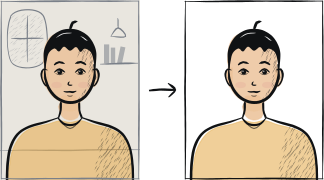
Il y a deux façons d’obtenir un fond uni et régulier. La première consiste à se photographier devant un mur clair et lisse, sans motif ni texture : placez-vous à au moins 50 cm du mur pour que votre ombre n’y tombe pas, et tournez-vous vers une fenêtre ou une autre lumière douce pour que les deux côtés du fond aient la même teinte. La seconde consiste à remplacer le fond après la prise de vue : Anfas.Pro détache votre silhouette de ce qui se trouvait derrière vous et remplit le fond avec exactement la teinte demandée par la spécification de votre document.
04Quelle couleur de fond pour une photo de bébé ?
La même teinte que pour les adultes dans le même pays. Les photos de bébé exigent elles aussi un fond uni et uniforme — un couffin texturé, une couverture ou l’intérieur d’une poussette visible est la cause de refus la plus fréquente pour une photo de passeport de bébé.
Guides associés
Obtenez le bon fond du premier coup
Envoyez un portrait — Anfas.Pro remplace votre fond par la teinte exacte exigée par votre pays.