Document photo background colour: country-by-country rules
Background colour is the single biggest reason a technically correct document photo is rejected at the consulate or border desk. The rules vary by country and by document type — even within Schengen the practical interpretation is not always identical.
Quick answer
Most countries require plain white or light grey
Plain white is the most common requirement worldwide, but it is not universal: France forbids a white background for its passport and ID card, and the Indian OCI card requires a plain light colour that is explicitly not white. Schengen states accept any plain light background.
Why background colour matters
Background colour is checked against the published specification when the photo is submitted — by portal validation on digital routes and by the clerk at the counter on paper routes. A photo that looks plain white on screen can read as cream, beige or grey once it is printed and scanned, and that difference is enough to send the application back.
The shade matters less than the consistency: every specification asks for a uniform background with no gradient, no shadow and no texture. A studio backdrop chosen for portraits rather than for documents is a common source of trouble — it can look right in the room and wrong in the print.
Required background colour by route
| Country / route | Required background | Notes |
|---|---|---|
| USA passport / visa | Plain white or off-white | US Department of State accepts white or off-white; the background must be plain and shadow-free. |
| UK passport | Light grey or cream | HMPO specifies a plain cream or light-grey background; photographer guidance warns the print must not read as white. |
| Schengen visa | Plain light-coloured background | The European Commission photograph sheet says only "plain light-coloured"; member states narrow it — France forbids white. |
| Germany passport | Plain light background, neutral grey preferred | BMI photo template: single-colour light background contrasting with face and hair; neutral grey is the recommended choice. |
| France passport / ID card | Plain light blue or light grey — white is forbidden | service-public.gouv.fr states it plainly: "Le fond blanc est interdit." |
| France Schengen visa | Plain light-coloured background | France-Visas uses the European Commission photograph sheet. |
| China passport / visa | Plain white | National Immigration Administration: white or light blue; consular applications abroad take white only. |
| India passport | Plain white | Passport Seva: 4.5 × 3.5 cm print on a white background. |
| India OCI card | Plain light colour — not white | OCI portal: 51 × 51 mm square, plain light colour background; white is rejected. |
| Japan passport | Plain light-coloured background | MFA Japan requires a plain light background with no pattern and no border; white and light blue are the usual studio choices. |
| Russia internal passport | Plain white | MVD order No. 773, clause 36.7: a plain white background. |
| UAE passport / Emirates ID | Plain white | ICP requires white and bars hands above shoulder level. |
| Turkey biometric photo | Plain white | NVI: white, no pattern, taken within 6 months — and the print must be 50 × 60 mm, not cut down to 35 × 45 mm. |
| Vietnam e-visa | Plain white (portal practice) | The portal specifies 4 × 6 cm and no glasses; the white background is standard practice rather than a published colour rule. |
How to test your background before printing
Put the unedited photo next to a sheet of plain white paper at your desk. If the photo background reads as a different shade than the paper, the reviewer will see the same difference. Reshoot with more diffuse frontal light before processing — unless you are applying for a French passport or ID card, where a white background is not allowed at all and the shade you are aiming for is light blue or light grey.
Common background mistakes
A wall painted "off-white" almost always reads as cream or beige under daylight. A bedsheet creates fabric texture even when ironed. Patterned wallpaper, gradient lighting from a side window, and the subject's own shadow are four of the most common background faults.
Frequently asked questions
01Does Schengen require white or grey?
The European Commission photograph sheet used across Schengen says only "a plain light-coloured background". Both light grey and off-white satisfy it, as long as the background is uniform and shadow-free. France forbids white for its own passport and ID card.
02Why was my white background photo rejected?
A photo can be turned down even when it looks white on screen. Common causes: a yellow indoor light source, a printer that adds a colour cast, or a shadow falling on the wall behind you that leaves one side of the background darker than the other.
03Can I replace the background digitally?
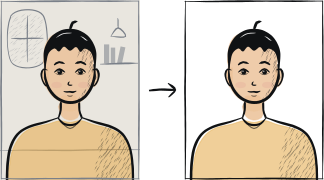
There are two ways to get a plain, even background. The first is to shoot against a smooth light wall with no pattern or texture: stand at least 50 cm away from it so your shadow does not land on it, and face a window or another soft light so both sides of the background come out the same shade. The second is to replace the background after the shot: Anfas.Pro separates you from whatever was behind you and fills the background with exactly the shade your document's specification asks for.
04What background colour for a baby photo?
Same shade as for adults in the same country. Baby photos still need a plain uniform background — a textured cot, blanket or pram interior is the most common reason a baby passport photo is rejected.
Related guides
Get the exact background right, the first time
Upload a portrait — Anfas.Pro replaces your background with exactly the shade your country requires.