Face Recognition at the Border: E-Gates and Photos 2026
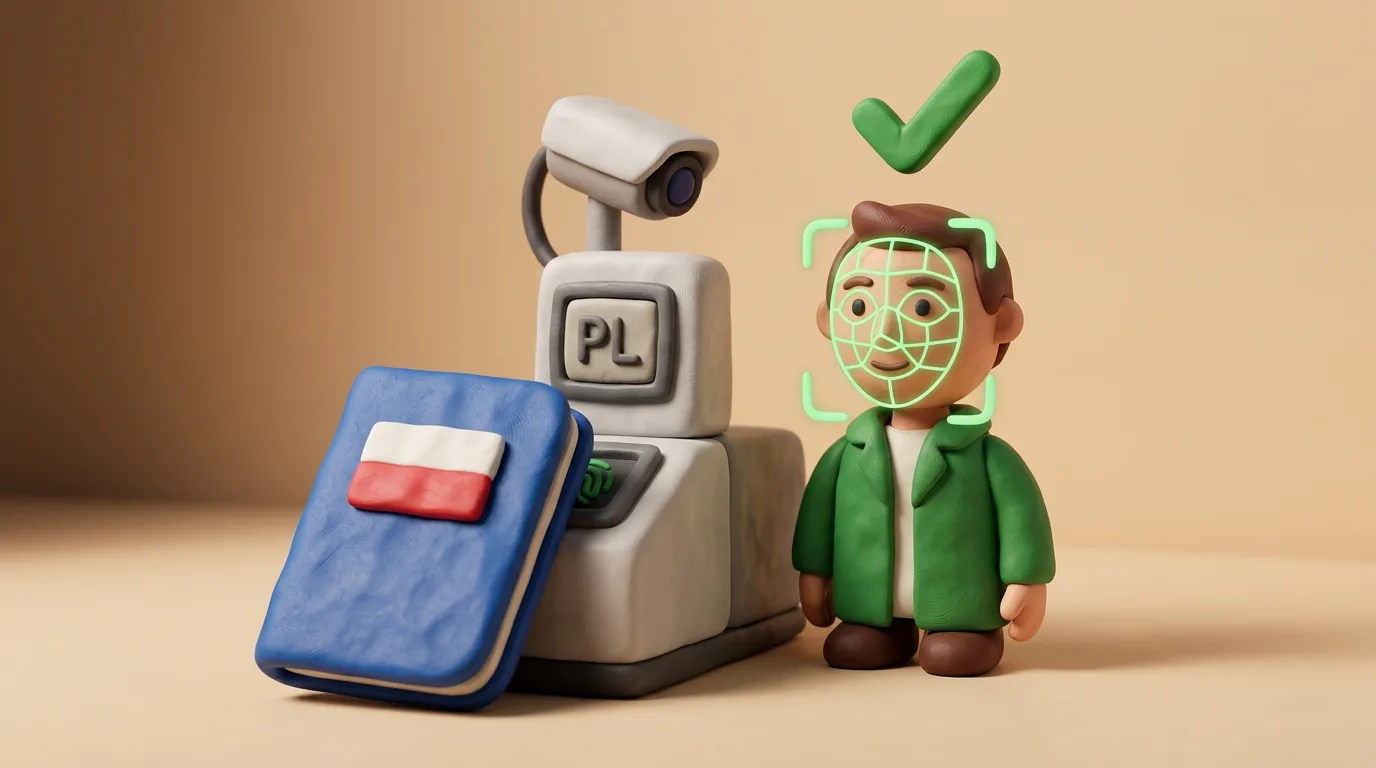
A biometric passport stores your photo and a facial template in a chip. At an automated border, the e-gate photographs you and compares your live face to the chip photo. A neutral expression, even light and sharp focus raise the match — and the gate opens.
Key points
5 points- A biometric passport stores your photo and a facial template in a chip per ICAO Doc 9303.
- At an e-gate the system matches your live face to the chip photo on a 1:1 basis.
- The algorithm measures distances between eyes, nose and mouth — the face geometry.
- A neutral expression, even light, sharp focus and a recent photo raise the match.
- A smile, glasses glare, shadows and hair over the face lower the match.
Why document photo rules are so strict
The rules for a passport photo can feel excessive: no smile, no glare from glasses, even light, a plain background. But they do not exist for the sake of looks. They make your photo reliable for a machine, because a machine is what checks you at a modern border.
What a biometric passport stores
A modern passport is biometric (an ePassport). Under the ICAO Doc 9303 standard, a contactless chip holds your photo and a facial template derived from it. This is the reference that your live face is later compared against.
How a border e-gate works
At an automated gate (e-gate) the sequence is:
- You present the passport — the system reads the chip and its data.
- A camera takes your live photo right there.
- The algorithm compares your live face to the chip photo on a 1:1 basis (verification).
The comparison relies on face geometry: distances between the centres of the eyes, the position of the nose and mouth, the proportions. If the match score passes a threshold, the gate opens. If not, you are sent for a manual check by an officer.
| Raises the match | Lowers the match |
|---|---|
| Neutral expression, mouth closed | Smile, open mouth |
| Even light, sharp focus | Shadows, blur, glasses glare |
| Eyes open and visible | Hair or frames over the eyes |
| Recent photo | Outdated photo |
Under Frontex guidelines automated gates are tuned so that a false accept is very rare; when a match is ambiguous, an officer makes the decision.
Where it already matters: EES
The European Entry/Exit System (EES) records travellers' biometrics — a facial image and fingerprints — at the external Schengen border. The system started operating on 12 October 2025 with a progressive roll-out and, according to the European Commission, became fully operational on 10 April 2026. It is a concrete example of where the quality of your facial photo affects how fast you pass.
Takeaway
The "boring" photo rules are really an instruction sheet for the algorithm. The closer your image is to a neutral, evenly lit and sharp reference, the higher the match and the faster the gate opens.
06Questions
5 answers01Why is a neutral expression required?
The algorithm compares face geometry. A smile shifts your features and lowers the match score against the chip photo, so a neutral expression gives a more reliable result.
02Why can glasses cause problems?
Glare from the lenses or frames covering the eyes stop the camera from seeing key facial points. If the eyes are clearly visible and there is no glare, glasses are usually acceptable.
03What happens if my face does not match?
The gate stays closed and you are directed to an officer for a manual check. It is not an accusation — the cause is often image quality or lighting.
04Should I update my photo if I have changed?
Yes. An outdated photo lowers the match with your live face. A recent photo that reflects how you look now passes more reliably.
05Does EES store my face?
Yes. EES records a facial image and fingerprints of travellers at the external Schengen border; the details are described by the European Commission.
07Official sources
- ICAO Doc 9303 — Machine Readable Travel Documents
icao.int - European Commission — Entry/Exit System (EES)
home-affairs.ec.europa.eu - Council of the EU — How the Entry/Exit System works
consilium.europa.eu - Frontex — Best Practice Operational Guidelines for Automated Border Control
frontex.europa.eu
Author: Yevhen Kravchenko. Published . Checked against official sources on .
Make your photo to the current rules
Pick your document and upload a selfie — we crop it to size, replace the background and check it. Free. The sizes come from the same official sources as the news.