Schengen visa photo requirements for all 29 countries
The Schengen short-stay visa uses one shared biometric photo standard — 35 × 45 mm, ICAO 9303 framing, plain light background — across every member state. This pillar covers the shared specification, the differences in how each consulate handles photo submission, and links to a dedicated page for each country.
In this article · 9 sections
- —35 × 45 mm, plain light background, biometric framing
- 01The Schengen photo specification at a glance
- 02The area, the 90/180 rule and border checks
- 03Choose your Schengen country
- 04Consulate route by country
- 05How to apply for a Schengen visa
- 06Frequently asked questions
- 07Cross-country photo guides
- 08Sources
Quick answer
35 × 45 mm, plain light background, biometric framing
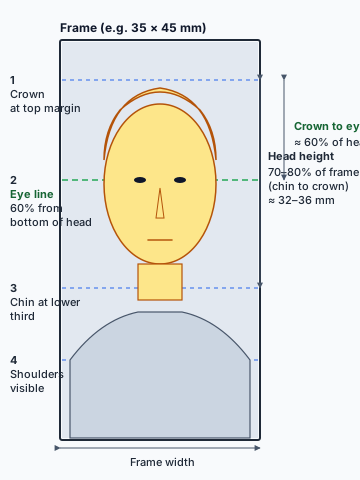
Every Schengen visa photo is 35 × 45 mm with the head occupying 70–80% of frame height (32–36 mm chin-to-crown) on a plain light grey or off-white, even illumination. Neutral expression, eyes open, no glasses, taken within the last six months. Last reviewed .
The Schengen photo specification at a glance
| Size | 35 × 45 mm [1] |
|---|---|
| Head height | 70–80% of frame height (32–36 mm chin-to-crown) [1] |
| Background | plain light grey or off-white, even illumination [1] |
| Pose | Front-facing, head level, both ears typically visible [2] |
| Expression | Neutral, mouth closed, eyes open and clearly visible [2] |
| Glasses | Strongly discouraged; banned at most consulates due to glare. See full rules → |
| Head covering | Religious head coverings allowed when facial features remain fully visible. See full rules → |
| Age of photo | Taken within the last 6 months [1] |
| Print copies | Two printed photos in most markets, even when a digital upload is accepted |
| Checked against primary sources. Updated . Sources | |
The area, the 90/180 rule and border checks
Which countries a Schengen visa covers
The Schengen area has 29 countries: 25 EU member states plus Iceland, Norway, Switzerland and Liechtenstein. Bulgaria and Romania became full members on 1 January 2025, when checks at their land borders were lifted — at air and sea borders they had already gone on 31 March 2024. Two EU countries stay outside the area: Cyprus and Ireland. A Schengen visa does not admit you to either one; both issue their own visas.
The 90/180 rule
A short-stay visa allows a maximum of 90 days in any 180-day period. The limit covers the whole area at once, not each country separately: days spent in Italy, Poland and Norway add up together. The count is rolling — on any day you are inside, look back over the previous 180 days and add up the days already spent. A visa valid for a year does not mean a year of stay: it means you may enter during that year, still within 90 days per 180.
At the border: the Entry/Exit System
Since 10 April 2026 the Entry/Exit System (EES) has been fully operational. Border officers no longer stamp passports: your face and fingerprints are recorded at the check, and every entry and exit is stored digitally. Nothing has to be filed in advance — the registration happens at the border itself, so allow extra time on the first crossing.
ETIAS is not for visa applicants
ETIAS is a separate travel authorisation for people who do not need a visa. It is not running yet: the launch is planned for the last quarter of 2026, the fee will be €20, and travellers under 18 or over 70 are exempt. Once issued it lasts three years or until the passport expires. If you are applying for a Schengen visa, you do not need ETIAS and you should not pay anyone for it.
Choose your Schengen country
The photo specification is identical across all 29 states. The application route — VAC operator, processing time, embassy network — is country-specific. Pick the country where you will spend the most days, or your first entry country if the days are equal. Bulgaria and Romania have been full members since 1 January 2025 and apply the same photo standard; applications go to their own consulates.















No such country in the list.
Consulate route by country
| Country | Primary VAC | Standard fee | Processing time |
|---|---|---|---|
| Austria | VFS Global | €90 | 15 calendar days standard |
| Belgium | TLScontact in most countries; VFS Global in some markets | €90 | 15 calendar days standard |
| Croatia | VFS Global / direct consulate booking | €90 | 15 calendar days standard |
| Czech Republic | VFS Global | €90 | 15 calendar days standard |
| Denmark | VFS Global; some Nordic representation in markets without a Danish consulate | €90 | 15 calendar days standard |
| Estonia | VFS Global; Finnish consulates handle Estonian Schengen applications in many countries | €90 | 15 calendar days standard |
| Finland | VFS Global in most markets | €90 | 15 calendar days standard |
| France | TLScontact in most markets; VFS Global and Capago in selected countries | €90 | 15 calendar days standard |
| Germany | VFS Global in most markets; TLScontact in selected countries | €90 | 15 calendar days standard |
| Greece | VFS Global in most markets | €90 | 15 calendar days standard |
| Hungary | VFS Global in most markets | €90 | 15 calendar days standard |
| Iceland | Depends on the representing Schengen state — most often a Danish or Norwegian post via VFS Global | €90 | 15 calendar days standard |
| Italy | VFS Global in most markets; some consulates accept direct appointments | €90 | 15 calendar days standard |
| Latvia | VFS Global in major markets | €90 | 15 calendar days standard |
| Liechtenstein | Swiss visa application centre (VFS Global) | €90 | 15 calendar days standard |
| Lithuania | VFS Global | €90 | 15 calendar days standard |
| Luxembourg | TLScontact / VFS Global through representation arrangements | €90 | 15 calendar days standard |
| Malta | VFS Global in major markets; Italian representation in markets without a Maltese post | €90 | 15 calendar days standard |
| Netherlands | VFS Global in most markets | €90 | 15 calendar days standard |
| Norway | VFS Global in most markets | €90 | 15 calendar days standard |
| Poland | VFS Global in many markets; some consulates accept direct appointments | €90 | 15 calendar days standard |
| Portugal | VFS Global in most markets | €90 | 15 calendar days standard |
| Slovakia | VFS Global; Czech consulates handle Slovak applications in selected markets | €90 | 15 calendar days standard |
| Slovenia | VFS Global in major markets; direct booking in many European posts | €90 | 15 calendar days standard |
| Spain | BLS International in many markets; TLScontact and VFS Global in selected countries | €90 | 15 calendar days standard |
| Sweden | VFS Global in most markets | €90 | 15 calendar days standard |
| Switzerland | VFS Global in most markets; TLScontact in selected countries | €90 | 15 calendar days standard |
How to apply for a Schengen visa
Pick the right consulate
Apply through the Schengen country where you will spend the most days. If the days are equal across countries, apply through your first entry country. Some countries are represented by others abroad.
Prepare the biometric photo
Use a 35 × 45 mm photo with neutral expression, eyes open, no glasses, plain light background. Print on photo paper or upload a sharp digital file matching the consulate's portal limits.
Complete the visa application form
Fill the Schengen visa form online if your consulate supports it, otherwise on paper. Bring two printed photos as a fallback — some consulates ask for physical copies even when the digital file was accepted.
Gather supporting documents
Standard set: passport, travel insurance with at least €30,000 medical coverage, itinerary, accommodation booking, return flight, financial proof, employment letter or study confirmation.
Book the biometrics appointment
Schedule through VFS Global, TLScontact, BLS International or a direct consulate slot. Fingerprints are collected for first-time applicants and stored for 59 months in the VIS database.
Submit and pay the fee
Pay €90 (€45 for children 6–12) at the appointment. If you apply through Switzerland or Liechtenstein, the same amount is charged in Swiss francs at the rate published by that mission. Keep the receipt — it is required if you need to follow up on the application status.
Frequently asked questions
01What size is a Schengen visa photo?
The Schengen visa photo is 35 × 45 mm (about 1.38 × 1.77 inches). All 29 Schengen states use the same biometric size; the head must occupy 70–80% of the frame height, with chin-to-crown roughly 32–36 mm.
02Is the Schengen visa photo the same as a passport photo?
The framing and biometric rules are the same — both follow the ICAO 9303 standard. National passport photo sizes can differ (the United Kingdom and the United States use different formats), but the Schengen visa photo is consistent across all member states at 35 × 45 mm.
03Can I wear glasses in a Schengen visa photo?
The Schengen baseline does not flatly forbid glasses, but it requires that the eyes be fully visible and free of glare. Consulates increasingly reject any photo with visible glasses because of reflection risk. The safest option is to remove glasses before the shot.
04How recent must the photo be?
No older than six months. That deadline comes from the national photo specifications published by consulates, not from EU law, which only requires a photo meeting the ICAO standard. Consulates compare the photo against the live applicant at the biometrics appointment; a clearly outdated photo (different hair, weight, age) will be rejected even when the geometry is correct.
05Can I use the same photo for multiple Schengen applications?
Yes, if the photo is still within the six-month window and your appearance has not changed. A second visa from a different consulate uses the same biometric standard.
06Does every Schengen country charge the same visa fee?
The standard short-stay visa fee is €90 (€45 for children 6–12) and has applied since 11 June 2024. Switzerland and Liechtenstein charge the same fee in Swiss francs: each mission publishes its own conversion rate and adjusts it as the exchange rate moves.
Cross-country photo guides
These guides cover one photo aspect across all of Schengen plus other major visa-issuing countries — useful when the question is about a rule rather than a country.
Sources
- European Union Visa Code (Regulation (EC) No 810/2009), Article 13 — biometric identifiers; the photograph must meet the standards of ICAO Doc 9303. EUR-Lex consolidated text ↗
- ICAO Doc 9303 Machine Readable Travel Documents, Part 3 (portrait specification) and Part 7 (machine readable visas), 8th edition 2021 with Amendment 2 (2024). Applied by all 29 Schengen states. ICAO 9303 specification ↗
Verified . We monitor the EU Visa Code consolidated text and ICAO 9303 editions for changes; the consulate handling rules listed for each country are taken from the official portal of that ministry of foreign affairs (see each country sub-page for the direct link).
Prepare your Schengen visa photo
Upload a portrait — Anfas.Pro crops, fits the 35 × 45 mm frame and checks the background against the Schengen biometric standard.