Lighting and shadows in document photos: avoid rejection 2026
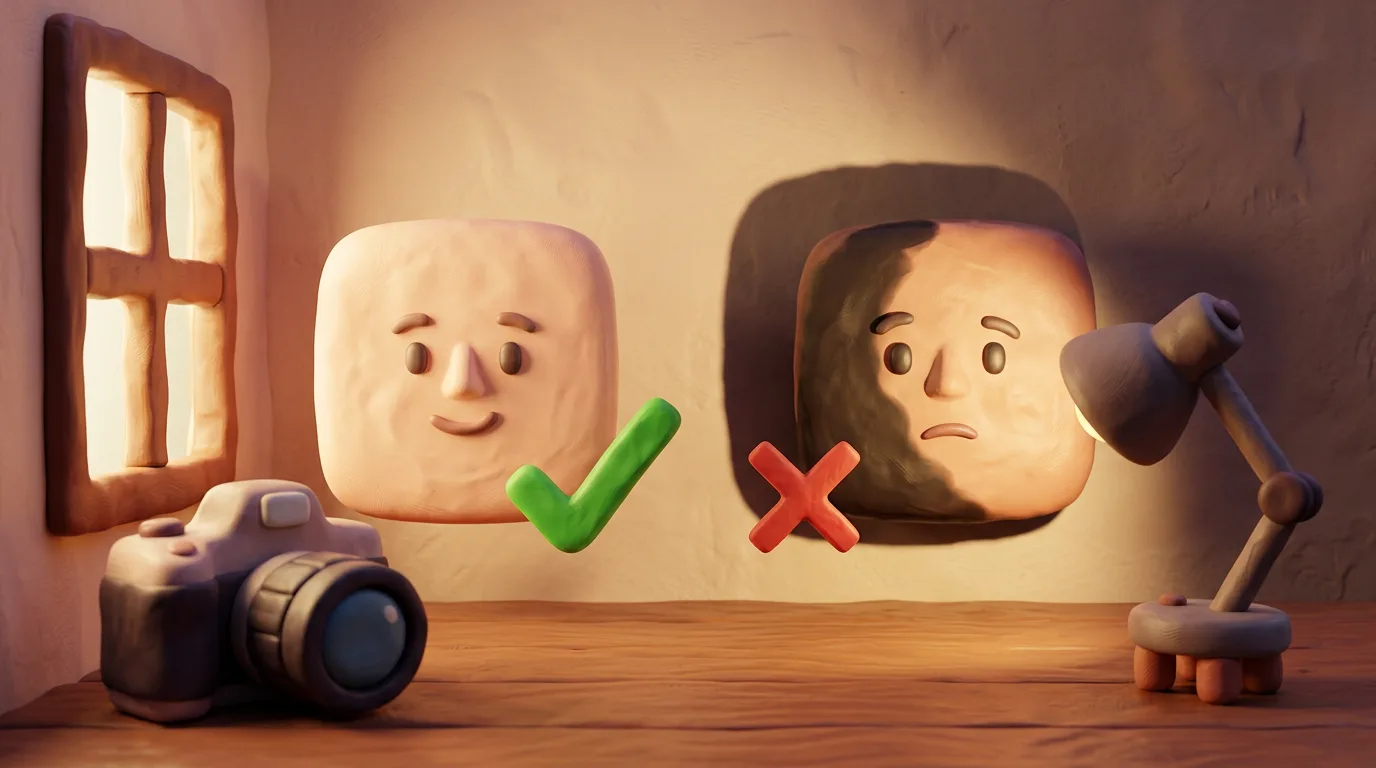
Your face and the background must be evenly lit: no shadows on the face, no shadow cast behind your head on the background, and no bright hot spots. Use soft, diffuse light — daylight from a window in front of you is ideal — and stand about 0.5 m from the background.
Key points
5 points- The face and background must be lit evenly: no shadows, glare or hot spots.
- A shadow behind the head on the background is a classic rejection; stand ~0.5 m from the wall.
- The best light is soft, diffuse daylight from a window; face the window directly.
- Avoid overhead light (shadows under eyes and nose) and direct flash (red-eye, hard shadow).
- Skin tone must be even: no half-lit face and no colour cast.
Why lighting is the No.1 cause of rejection
Uneven lighting and shadows are among the most common reasons document photos are not accepted, and this is the stage at which home-made shots most often fail. Under ICAO and national standards, the face and background must be evenly lit: no shadows on the face, no shadow cast from the head onto the background, and no bright glare or hot spots that hide facial features. A human examiner or an algorithm must clearly see the outline of the eyes, nose and mouth, so any shadow that changes the shape of the face becomes grounds for rejection.
What the right light looks like
The goal is soft, diffuse light that covers the face and background evenly, with no harsh transitions. The best source is natural daylight from a window: face the window so the light comes from the front rather than from the side or behind. An overcast day acts as a natural diffuser and gives especially even light. As an alternative, use two balanced sources of equal brightness at a 45° angle on each side at face height, ideally with a diffuser — a net curtain, a sheet of paper or a softbox.
There must be no shadows on the face or on the background that hide details important for inspecting the document.
Setting it up step by step
- Choose an even, light-coloured background with no textures or objects.
- Stand about 0.5 m from the background so your body casts no shadow on it.
- Face the window, or place two lights at a 45° angle.
- Diffuse the light (net curtain, sheet of paper, softbox) to remove hard shadows.
- Check: the face is evenly lit, the background has no shadow, and there is no glare.
Common mistakes
- Direct overhead light — casts shadows under the eyes, nose and chin.
- Direct camera flash — red-eye and a hard shadow on the wall behind.
- Light from the side — a half-lit face and uneven skin tone.
- Too close to the wall — a dark halo of shadow around the head.
- A warm lamp or coloured wall — a colour cast on the skin.
| Light source | Result |
|---|---|
| Daylight from a window in front | Even, soft — recommended |
| Two lights at 45° with a diffuser | Even, no shadows — good |
| Overhead light | Shadows under eyes and nose — poor |
| Direct flash | Red-eye, shadow on background — poor |
Follow these rules and you will get an even skin tone, a clean background with no shadow and a photo that passes inspection the first time. If you are unsure of the result, take several shots with the light source in different positions and compare them: a correct photo looks evenly lit, with no darkened areas and no bright glare.
05Questions
5 answers01Why was my photo rejected for lighting?
Most often because of a shadow on the face or behind the head on the background, an uneven skin tone, or bright glare. Lighting must be even and soft.
02What light is best for document photos?
Soft, diffuse daylight from a window when you are facing it. An overcast day works as a natural diffuser.
03Can I use a flash?
Direct flash is not recommended: it causes red-eye, glare and a hard shadow on the wall behind. If you must use it, bounce the light off a white ceiling.
04How do I remove the shadow on the background?
Stand about 0.5 m from the wall and light your face from the front, not from the side or above. Then no shadow falls on the background.
05Why is my face half-lit?
The light comes from only one side. Add a second source on the opposite side, or face the window directly.
06Official sources
- GOV.UK — Passport photos: guidance for photographers
gov.uk - U.S. Department of State — Passport Photos
travel.state.gov - U.S. Department of State — Photo Requirements (visas)
travel.state.gov - ICAO — Photograph Guidelines (Annex A, MRTD)
www2023.icao.int
Author: Yevhen Kravchenko. Published . Checked against official sources on .
Make your photo to the current rules
Pick your document and upload a selfie — we crop it to size, replace the background and check it. Free. The sizes come from the same official sources as the news.