Neutral expression for your document photo in 2026
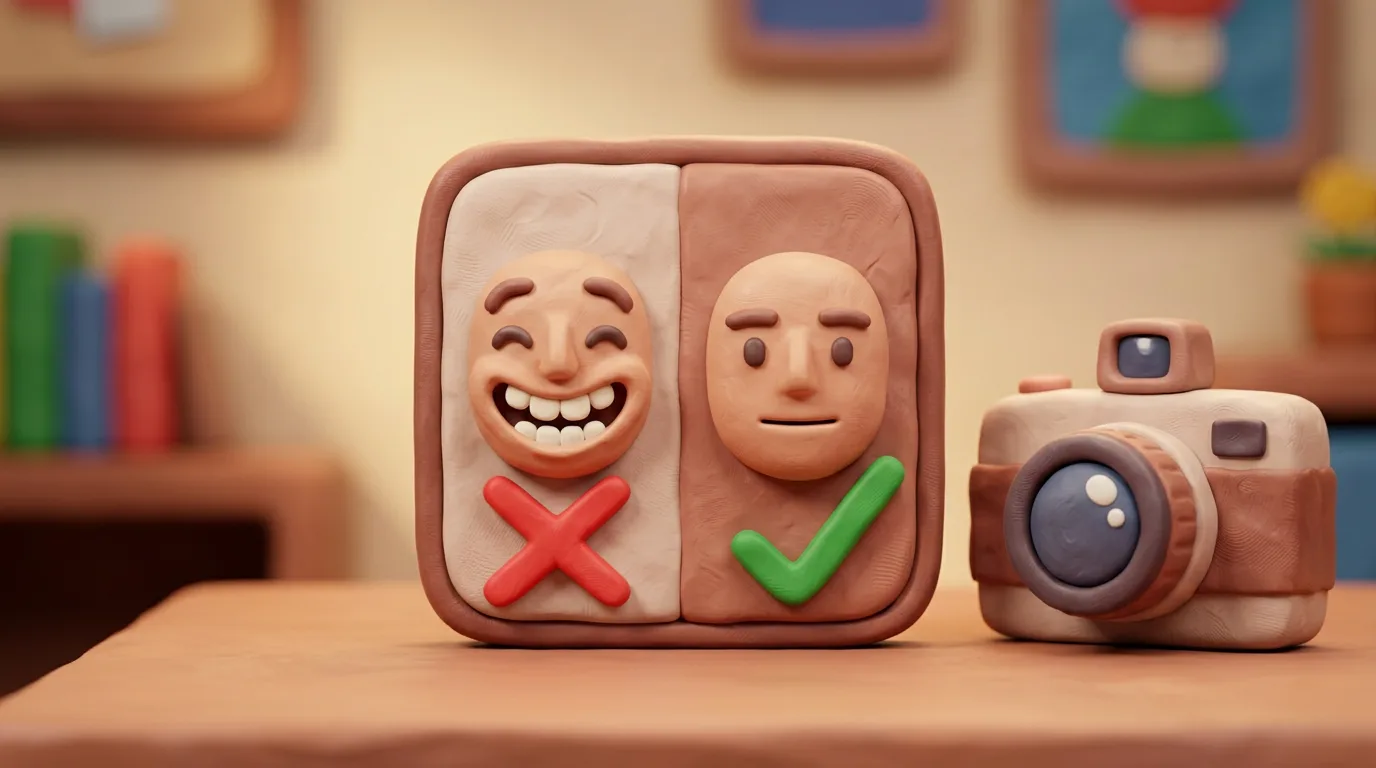
A document photo needs a neutral expression: mouth closed, no smile or teeth, both eyes open, looking straight at the camera, head not tilted. A smile distorts facial features and lowers biometric matching accuracy.
Key points
5 points- Neutral expression: mouth fully closed, no smile and no visible teeth.
- Both eyes open and clearly visible, no squinting, hair not covering the eyes.
- Looking straight at the camera, head level — no tilt or turn.
- Biometrics measure fixed facial landmarks; a smile distorts them and lowers the match.
- A slight natural smile is tolerated by some authorities, but it is risky — a broad smile means rejection.
Why a neutral expression is a mandatory requirement
The ICAO Doc 9303 standard, which the vast majority of authorities rely on, from the United States to the Schengen-area countries, explicitly requires a neutral facial expression. That means: mouth closed, no smile, both eyes open and clearly visible, looking straight at the camera, and the head held level, with no tilt or turn. The core logic is simple: the photo must be reproducible and unambiguous — so that the face in the image can be verified not only by a person at the desk but also by an automated machine at the border.
What exactly "neutral expression" means
- Mouth fully closed, with no smile and no visible teeth.
- Eyes open and clearly visible, no squinting; hair not covering the eyes.
- Gaze straight into the lens, head level — no tilt or turn.
- Eyebrows in a natural position, neither raised nor frowning.
Why a biometric system dislikes a smile
Modern border control works through face recognition. The system turns the photo into a set of digital data — it measures distances between fixed facial landmarks (the corners of the eyes, the nose, the line of the mouth, the contour of the chin) and builds a "mathematical fingerprint". A smile shifts the corners of the mouth, lifts the cheeks, narrows the eyes and reshapes the whole lower face, so the fingerprint from the photo matches less well with the live face in front of the camera at an e-gate. The lower the match, the higher the chance that the automated gate will not let you through and you will have to go through a manual check.
The photo must be neutral and reproducible, so that the check is passed not only by a human inspector but also by the automated system at the border.
What if I want a slight smile?
This calls for caution, and the rules differ from country to country. Some authorities (for example, the U.S. Department of State) tolerate a natural smile with the mouth closed, with no teeth and no exaggerated expression. Others, however — in particular the UK's HMPO — flag even a barely noticeable smile, parted lips or raised eyebrows as an error, and the automated system simply rejects the image. Since one photo is often submitted to several authorities, the safe choice is the same for any country:
- Relax your face and look straight at the camera.
- Close your mouth and do not show teeth.
- Keep both eyes open and your head level.
| Element | Correct | Mistake |
|---|---|---|
| Mouth | Closed | Smile, teeth |
| Eyes | Open, visible | Squinted, covered by hair |
| Head | Level, looking straight | Tilt, turn |
A neutral expression looks simple, but breaking it is one of the most common reasons for rejection and a repeat submission. Take the shot calmly, breathing evenly and without emotion, then check the mouth, eyes and head position — and the photo will pass on the first try, saving you time and money.
05Questions
5 answers01Why can't you smile in a document photo?
The ICAO Doc 9303 standard requires a neutral expression because a smile distorts facial features and lowers the accuracy of biometric recognition at the border. The mouth must be closed, with no visible teeth.
02Is a slight smile with a closed mouth allowed?
Some authorities (for example, the U.S.) tolerate it, but others (in particular the UK's HMPO) flag even a barely noticeable smile as an error. It is safer to keep a fully neutral expression.
03Do both eyes have to be open?
Yes. Both eyes must be open and clearly visible, with no squinting; hair must not cover the eyes. Otherwise the photo will be rejected.
04Where should you look in the photo?
Straight into the camera (the lens). Keep your head level, with no tilt or turn — your gaze directed at the lens.
05Why does the automated system reject the photo, not a person?
Many authorities (in particular GOV.UK) use an automated check that measures fixed facial landmarks. A smile or raised eyebrows shift these points, so the system may reject the photo.
06Official sources
- ICAO Doc 9303 (Machine Readable Travel Documents)
icao.int - U.S. Department of State — Passport Photos
travel.state.gov - GOV.UK — Rules for digital passport photos
passport.service.gov.uk - European Commission / Schengen Visa Code (Regulation (EC) 810/2009)
schengenvisainfo.com
Author: Yevhen Kravchenko. Published . Checked against official sources on .
Make your photo to the current rules
Pick your document and upload a selfie — we crop it to size, replace the background and check it. Free. The sizes come from the same official sources as the news.