Passport vs Visa vs ID Photo in 2026: What's Different
All three documents rely on one ICAO biometric baseline, so the rules feel alike. But exact size, head proportion and file format often differ, so one photo isn't always valid for another document.
Key points
5 points- The biometric baseline is shared: ICAO Doc 9303 sets a neutral expression, a light plain background and a fully visible face for all three documents.
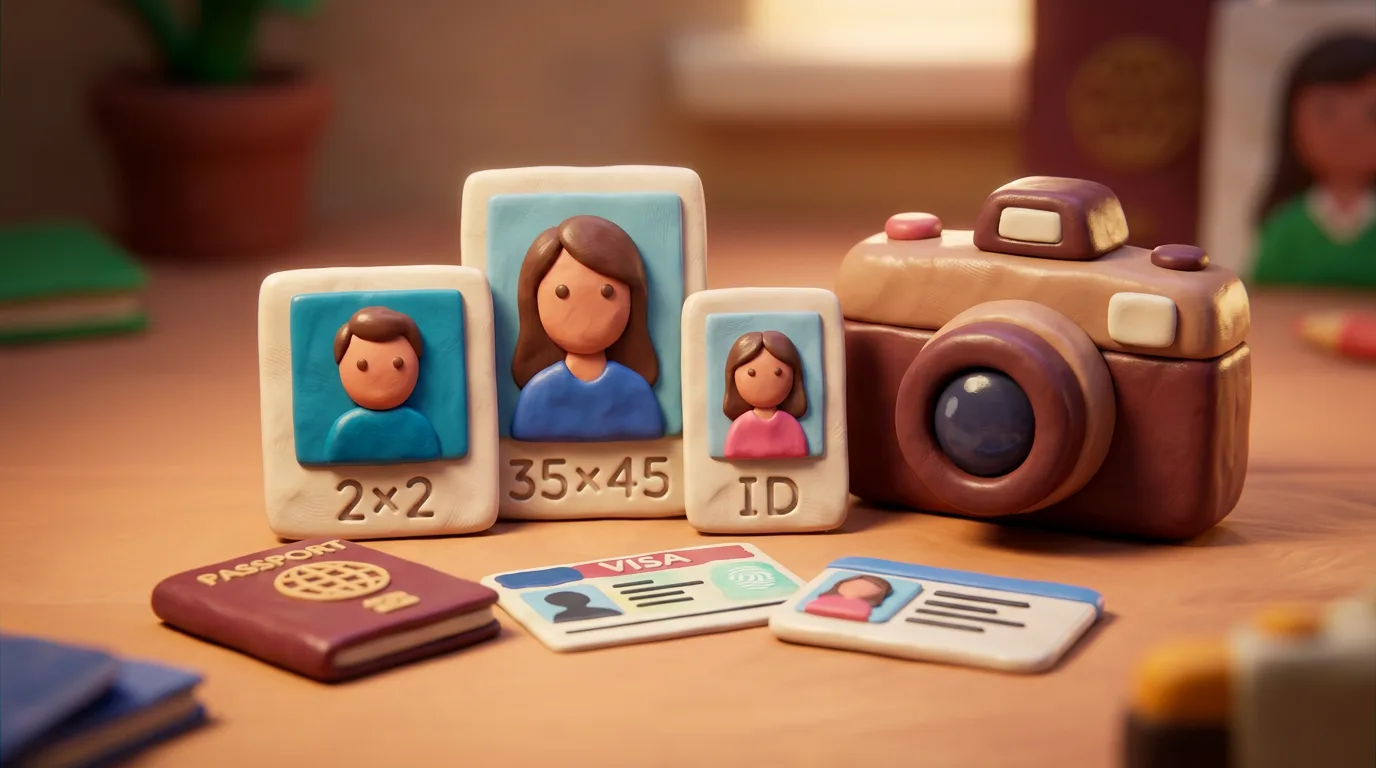
- Size differs: many countries use 35×45 mm, while US passports and many US visas use a 2×2 inch (51×51 mm) square.
- Head proportion, background shade, pixel file size and how recent the photo must be are often specified separately per document.
- A photo for one document isn't automatically accepted for another: a 35×45 mm shot won't fit the 2×2 inch square needed for a US visa.
- Always check the exact spec for the specific document and country before you take or print the photo; the issuing authority's page is the source of truth.
Why the rules feel identical
Passports, visas and national ID cards rely on the same biometric baseline. Most countries align their requirements with ICAO Doc 9303: a neutral expression with the mouth closed, a plain light background with no patterns or shadows, a fully visible face from chin to crown, eyes open and looking straight at the camera, and glasses ideally removed. The goal is consistent input for facial-recognition systems, so the same logic shows up across documents. Because of this shared baseline, it feels like any "document" photo will work everywhere — and that assumption is where rejected applications usually begin.
Why one photo isn't always valid
A shared biometric baseline is not the same as an identical spec. The exact requirements often differ by document and country: the physical size of the shot, the head-to-frame proportion, sometimes the background shade, the digital file size in pixels, and how recent the photo must be. A photo can be perfectly biometric yet still be the wrong shape or the wrong number of pixels for a given form. So a shot made for one document is not automatically accepted for another, even within the same country.
| Document | Typical size | Notes |
|---|---|---|
| Passport | 35×45 mm (many countries); 2×2 in / 51×51 mm (US) | Head height is set separately; background light grey or cream. |
| Visa | 35×45 mm (Schengen); 2×2 in (US) | Photo usually no older than 6 months; a digital file is often required. |
| National ID card | Country-specific (e.g. 35×45 mm; Spain's DNI 26×32 mm) | Sometimes its own size and proportions, different from the passport. |
What's usually the same versus different
Almost always the same is the biometric logic: a plain light background, a neutral face, no glasses or headwear (except religious). What varies most often is the numbers.
- Frame size. A 2×2 inch square for the US versus a 35×45 mm rectangle in many other countries.
- Head height. For example, the US passport is 25–35 mm and the UK passport is 29–34 mm.
- File format. For US visas the digital image runs from 600×600 to 1200×1200 pixels.
The shared biometrics make the rules feel alike; the exact numbers make them different. Check the spec for the specific document, not "for documents in general".
What to do in practice
- Identify the document and country the photo is for, because the spec is tied to both.
- Find the official issuing authority's page and note the exact size, head height, background and file requirements.
- Take or print the shot to those exact parameters; do not reuse an old photo from another document without checking.
When in doubt, defer to the issuing authority's page — that is the source of truth, not a third-party blog or an old photo strip. A few minutes confirming the spec is far cheaper than a rejected application, a re-shoot and a delayed trip.
05Questions
5 answers01Can I use my passport photo for a visa?
Not always. The biometric baseline is shared, but the size and format can differ. A 35×45 mm shot won't fit the 2×2 inch square required for many US visas. Check the exact spec for the specific visa.
02Why are passport and ID-card photos different sizes?
Size is set by the issuing authority, not a single global standard. Many countries use 35×45 mm, but some ID cards have their own format — for example, Spain's DNI is 26×32 mm.
03How recent does the photo need to be?
This is often specified separately per document. For a Schengen visa the photo usually must be no older than 6 months; for other documents the rule can differ, so check the official page.
04What is the source of truth for the requirements?
The issuing authority's page: for US passports and visas, travel.state.gov; for UK passports, GOV.UK; for a Schengen visa, the relevant country's consulate. The biometric baseline is described by ICAO Doc 9303.
05Can I edit the photo in an editor?
Usually no. For example, the US State Department prohibits altering the shot with software, apps, filters or artificial intelligence. The photo must be truthful and free of retouching that changes facial features.
06Official sources
- ICAO Doc 9303 — Machine Readable Travel Documents
icao.int - U.S. Department of State — Passport Photos
travel.state.gov - U.S. Department of State — Visa Digital Image Requirements
travel.state.gov - GOV.UK — Get a passport photo
gov.uk - Schengen Visa Info — Photo Requirements
schengenvisainfo.com
Author: Yevhen Kravchenko. Published . Checked against official sources on .
Make your photo to the current rules
Pick your document and upload a selfie — we crop it to size, replace the background and check it. Free. The sizes come from the same official sources as the news.