Can You Use a Selfie for a Document Photo in 2026?
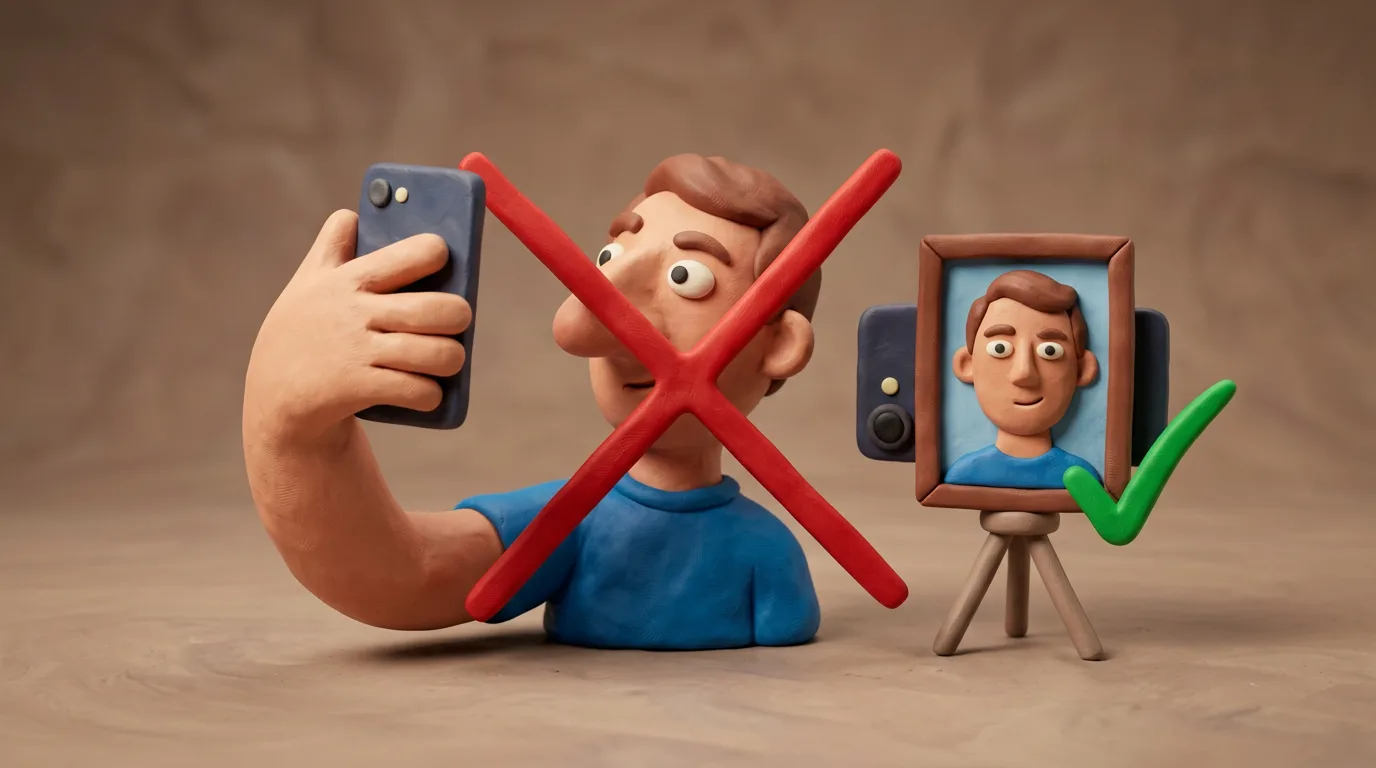
A typical arm's-length selfie almost always fails official requirements: the front camera is weaker and the close distance distorts your facial proportions. Use the rear camera from 1.5–2 m, phone on a tripod at eye level.
Key points
5 points- Do not submit a front-camera selfie as your final document photo.
- The front camera usually has lower resolution than the rear camera.
- Arm's length is too close: it distorts proportions (an enlarged nose).
- Shoot with the rear camera from 1.5–2 m, phone at eye level.
- Look straight at the lens, neutral expression, even light, plain background.
Can you use a selfie for a document?
In short — usually no. A typical arm's-length selfie almost always fails passport, visa and ID requirements. Official sources directly advise against selfies and tell you to ask another person or use a tripod and timer.
Why a selfie fails
The problem is not your appearance but the shooting technique. There are three typical reasons for rejection:
- The front camera is weaker. The "selfie" camera usually has lower resolution than the rear (main) one, so the shot comes out less sharp.
- Arm's length is too close. A close distance distorts perspective: the nose looks larger and facial proportions look wrong. Biometric systems measure the distances between facial points and reject such photos.
- Pose and light. You look at the screen rather than the lens; the arm tilts the head and shoulders; lighting is uneven.
The official advice from authorities is simple: "Have someone else take your photo. No selfies."
How to self-shoot correctly
Self-shooting is perfectly possible — you just need to meet a few conditions:
- Use the rear (main) camera, not the front one.
- Prop the phone on a tripod or stand, or ask someone to help.
- Stand about 1.5–2 m away from the camera.
- Keep the phone at eye level and look straight at the lens.
- Neutral expression, mouth closed, both ears and the face outline visible.
- A plain, evenly lit background without shadows or objects.
| Parameter | Selfie (front) | Correct (rear) |
|---|---|---|
| Distance | 40–50 cm | 1.5–2 m |
| Camera | Front | Rear |
| Support | Hand | Tripod / helper |
Some services let you upload a phone photo and crop and check it to spec for you — but the underlying shot must still meet the rules above.
04Questions
5 answers01Will a selfie be accepted for a passport?
Usually no. An arm's-length selfie distorts facial proportions and has lower quality, so authorities advise against submitting one as your final photo.
02Why is the front camera worse than the rear one?
The front camera usually has lower resolution and introduces more distortion than the rear (main) camera, so the shot comes out less sharp.
03Can I self-shoot without a helper?
Yes. Prop the phone on a tripod or stand, set the timer, step back 1.5–2 m and shoot with the rear camera at eye level.
04How far from the camera should I stand?
About 1.5–2 m. This removes the distortion of facial proportions and leaves room for your head and shoulders in the frame.
05Will an online service help with a selfie?
The service crops and checks the shot to spec, but if the underlying frame has errors (front camera, too close), the photo may still fail.
05Official sources
- U.S. Department of State — Passport Photos ("No selfies")
travel.state.gov - GOV.UK — Get a passport photo: Digital photos
gov.uk - GOV.UK — How to take a digital passport photo
passport.service.gov.uk - ICAO — Machine Readable Travel Documents (Doc 9303), photograph guidelines
icao.int
Author: Yevhen Kravchenko. Published . Checked against official sources on .
Make your photo to the current rules
Pick your document and upload a selfie — we crop it to size, replace the background and check it. Free. The sizes come from the same official sources as the news.