Dress code and clothing rules in passport and visa photos
Most countries do not have an explicit clothing rule for document photos beyond two practical requirements: no uniform, and the clothing must contrast with the background so the shoulder outline is visible. Beyond that, the choice is up to the applicant.
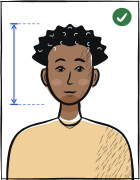
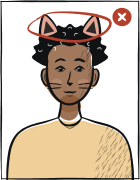
Quick answer
No uniform, no white tops, contrast with background
Avoid uniforms (military, police, airline). Avoid white or very light tops against a white background — they merge and hide the shoulder outline. Solid darker colours work best. No hats unless religious.
Why clothing matters at all
A document photo is not a fashion shot. The biometric algorithm needs to detect the shoulder line to anchor the face position in the frame. Clothing that blends into the background — white shirt on a white background, light pastel against light grey — confuses the shoulder detection and causes automated rejection.
Uniforms are banned in most countries because they create identification ambiguity. A police-uniform photo in a passport could be mistaken for an official ID and used fraudulently.
Clothing rule by route
| Country / route | No uniform | Other |
|---|---|---|
| United States passport / visa | No uniform (military, police, airline) | Plain everyday clothing recommended. |
| United Kingdom passport | No uniform | No tops that merge with background. |
| Schengen visa | Not addressed in the EU sheet | The European Commission photograph sheet sets no clothing rule; individual consulates may add one. |
| Germany passport | No uniform | BMI photo template: plain everyday clothing. |
| France passport | No uniform | France-Visas: ordinary clothing. |
| China passport | No uniform | NIA: no military or police uniform. |
| India passport | No uniform | PSK: ordinary clothing. |
| Russia internal passport | No uniform | MVD: plain everyday clothing. |
| Canada passport | No uniform | IRCC: ordinary clothing. |
| Saudi Arabia passport | Religious dress accepted | Thobe / ghutra acceptable for men; hijab for women. |
| Japan passport | No uniform | MFA Japan: ordinary clothing. |
| UAE Emirates ID | No uniform | Kandura / abaya accepted as ordinary clothing. |
What to wear for best results
Solid darker colours that contrast with the background work best. Navy, dark teal, burgundy, charcoal grey, dark green. Avoid white or very light tops against a white background. Avoid heavy patterns that distract from the face. Avoid logos visible at the shoulders.
No hats
Hats are banned in document photos at every listed authority. Religious head coverings (hijab, turban, kippah) are accepted separately — see the head-coverings guide.
Jewellery
Small, non-distracting jewellery is accepted everywhere. Large hoop earrings, statement necklaces, lip rings, nose studs are not banned but can trip background-uniformity checks. The safest choice is to remove obvious jewellery for the shot.
Frequently asked questions
01Can I wear a suit and tie in my passport photo?
Yes. A suit is ordinary clothing in every listed jurisdiction. It is not required, and most passport photos use ordinary everyday clothing.
02I work in the military / police / airline — can I wear the uniform?
No. Uniforms are banned in document photos across all listed authorities. Change into civilian clothing for the shoot.
03My traditional / religious clothing covers the shoulders — is this a problem?
No. Traditional and religious clothing is accepted. The shoulder outline rule applies to the upper-body silhouette — as long as the silhouette is detectable against the background, the clothing is fine.
Related guides
Prepare your document photo now
Upload a portrait — Anfas.Pro applies the rules from this guide automatically against the selected country and document profile.