Expression rules in document photos: smile, mouth and eye position
Almost every modern biometric photo standard requires a neutral expression with the mouth closed and eyes open. The reason is technical: biometric face-matching systems calibrate against a neutral reference, and any muscular movement lowers the match confidence score.
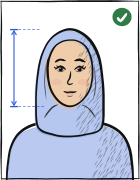
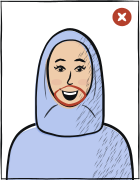
Quick answer
Neutral, mouth closed, eyes open — everywhere
No smile (closed-lip soft smiles are sometimes accepted but never the safest choice). Mouth fully closed. Eyes open and clearly visible. Eyebrows relaxed. Head straight, no tilt. Look directly into the lens.
Why expression matters more than people expect
Biometric matching reads the eye area, the jaw outline and the lip line as three of the most important reference points. A smile lifts the cheeks, widens the mouth and changes the jaw outline. A raised eyebrow shifts the eye region. Even a closed-lip smile changes the lip-line angle enough to lower the automated match confidence.
The historical "soft smile" habit from the early 2000s was retired by most authorities once biometric chip-based passports became standard. Today a soft smile is rejected for a USA visa photo, and by China, Japan, the UK and most Schengen states — but the USA passport route still accepts a natural, closed-mouth smile.
Expression rule by route
| Country / route | Expression rule | Notes |
|---|---|---|
| USA passport | Neutral or natural smile, mouth closed | Soft closed-lip smile tolerated; broad smile rejected. |
| USA visa (DS-160) | Neutral, mouth closed | The visa route asks for a neutral expression — no smile. |
| UK passport | Neutral, mouth closed | HMPO asks for a plain expression with the mouth closed; examiners reject expressions that change the shape of the face. |
| Schengen visa | Neutral, mouth closed | European Commission photograph sheet: neutral expression, mouth closed. |
| Germany passport / visa | Neutral, mouth closed | BMI photo template: neutraler Gesichtsausdruck, mouth closed. |
| France passport / ID card | Neutral, mouth closed | service-public.gouv.fr: "L'expression doit être neutre et la bouche doit être fermée." |
| China passport / visa | Natural expression, lips closed | NIA wording is "natural expression" with lips closed — a broad smile fails, a blank face is not demanded. |
| India passport | Natural expression, eyes open | Passport Seva asks for a natural facial expression; at a PSK the photo is captured on site. |
| Japan passport | Neutral, mouth closed | MFA Japan rejects an open mouth showing teeth, and laughing or crying faces. |
| Russia internal passport | Neutral, mouth closed | MVD order No. 773, clause 36.7. |
| Canada passport | Neutral, mouth closed | IRCC: no smile; some range of expression is allowed for newborns. |
| Australia passport | Neutral, mouth closed (age 3+) | Australian Passport Office: under-3s may have the mouth open. |
| UAE Emirates ID | Neutral, mouth closed | ICP: the face must be straight and the expression neutral. |
| Turkey biometric photo | Neutral, mouth closed | NVI: nötr yüz ifadesi, mouth closed. |
Children and babies
Age thresholds differ by country and there is no common "under-6" rule. Australia relaxes the mouth-closed rule under 3. The UK waives the plain expression and eye contact under 6, and the eyes-open rule under 1. Canada allows a range of expression for newborns. The Schengen visa photograph sheet grants no age exemption at all. In every case the face must still be clearly visible. See the baby and child guides for handling.
What "neutral" actually looks like
A neutral face has relaxed jaw, lips together but not pressed, eyes open and looking forward, eyebrows in their natural position. The easiest way to reach neutral is to take a deep breath, let it out, and shoot before any muscle tension returns.
Frequently asked questions
01Can I smile in a USA passport photo?
Yes, within limits: the US Department of State says you can smile as long as your eyes are open and your mouth is closed. The visa route is the opposite — a DS-160 photo asks for a neutral expression with no smile. Because biometric scoring penalises any cheek lift, fully neutral remains the safer choice on both routes.
02Why do I need to close my mouth?
An open mouth changes the lip line and the jaw outline, both of which are reference points in biometric matching. Every specification listed on this page asks for the mouth closed, which makes an open mouth one of the most common reasons a photo comes back.
03I can't open my eyes in a flash photo — what should I do?
Use natural daylight from a window instead of a flash. Look at a point near the lens for a few seconds before the shutter to relax the eyes. Take several frames and pick the best one.
04Are squinting eyes accepted?
No. Both eyes must be fully open and clearly visible. Reshoot under softer light if you cannot keep your eyes open with the original lighting.
Related guides
Prepare your document photo now
Upload a portrait — Anfas.Pro applies the rules from this guide automatically against the selected country and document profile.