 Lithuania
 Latvia
 Estonia
Temporary protection in the Baltic states extended to 4 March 2027: what differs in Lithuania, Latvia and Estonia
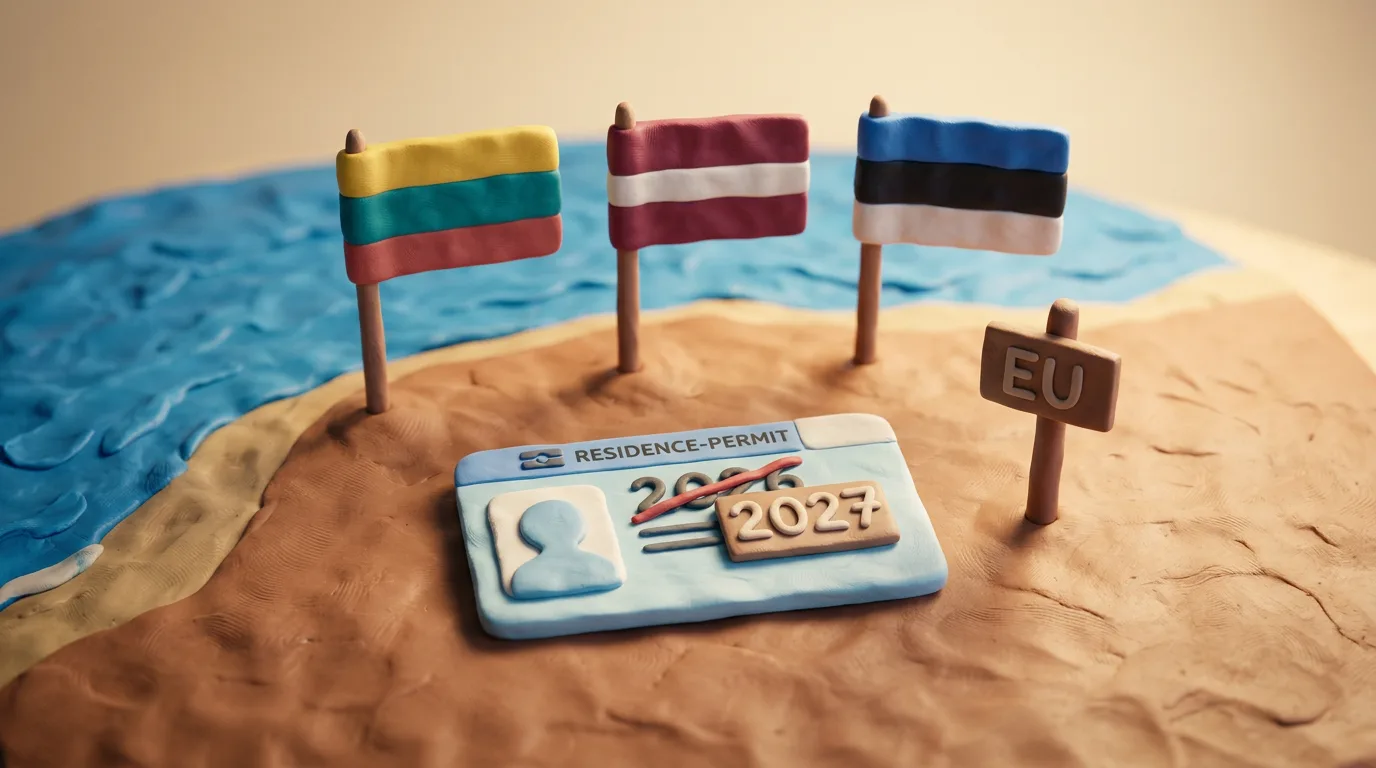
Following the Council of the EU decision (Implementing Decision (EU) 2025/1460 of 15 July 2025), temporary protection for Ukrainians in the EU has been extended from 4 March 2026 to 4 March 2027. Lithuania, Latvia and Estonia have transposed this deadline into their legislation, but the procedure differs: in Lithuania the status is extended mostly automatically and there are no language requirements; in Latvia there is a requirement to learn Latvian to at least A2 level; in Estonia the term depends on the date the application was filed (the cut-off is 13 August 2025) and participation in an adaptation programme is required. Check the validity of your document and apply in good time.
In this article · 7 sections
Key points
6 points- By Decision (EU) 2025/1460 of 15 July 2025, the Council of the EU extended temporary protection for Ukrainians from 4 March 2026 to 4 March 2027 — this is the basic framework for all three Baltic states.
- Lithuania: the government enshrined the extension until March 2027 by a resolution of 24 September 2025; around 47,600 people are covered; there is no requirement for status holders to learn Lithuanian.
- Latvia: protection runs until 4 March 2027; from 2026 a requirement was introduced to master the state (Latvian) language to at least A2 level within two years of being granted the status.
- Estonia: the key cut-off is 13 August 2025. Applications filed before this date are valid until March 2026; those filed from 13 August 2025 — until March 2027; participation in an adaptation programme is required.
- Renewal is not automatic everywhere: in Estonia and (historically) Latvia the status must be actively re-registered, so watch the date on your residence card and apply 1–3 months in advance.
- After 4 March 2027 automatic extension is not yet guaranteed — the EU recommends that countries prepare a transition to other legal statuses (work, study, family grounds).
Following the Council of the EU decision, temporary protection for Ukrainians has been extended from 4 March 2026 to 4 March 2027. This is the basic framework for the entire European Union, and all three Baltic states — Lithuania, Latvia and Estonia — have transposed this deadline into their national legislation. But the procedure, the language requirements and the way the status is renewed differ noticeably across the three countries. Below is what exactly has changed and what to watch out for.
What the EU decided
On 4 June 2025 the European Commission proposed extending temporary protection for people fleeing Russia's aggression against Ukraine by another year. On 13 June 2025 the member states politically backed this proposal, and on 15 July 2025 the Council of the EU adopted the final decision — Implementing Decision (EU) 2025/1460. It extends temporary protection until 4 March 2027.
In the European Commission's official wording, this should provide "legal certainty" and ensure that "the same standards of protection continue to apply across the EU". The status, as before, allows people to legally reside, work, study and receive basic social assistance without having to apply for asylum. Separately, on 16 September 2025 the Council of the EU adopted a recommendation on an orderly transition out of temporary protection — countries are advised to gradually prepare people for other legal statuses or voluntary return when conditions allow.
Lithuania
The Lithuanian government enshrined the extension of temporary protection until March 2027 by a government resolution of 24 September 2025. Previously, residence permits were due to expire on 4 March 2026, so the decision synchronizes the Lithuanian deadlines with the EU decision.
- Who is covered: according to Lithuania's Migration Department (as of September 2025), around 47,600 people hold temporary protection; some 30–40 new applications for residence permits based on protection come in each day.
- No language requirements: no obligation to learn Lithuanian has been introduced for temporary-protection holders.
- Renewal: valid permits are extended for an additional 12 months; the authorities frame this as reducing the administrative burden. Before submitting documents, check the current procedure via the MIGRIS system at migracija.lt.
Latvia
Latvia also applies the extension until 4 March 2027. Under amendments to the Law on Assistance to Ukrainian Civilians (adopted on 21 November 2024), residence permits based on temporary protection are now issued for a term of three years — both at the first application and at status renewal (previously it was two years); the authorities explain this as reducing the administrative burden. Latvia's main distinguishing feature is the language requirement.
- Latvian language: from 2026, Ukrainian civilians are obliged to master the state language to at least A2 level within two years of being granted temporary protection, and within five years — to the level set by the Cabinet of Ministers for the relevant professional and official duties.
- Renewal is not automatic: historically, in Latvia one needs to obtain/re-register the residence card in good time through the Office of Citizenship and Migration Affairs (PMLP). By law the status is lost if the visa or permit has expired and the person has not applied for a new document within one month.
- Procedure: after a positive decision, you must apply in person at a territorial PMLP branch for a new eID card; processing can take up to three months. For the current steps, see the PMLP page on extending the status.
Estonia
In Estonia the term of protection depends directly on the date the application was filed, and the key cut-off is 13 August 2025.
- Validity dates: applications filed before 13 August 2025 are valid until March 2026; applications filed from 13 August 2025 — until March 2027. This is confirmed on the official page of the Politsei- ja Piirivalveamet.
- Renewal by application: the status is renewed through the Police and Border Guard Board's self-service (asylum.politsei.ee), as a rule 1–3 months before the term expires.
- Adaptation programme: according to official information, a status holder is required to complete an Estonian-language course at A1 level (100 academic hours) and a one-day adaptation course, and to renew protection one must complete the adaptation programme or sign up for it. Details are on the official portal kriis.ee.
What this means for you
- Check the expiry date of temporary protection on your own residence card/document — especially in Estonia, where everything depends on the date the application was filed.
- Do not rely on it being "automatic": in Lithuania renewal mostly happens without a new application, but in Estonia and Latvia active steps and early filing are required.
- Factor in the language requirements: in Latvia — Latvian A2 within two years, in Estonia — an adaptation programme with A1 courses; in Lithuania there is no such requirement for status holders.
- Plan ahead: after 4 March 2027 automatic extension is not yet guaranteed. It is worth considering alternative legal grounds already now — work, study, business or family ties.
This extension does not change the requirements for the documents for the residence card itself or other certificates: biometric photos must comply with national standards. Always verify all exact deadlines and the list of documents on your country's official resources before applying.
06Questions
6 answers01Until what date has temporary protection for Ukrainians in the Baltic states been extended?
Until 4 March 2027. This follows from the Council of the EU's Implementing Decision (EU) 2025/1460, adopted on 15 July 2025, which Lithuania, Latvia and Estonia have implemented in their legislation.
02Is the status renewed automatically, or do I need to apply?
It depends on the country. In Lithuania, renewal mostly happens without a new application. In Estonia, the status must be renewed through the Police and Border Guard Board's self-service, usually 1–3 months before the term expires. In Latvia, active re-registration of the residence card through the PMLP has historically been required. Always check with your country's official source.
03Are there language requirements to keep the status?
In Lithuania there is no obligation for temporary-protection holders to learn Lithuanian. In Latvia, from 2026 there is a requirement to master Latvian to at least A2 level within two years of being granted protection. In Estonia, participation in an adaptation programme is provided for, including Estonian courses at A1 level.
04What does the 13 August 2025 cut-off mean in Estonia?
In Estonia the term of protection depends on the date the application was filed: if it was filed before 13 August 2025, the document is valid until March 2026; if from 13 August 2025 — until March 2027. That is why it is important to check the date on your own document.
05What will happen after 4 March 2027?
For now there is no decision on a further automatic extension. In September 2025 the Council of the EU adopted a recommendation on an orderly transition out of temporary protection — countries are advised to prepare to move people to other legal statuses (work, study, business, family grounds) or voluntary return when conditions allow.
06How many people in Lithuania does this extension cover?
According to Lithuania's Migration Department, around 47,600 people hold temporary protection; some 30–40 new applications for residence permits based on temporary protection come in each day.
07Official sources
- Council of the EU (Consilium) — extension of temporary protection until 4 March 2027
consilium.europa.eu - Єврокомісія — продовження тимчасового захисту та спільний європейський шлях
home-affairs.ec.europa.eu - Рада ЄС — рекомендація про перехід з тимчасового захисту (16.09.2025)
consilium.europa.eu - LRT — Lithuania extends temporary protection until March 2027
lrt.lt - PMLP (Латвія) — продовження статусу тимчасового захисту
pmlp.gov.lv - Politsei- ja Piirivalveamet (Estonia) — temporary protection for Ukrainian citizens
politsei.ee
Author: Yevhen Kravchenko. Published . Checked against official sources on .
LithuaniaLithuania ID Card Photo: a 40 x 60 mm Sheet You Can Cut to 35 x 45 mm, Black and White Recommended
The Migration Department wants a 40 x 60 mm photo sheet from which 35 x 45 mm can be cut.

 Schengen Area
 Germany
 Spain+6
EU ID card photo requirements: sizes and rules by country
The size for an ID card photo in EU countries is not uniform: Spain requires 32 × 26 mm, France needs 35 × 45 mm, and in Lithuania, the initial print must be 40 × 60 mm.
 Lithuania
Lithuania Visa, Residence Permit (MIGRIS) and Passport Photo 2026: Requirements and Size
A detailed overview of the official requirements of the Migration Department of Lithuania for photos for national visas, temporary residence permits (via the MIGRIS system), and passports in 2026. The article explains the exact sizes, facial proportions, background, and print quality requirements, and clarifies when photographing takes place on-site and when paper photos must be brought (e.g., for children under 2 years old).

Make your photo to the current rules
Pick your document and upload a selfie — we crop it to size, replace the background and check it. Free. The sizes come from the same official sources as the news.