EES is already live, ETIAS comes in late 2026: what changes for Ukrainians in Schengen
EES is fully operational from 10 April 2026 (biometrics instead of passport stamps). ETIAS — an online authorisation costing €20, valid for 3 years — is expected in the last quarter of 2026, with a transition period running until roughly April 2027.
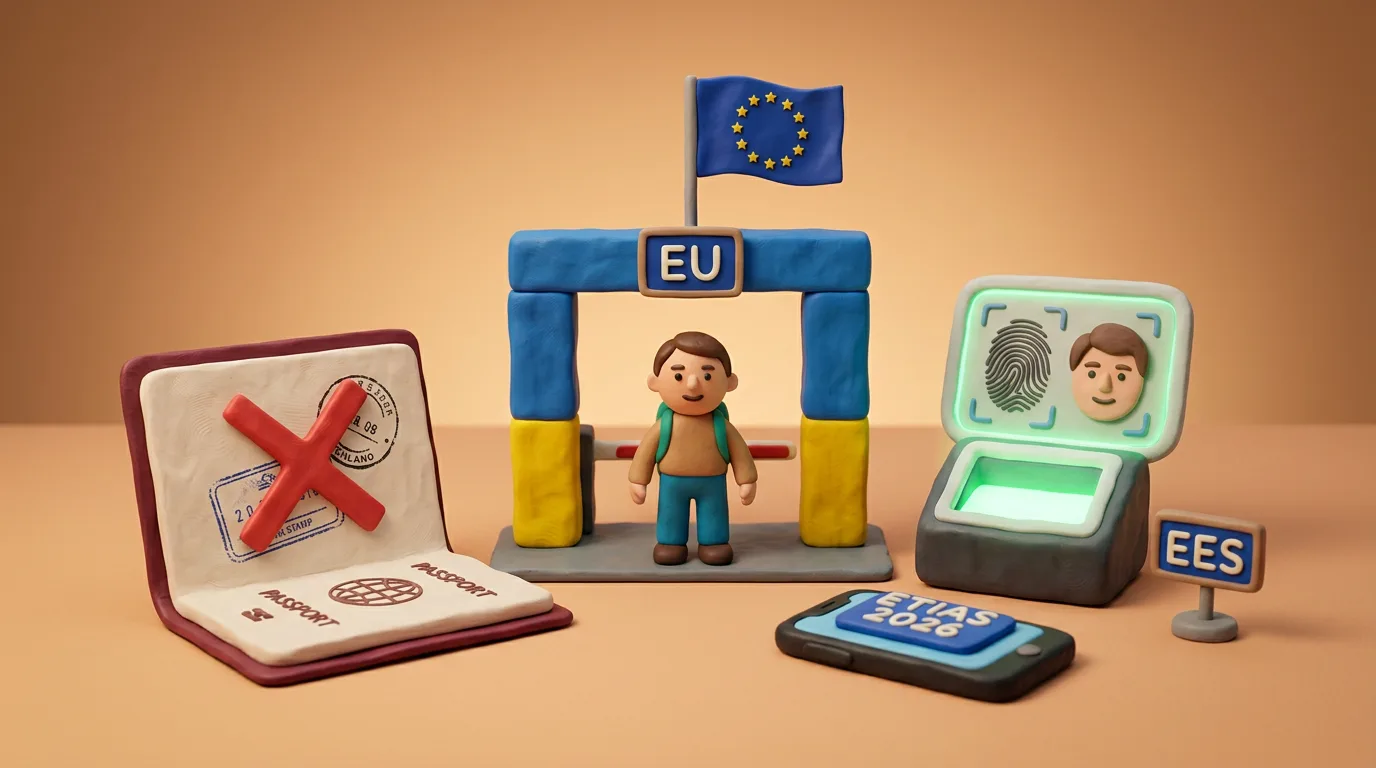
Key points
6 points- EES (the Entry/Exit System) is fully operational from 10 April 2026 at all external borders of 29 European countries; the phased rollout had been running since 12 October 2025.
- Instead of a passport stamp, on first entry your fingerprints are taken and your face is photographed; this biometric data is stored and read at subsequent crossings.
- EES concerns third-country nationals on short stays, in particular Ukrainians with a biometric passport who travel visa-free (90 days within 180).
- ETIAS — a separate online authorisation, not a visa — is expected in the last quarter of 2026; it will cost €20 and be valid for 3 years or until the passport expires.
- After ETIAS launches, transitional and grace periods of at least 12 months are provided: the authorisation will become mandatory around April 2027.
- People with temporary protection in the EU are exempt from the ETIAS requirement; they are exempt from EES registration only if they hold a valid residence permit — without proof of status at the border, biometrics may be taken on general grounds.
The European Union is completing the transition to digital biometric borders. The Entry/Exit System (EES) became fully operational on 10 April 2026 at all Schengen external borders, and the European Travel Information and Authorisation System (ETIAS) is expected in the last quarter of 2026. Both changes directly concern Ukrainians who travel to the EU visa-free on a biometric passport.
What EES is and why it is already working
EES is an automated system that records every external-border crossing by third-country nationals on short trips. The phased rollout started on 12 October 2025, and from 10 April 2026 the system is fully operational in all 29 European countries that apply it at the border. The European Commission announced full readiness.
The main change: the paper passport stamp has been abolished. Instead, data on entry, exit or refusal of entry is recorded digitally. According to the Commission, the system records the name, travel-document data, biometric data (fingerprints and facial image) and the date and place of entry and exit. This makes it possible to automatically detect those who have overstayed their permitted period of stay.
How a Ukrainian crosses the border under the new rules
EES applies to third-country nationals on short stays, including visa-free travellers. Ukrainians with a biometric passport can still enter 30 European countries visa-free and stay up to 90 days within 180 days — this rule has not changed.
- First entry after launch: the border officer takes your fingerprints and a photo of your face; this data is recorded in your personal file.
- Subsequent trips: biometrics are checked against the record, so the control should speed up once the profile is created.
- The 90/180 count is kept automatically — the system counts the days of stay itself, so keep track of the limit to avoid a refusal.
A separate point for those with temporary protection in the EU: according to the European External Action Service, such persons are exempt from the ETIAS requirement. EES registration is generally waived by holding a valid residence permit (holders of permits and long-stay visas are outside the scope of EES). However, if there is no way to confirm your status with a document at the border, biometrics may be taken on general grounds — so it is worth carrying your residence permit or other proof of status.
ETIAS: a separate online authorisation in late 2026
ETIAS is not a visa but a prior entry authorisation issued online. According to the official EU legal summary, the authorisation will cost €20 and be valid for 3 years or until the passport expires (whichever comes first). Applicants under 18 and over 70 are exempt from the fee.
ETIAS is expected to launch in the last quarter of 2026; the European Commission will announce the exact date separately. After the start, two stages are provided:
- Transition period (first 6 months): you will be able to enter even without ETIAS, provided you meet the other entry requirements.
- Grace period (the next 6 months): ETIAS is already required for everyone. The only exception is those entering for the first time after the transition period ends: by way of exception they will be let in without ETIAS if they meet the rest of the entry conditions.
In total these periods last at least 12 months, so ETIAS will become mandatory around April 2027. The authorisation should only be obtained on the official portal travel-europe.europa.eu, to avoid copycat sites with inflated prices.
Note: the Ukrainian-language EEAS page still shows the old fee amount (€7), but the current version of the ETIAS regulation sets the fee at €20 — this is the amount to go by.
What to do right now
- Make sure your biometric passport is valid: the document must not be older than 10 years, and its validity must extend beyond the date of departure by at least 3 months.
- Allow more time at the border during your first entry after the EES launch — creating the biometric profile takes extra minutes.
- Watch for the official announcement of the ETIAS date and do not pay the fee on third-party sites before the system launches.
05Questions
6 answers01Do Ukrainians now need a visa for the EU because of EES and ETIAS?
No. Ukrainians with a biometric passport still travel visa-free and may stay up to 90 days within 180 days. EES is a digital registration at the border, and ETIAS is an online authorisation, not a visa. The visa-free regime remains in place.
02When did EES become fully operational?
The phased rollout started on 12 October 2025, and the Entry/Exit System has been fully operational since 10 April 2026 at all external borders of the 29 European countries that apply it.
03What biometric data is taken under the EES system?
On first entry after launch, fingerprints are taken and a photo of the face is made. Together with the travel-document data, they are stored in a personal file and checked at subsequent border crossings.
04How much does ETIAS cost and how long is it valid?
An ETIAS authorisation costs €20 and is valid for 3 years or until the passport expires — whichever comes first. Applicants under 18 and over 70 are exempt from the fee.
05When will ETIAS become mandatory?
The launch is expected in the last quarter of 2026. Then come the transition period (at least 6 months, when entry is possible even without ETIAS) and the grace period (at least another 6 months). During the grace period ETIAS is required by everyone except those entering for the first time after the transition period ends — by way of exception they may be let in without the authorisation. ETIAS will become fully mandatory around April 2027.
06Do EES and ETIAS apply to Ukrainians with temporary protection?
People with temporary protection in the EU are exempt from the ETIAS requirement. EES registration is waived by holding a valid residence permit — it is worth carrying it or other proof of status, otherwise biometrics may be taken at the border on general grounds. Ordinary short visa-free trips fall under both systems.
06Official sources
- European Commission — Entry/Exit System (EES) is fully operational (10 April 2026)
home-affairs.ec.europa.eu - European Commission — Entry/Exit System (EES) policy page
home-affairs.ec.europa.eu - EUR-Lex — Legal summary of the ETIAS
eur-lex.europa.eu - EU official ETIAS portal — Travel to Europe
travel-europe.europa.eu - EEAS — Travelling to Europe (EES/ETIAS) for Ukraine
eeas.europa.eu
Author: Yevhen Kravchenko. Published . Checked against official sources on .
Make your photo to the current rules
Pick your document and upload a selfie — we crop it to size, replace the background and check it. Free. The sizes come from the same official sources as the news.