 Germany
Recognition of Ukrainian diplomas and qualifications in Germany: what changed in 2026
From 18 May 2026, in the federal state of North Rhine-Westphalia, Ukrainian school certificates are assessed on a case-by-case basis (previously — under a general procedure). On 26 February 2026, the KMK adopted a new procedure for university admission of persons under temporary protection. The recognition procedure itself has not changed: professional qualifications are recognized by the chambers (Kammer), and higher education is assessed by the ZAB.
Key points
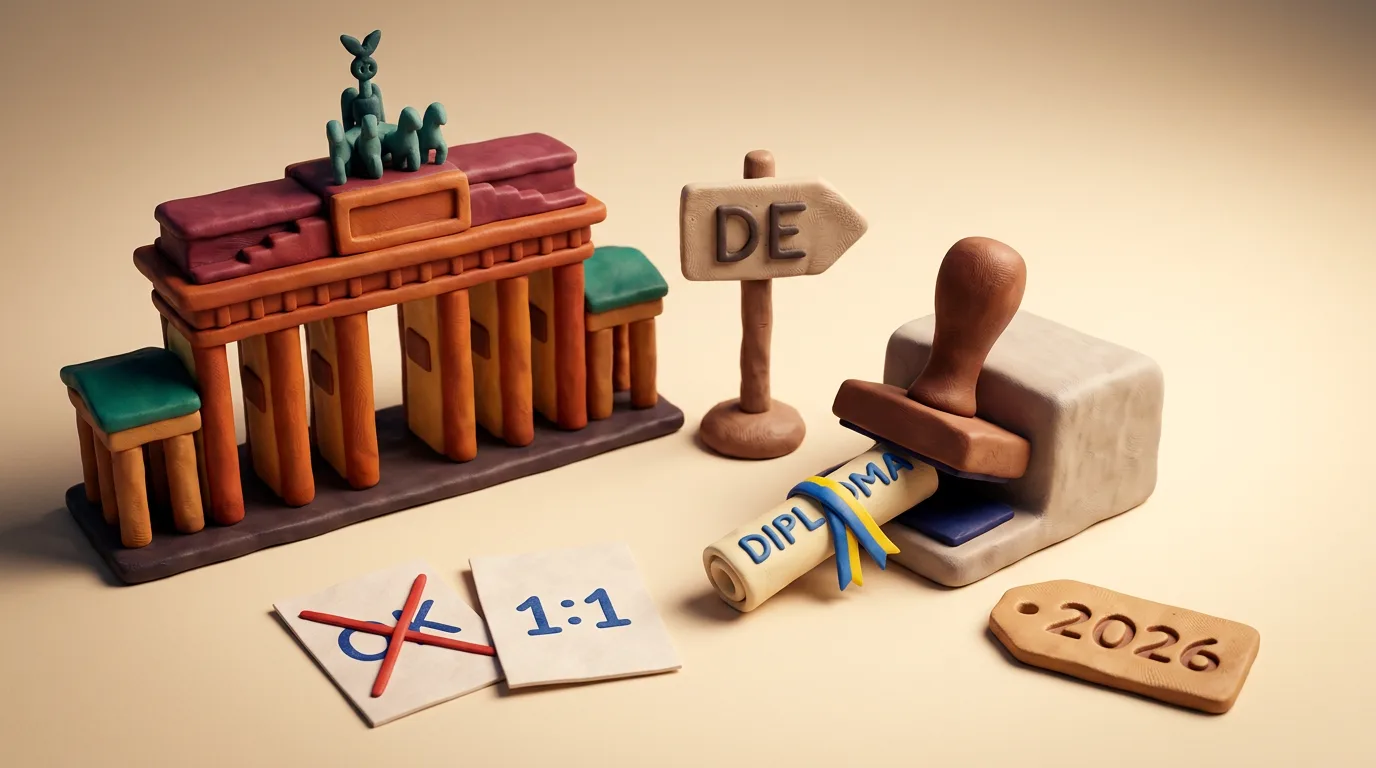
5 points- From 18 May 2026, in North Rhine-Westphalia (NRW), Ukrainian school certificates are excluded from the general recognition procedure and assessed individually by the Dezernat 48 authority; certificates for the academic year up to and including 2022/2023 still fall under the previous procedure.
- On 26 February 2026, the KMK adopted an updated procedure for access to universities for persons under temporary protection (§24 AufenthG), replacing the decision of 3 February 2025; the aim is to ensure that an interruption of education due to the war does not deprive a person of the right to enroll.
- Professional qualifications (Anerkennung) are recognized by the relevant chambers (Kammer), and the assessment of higher education is issued by the ZAB — this division has not changed.
- According to BIBB (October 2025), in 2024 around 7,300 applications for recognition of Ukrainian professions were submitted — five times more than two years earlier; in about 95% of cases, full or partial equivalence is recognized.
- Most applications are submitted by engineers, nurses and teachers; for regulated professions (medicine, care, education), recognition is mandatory.
In 2026, Germany updated several rules concerning the recognition of Ukrainian educational documents. The changes primarily affect school certificates and access to higher education, while the basic procedure for recognizing professional qualifications (Anerkennung, nostrification) has remained unchanged. Below is exactly what changed, who is affected and how to act.
What changed in 2026
School certificates: individual assessment in NRW from 18 May 2026
In the federal state of North Rhine-Westphalia (NRW), from 18 May 2026, Ukraine has been excluded from the general procedure for recognizing school certificates (Allgemeinverfügung) — due to a change in the assessment criteria. Now Ukrainian certificates are again reviewed and assessed by the Dezernat 48 authority of the Cologne District Government (Bezirksregierung Köln) on an individual basis (Einzelfallentscheidung), rather than under a single template.
A transitional rule is provided: certificates from Ukraine for the academic year up to and including 2022/2023 continue to fall under the previous general procedure. This decision applies to the state of NRW; in other states, the rules for assessing school documents may differ.
Access to universities: the new KMK procedure of 26 February 2026
The Standing Conference of the Ministers of Education (KMK) on 26 February 2026 adopted an updated procedure “Access to higher education and admission to universities based on Ukrainian educational documents.” It replaced the previous decision of 3 February 2025 and applies to persons with a residence permit under §24 of the Residence Act (AufenthG) — that is, those with temporary protection.
The key aim of the procedure is to ensure that persons who were unable to complete the academic year or school level due to the war are not placed at a disadvantage during admission to German universities, even if some examination documents are missing.
How recognition works — unchanged in 2026
The structure of recognition in Germany itself has remained the same. It is important to distinguish two tracks:
- Professional qualifications (for example, nurse, electrician, educator) are recognized by the relevant chambers (Kammer) and the competent authorities for the respective profession. This is “nostrification” in the narrow sense — confirmation of equivalence (Gleichwertigkeit).
- Higher education (a university diploma) is assessed by the ZAB — the Central Office for Foreign Education, which issues a statement of comparability (Zeugnisbewertung).
For regulated professions (medicine, nursing care, education, engineering specialties with protected status), recognition is mandatory in order to work in the field. For non-regulated professions (for example, in IT, natural sciences, economics), recognition is not mandatory for employment, but it helps the employer assess the qualification.
Who is affected and how many such cases there are
According to the Federal Institute for Vocational Education and Training (BIBB, special analysis of October 2025), in 2024 Ukrainians submitted around 7,300 applications for recognition of professional qualifications — a historic record, with the number of applications rising about fivefold over two years. Ukraine became the second country of origin by number of applications after Turkey.
In about 95% of cases, full or partial equivalence of the qualification was established. The most applications were submitted by engineers (1,644), nurses (1,344) and teachers (1,308). Separately, the ZAB recorded a record 45,100 applications for the assessment of Ukrainian higher education diplomas. The majority of applicants are women (about 71%).
How to act
- Determine the track. Professional qualification — contact the competent chamber/authority; a university diploma — the ZAB.
- Prepare the documents. Usually you need a copy of your international passport, a CV (Lebenslauf) in German, and certified translations of your diploma/certificate and of confirmations of work experience.
- If documents are lost. The ZAB and the authorities provide for an alternative check (a plausibility procedure, a qualification analysis, a qualification examination) if the authenticity of the education can be established.
- Use the free consultation. The IQ Network (Förderprogramm IQ) and counseling centres help with the procedure; the costs of recognition can be fully or partially covered.
- Check the rules of your federal state. The change regarding school certificates applies to NRW; in other states, contact your local recognition authority.
Important: this article is for information purposes. The exact document requirements and time frames depend on the profession, the federal state and the specific authority — verify them on official sources (KMK/ZAB, anerkennung-in-deutschland.de, the recognition authority of your federal state) before submitting.
GermanyResidence Permit · requirements
05Questions
6 answers01What does the change of 18 May 2026 mean for Ukrainian school certificates?
In the federal state of North Rhine-Westphalia (NRW), Ukraine has been excluded from the general procedure for automatic recognition of certificates. Now the Dezernat 48 authority assesses each Ukrainian certificate individually. Certificates for the academic year up to and including 2022/2023 still fall under the previous procedure.
02Who is affected by the KMK decision of 26 February 2026 on access to universities?
It concerns persons with a residence permit under §24 AufenthG (temporary protection). The aim is to ensure that an interruption of education due to the war does not deprive a person of the right to enroll at a German university, even when some examination documents are missing.
03Who recognizes my professional qualification, and who — my university diploma?
Professional qualifications are recognized by the relevant chambers (Kammer) and the competent authorities for the profession. The assessment of a higher education diploma is issued by the ZAB — the Central Office for Foreign Education (Zeugnisbewertung).
04Is recognition mandatory in order to work in Germany?
For regulated professions (medicine, care, education, etc.), recognition is mandatory. For non-regulated professions (IT, economics, natural sciences), it is not a mandatory condition for employment, but it helps confirm the qualification to the employer.
05What should I do if I have lost my education documents?
The ZAB and the recognition authorities provide for alternative paths: a plausibility check procedure, a qualification analysis or a qualification examination, if the authenticity of the education obtained can be confirmed.
06Can I get free help with the procedure?
Yes. Counseling centres and the IQ Network help with submitting applications, and the costs of the recognition procedure itself can be fully or partially covered under the relevant conditions.
06Official sources
- KMK/ZAB — Ukraine: Informationen zur Anerkennung
kmk.org - KMK/ZAB — Hochschulzugang (Beschlüsse, у т.ч. 26.02.2026)
kmk.org - Bezirksregierung Köln — Auslaendische Schulzeugnisse (зміна з 18.05.2026)
bezreg-koeln.nrw.de - BIBB — Rekordzuwachs bei der Anerkennung ukrainischer Berufsqualifikationen (20.10.2025)
bibb.de - Anerkennung in Deutschland — Berufsanerkennung von Geflüchteten
anerkennung-in-deutschland.de
Author: Yevhen Kravchenko. Published . Checked against official sources on .
 United KingdomGermany
Baby Passport Photo Rules: Eyes Open? Toys? Dummies? What the UK and Germany Actually Say
For a UK passport the baby must be alone, without toys or dummies; under-1s needn't have eyes open, under-6s needn't look at the camera.
 Germany
Germany's Digital Passport Photo Rule: How the E-Passfoto Process Works Since May 2025
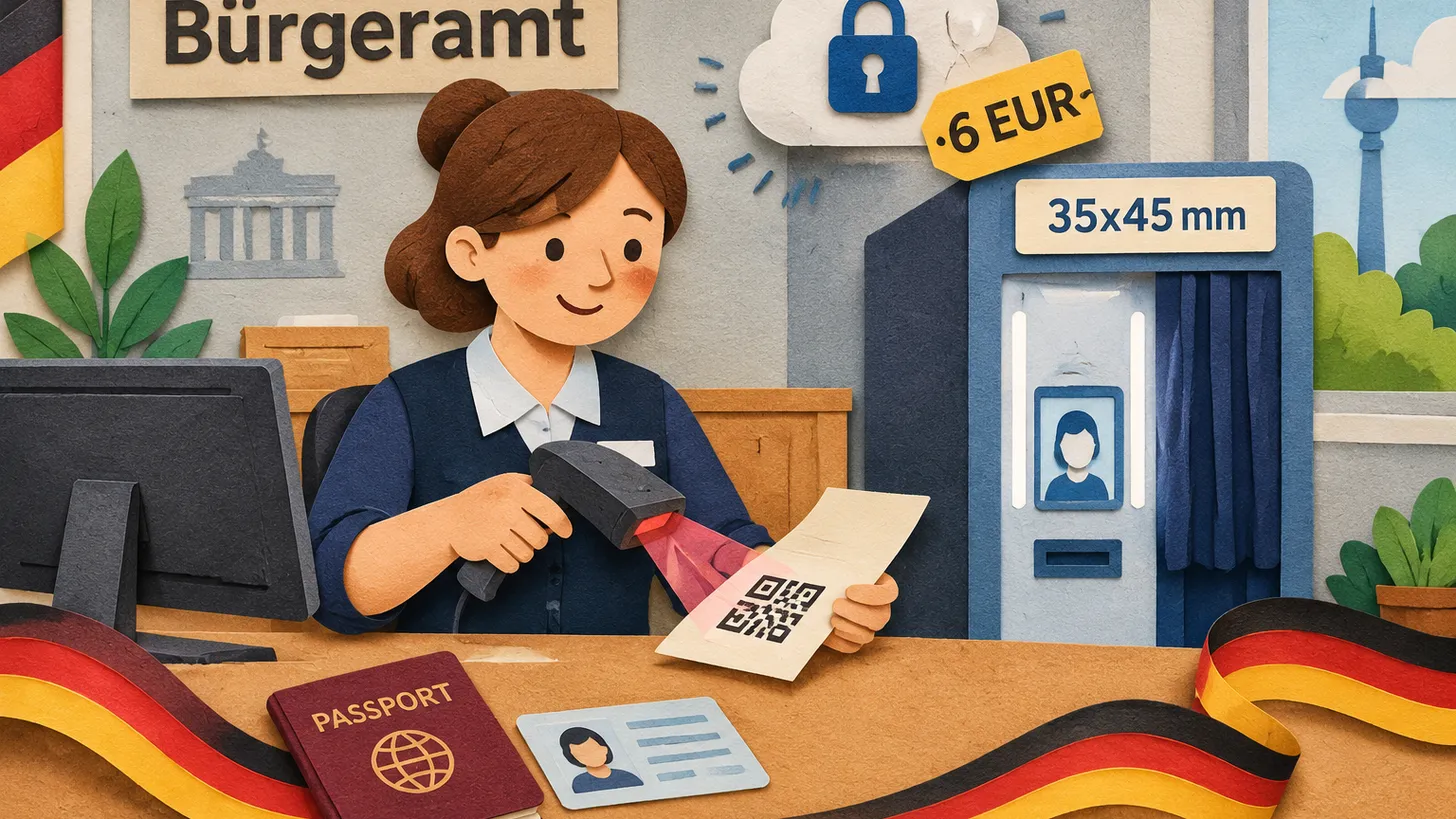
German passports and ID cards now take only digital photos — captured at the office or uploaded by a registered photographer and retrieved via a code.
 USAUnited KingdomGermany+5
Passport Photo Size by Country: 18 Passports, 8 Different Formats — and Why One Photo Never Fits All
Of 18 passports we compared, 8 use 35x45 mm — but the US, Canada, Turkey, China, Spain and others don't, and head size ranges from 26 to 36 mm.

Make the photo for this document
Upload a selfie — we crop it to 35 × 45 mm, replace the background and check it against the document rules. Free.
Residence Permit · GermanyUpload