SourceBerlin Immigration Office (Landesamt für Einwanderung), Service Berlin and the German Federal Ministry of the Interior
Verified
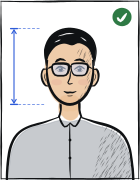
Quick answer: A Germany residence permit photo must be 35 × 45 mm. Plain light background. Head occupies 71–80% of photo height (32–36 mm chin to crown). Neutral expression, eyes fully visible. Last verified .
Germany residence permit photo: size in mm, cm, inches and pixels
Millimetres
35 × 45 mm
Centimetres
3.5 × 4.5 cm
Inches
1.38 × 1.77″
Pixels at 300 dpi
413 × 531 px
Pixels at 600 dpi
827 × 1063 px
Germany-specific things to know
Since 1 May 2025 a photo you bring on paper is no longer accepted for the electronic residence title: the photo is taken at the authority or by a studio or drugstore that sends it digitally. Do not print one at home or in a photo booth.
The studio gives you a QR code to bring to the appointment; on site a self-service terminal (PointID) costs 6.00 euros. These details are the Berlin office's.
Exceptions keep paper photos: residence permits for refugees from Ukraine, Duldung and Aufenthaltsgestattung.
How residence permit photos are verified
The photo for a German residence permit (the electronic residence title, eAT) changed on 1 May 2025. The law strengthening the security of passports and ID documents says that biometric passport photos may only be taken directly at the authorities or in photo studios that can send them digitally to the authorities through a secure electronic channel — and that covers the electronic residence title and travel documents of foreigners.
Read more
At the Berlin Immigration Office (LEA), for appointments from 14 July 2025, «please do not bring classic biometric passport photos (on photo paper) any more — they are no longer accepted». Two ways are offered: have the digital passport photo taken beforehand in a photo studio or a participating drugstore that sends it through a secure photo cloud and gives you a QR code to bring to the appointment, or take it on site at a self-service terminal (PointID) for 6.00 euros.
The exceptions — residence permits of refugees from Ukraine, Duldung and Aufenthaltsgestattung — still use paper biometric photos. The photo itself follows the Ministry of the Interior sheet: 35 × 45 mm, face 70–80 % of the height, a monochromatic background without shadows, neutral expression with the mouth closed.
Examples and mistakes
What makes Germany residence permit photos accepted
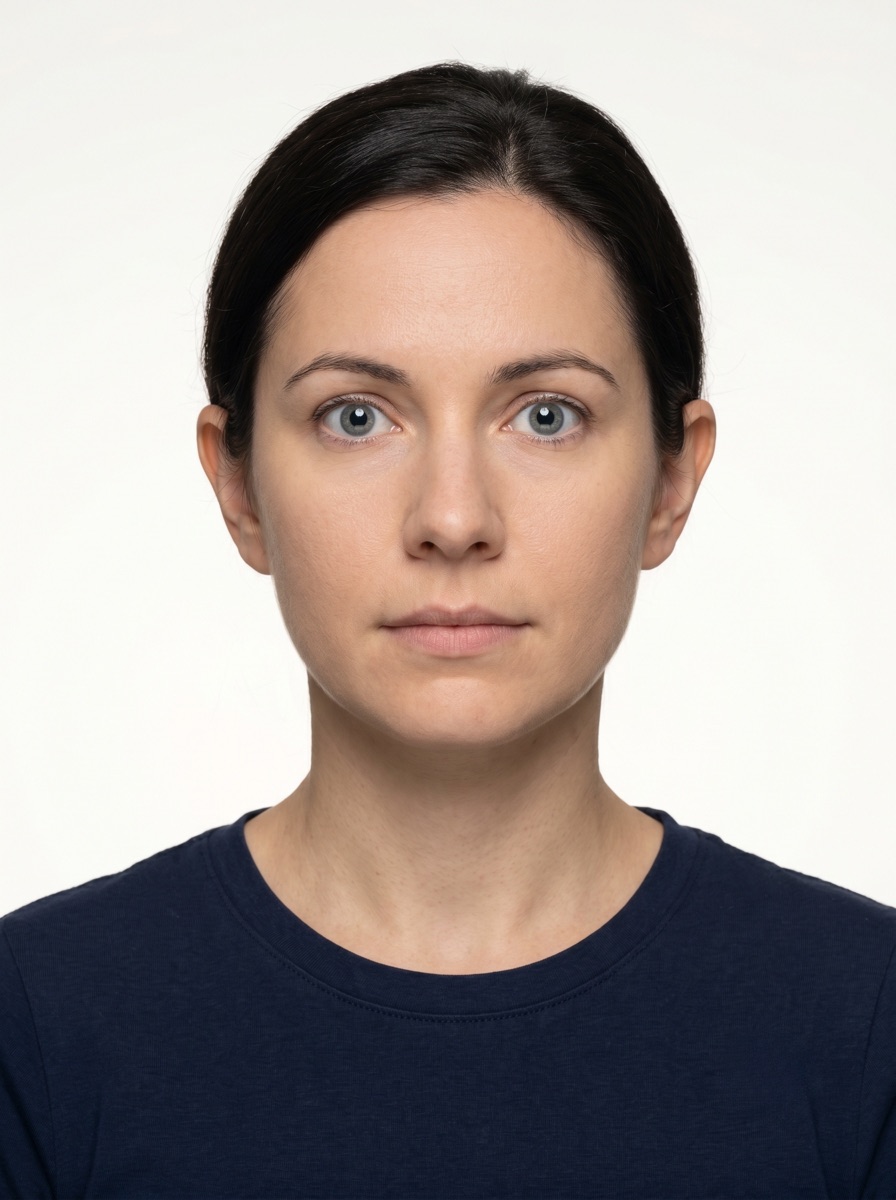
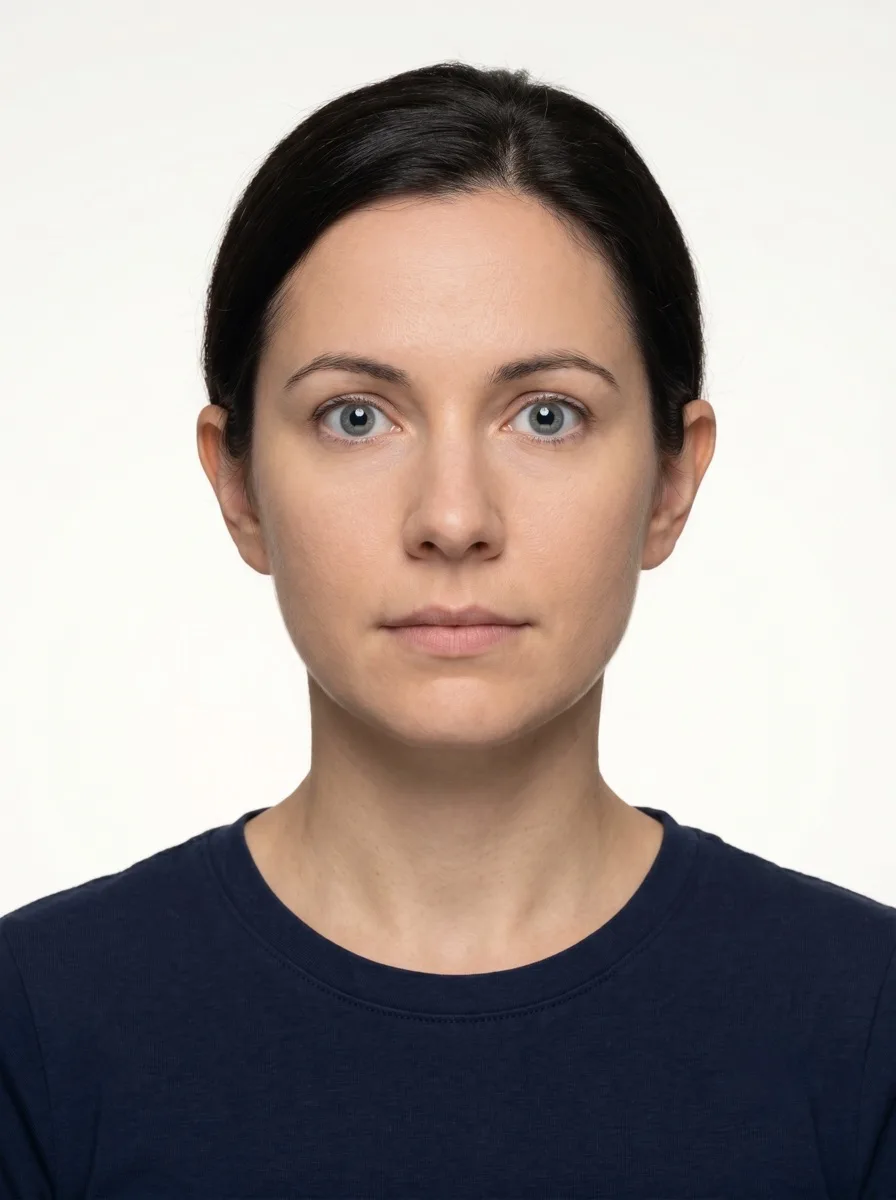
A photo that will be accepted, next to the six most common reasons Germany residence permit photos get rejected.
Accepted
Compliant Germany residence permit example (35 × 45 mm)
Face centred, looking directly into the lens
Plain background — no shadow, pattern or texture
Neutral expression, eyes open, mouth closed
No glasses, no hair across the face
Top 6 Germany residence permit rejection causes
Background shadowShadow on the wall behind the head, or background with a visible pattern or gradient
Smile / open mouthVisible smile with teeth or open mouth instead of a neutral expression
Glasses with glareGlasses with a clearly visible light reflection covering part of the eye
Hair across the faceLoose hair strands covering the eyes, eyebrows or part of the face
Eyes off-cameraEyes looking to the side instead of directly into the camera lens
Head tiltedHead tilted so the eye line is no longer horizontal
Typical rejection reasons and how to fix them
Typical reasons a photo is rejected under the rules Berlin Immigration Office (Landesamt für Einwanderung), Service Berlin and the German Federal Ministry of the Interior publishes: what is wrong and what to change.
Reason
Fix
A classic biometric passport photo on photo paper brought to the appointment
Have the digital photo made at a studio or drugstore with a QR code, or at the office terminal.
A photo taken at a studio that cannot send it to the authority through a secure channel
Choose a studio or drugstore that works with the authority's photo cloud.
A face outside 70–80 % of the height, shadows or a patterned background
Keep the face 70–80 % with a plain monochromatic background without shadows.
Laughing, open mouth, closed eyes, hair over the eyes, or reflecting lenses
Neutral expression, mouth closed, eyes open and clear; no reflections.
How to take your Germany residence permit photo correctly
Background and light
Background: plain light
The tool puts in the required background. Stand half a metre from a plain light wall, face a window and shoot without flash — then there are no shadows on your face or on the wall.
Framing
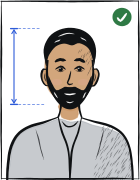
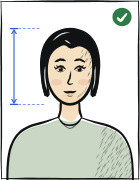
Head: 71–80 % of the photo height (32–36 mm)
Camera at eye level, about a metre away; head and shoulders in the shot. The tool crops it to 35 × 45 mm.
Glasses
Eyes fully visible
If you wear glasses, check the shot: no glare on the lenses, eyes clearly visible.
Expression and gaze
Neutral expression, mouth closed, eyes open
Look straight into the lens with your head level; keep hair away from your eyes and eyebrows.
Print at 100% scale, borderless, and turn off fit-to-page so each photo keeps its exact size.
Where to submit your residence permit application
A German residence title is applied for or reissued by appointment at the competent immigration office (in Berlin the Landesamt für Einwanderung or, for a reissue of a settlement permit, a Bürgeramt); the photo is taken digitally at the office or beforehand at a connected studio or drugstore.
Berlin Immigration Office (LEA) or a Bürgeramtby appointment, in person
berlin.de/einwanderung — book the appointment; bring the QR code of the studio photo
Processing
After the appointment about 3–4 weeks for a settlement permit
Cost
Fee 67.00 euros for adults; terminal photo 6.00 euros
Digital photo only: QR code from a studio or a PointID terminal on site.
Berlin Immigration Office, update of 11 July 2025: «On 1 May 2025 the law strengthening the security of passports and ID documents came into force. Since then biometric passport photos may only be created directly in the authorities or in photo studios that can transmit them digitally to the authorities via a secure electronic channel. This change also affects the Landesamt für Einwanderung (LEA) and the issuing of electronic residence titles and travel documents.»
Same notice, appointments from 14 July 2025: do not bring classic biometric passport photos on photo paper — they are no longer accepted. Recommended: have the digital passport photo made beforehand in a photo studio or certain drugstores that can send photos through a secure photo cloud to the office (especially with children); you get a QR code from the studio or drugstore to bring to the appointment. Alternative: make the photo on site at a self-service terminal (PointID device) for a fee of 6.00 euros.
Same notice, exceptions: the changes do not apply to residence permits for refugees from Ukraine, to Duldung for persons obliged to leave the country, or to Aufenthaltsgestattung of people in asylum proceedings; they still bring non-digital biometric photos on photo paper. Service Berlin, reissue of a permanent residence title: «1 current biometric photo. Since May 1, 2025… Biometric passport photos may only be taken digitally at government offices or in photo studios/drugstores that can transmit them to the authorities via a secure electronic channel»; creating a digital passport photo at a self-service terminal on site costs 6.00 euros.
Ministry of the Interior photo sheet (October 2024): the face from the tip of the chin to the top of the head taking up 70–80 % of the photo height; evenly lit without reflections or red eyes; the head centred and straight; sharp and high-contrast; a monochromatic background free of shadows; true colours; a neutral expression with the mouth closed, looking directly into the camera, eyes clearly visible; head coverings only for religious reasons with the face visible from chin to forehead. The residence-title profile of the site uses 35 × 45 mm.
Questions
Frequently asked questions
Not any more. Since 1 May 2025 biometric passport photos may only be taken digitally at the authority or at a studio or drugstore that transmits them securely; the Berlin Immigration Office says for appointments from 14 July 2025 paper biometric photos are no longer accepted (exceptions: Ukraine refugees, Duldung, Aufenthaltsgestattung).
Either beforehand at a photo studio or a participating drugstore that sends it through a secure photo cloud — you get a QR code to bring to the appointment — or on site at a self-service terminal (PointID) for 6.00 euros at the Berlin office.
The biometric photo of the Ministry of the Interior sheet: 35 × 45 mm, face 70–80 % of the height, centred and straight, a monochromatic background without shadows, a neutral expression with the mouth closed, eyes clearly visible, head coverings only for religious reasons — taken digitally, not on paper.
The rule comes from the federal law of 1 May 2025, so it applies to the whole country; the QR code and the 6.00 euro terminal are the Berlin office's own arrangement.
The Germany residence permit photo must be 35 × 45 mm. The head must occupy 71–80% of the photo height.
Usually no older than six months; some immigration offices ask for a more recent one. Take a new photo that looks like you on the day you apply.
Plain light background. A plain, evenly lit wall without shadows or pattern is enough — the tool sets the required background colour.
Only if the size and rules are the same and the photo is still recent. Otherwise take a new one: the same selfie can be turned into photos for both documents.
Take a new photo: it should show how you look now — hairstyle, beard, glasses.
We refund the payment in full. Email us within 14 days of purchase with your order number and the rejection notice from the Germany immigration office.
35 × 45 mm = 3.5 × 4.5 cm = 1.38 × 1.77 inches. At 300 dpi that is 413 × 531 pixels; at 600 dpi, 827 × 1063 pixels.
Religious reasons only; must not cover the facial oval. The face must stay fully visible from chin to forehead and on both sides, with no shadow across it.
Yes. The same 35 × 45 mm format and head size apply to: electronic residence permit (eAT), EU blue card, EU long-term residence permit, ID card (Personalausweis), national visa (Type D), opportunity card (Chancenkarte).