 Germany
Wohngeld for Ukrainians in Germany 2026: who is eligible, how much and how to apply at the Wohngeldstelle
If you work and have income but it is not enough for the full rent, you can apply for Wohngeld instead of Bürgergeld. It is not granted at the same time as Bürgergeld/Sozialhilfe/AsylbLG/BAföG. Apply at the Wohngeldstelle of your city; payment starts from the 1st of the month of application. Calculate the exact amount in the official BMWSB Wohngeldrechner.
In this article · 10 sections
- 01Which Ukrainians are entitled to Wohngeld
- 02When Wohngeld is not granted (important)
- 03Wohngeld or Bürgergeld — what to choose
- 04How much you can receive
- 05How to apply: step by step
- 06What documents are needed
- 07The change in the law for those who entered on 1 April 2025 or later
- 08In brief
- 09Questions
- 10Official sources
Key points
6 points- Wohngeld and Bürgergeld/Sozialhilfe/Grundsicherung/AsylbLG/BAföG are mutually exclusive: you cannot receive them at the same time, because housing is already accounted for in these benefits (§7 WoGG).
- Ukrainians with a §24 AufenthG permit are entitled to Wohngeld under the general conditions (§3 Abs. 5 WoGG; §24 is not in the list of excluded permits); existing §24 permits have been automatically extended until 4 March 2027 — but this applies to those who already have §24, not to those who only have a Fiktionsbescheinigung or who have not yet obtained §24.
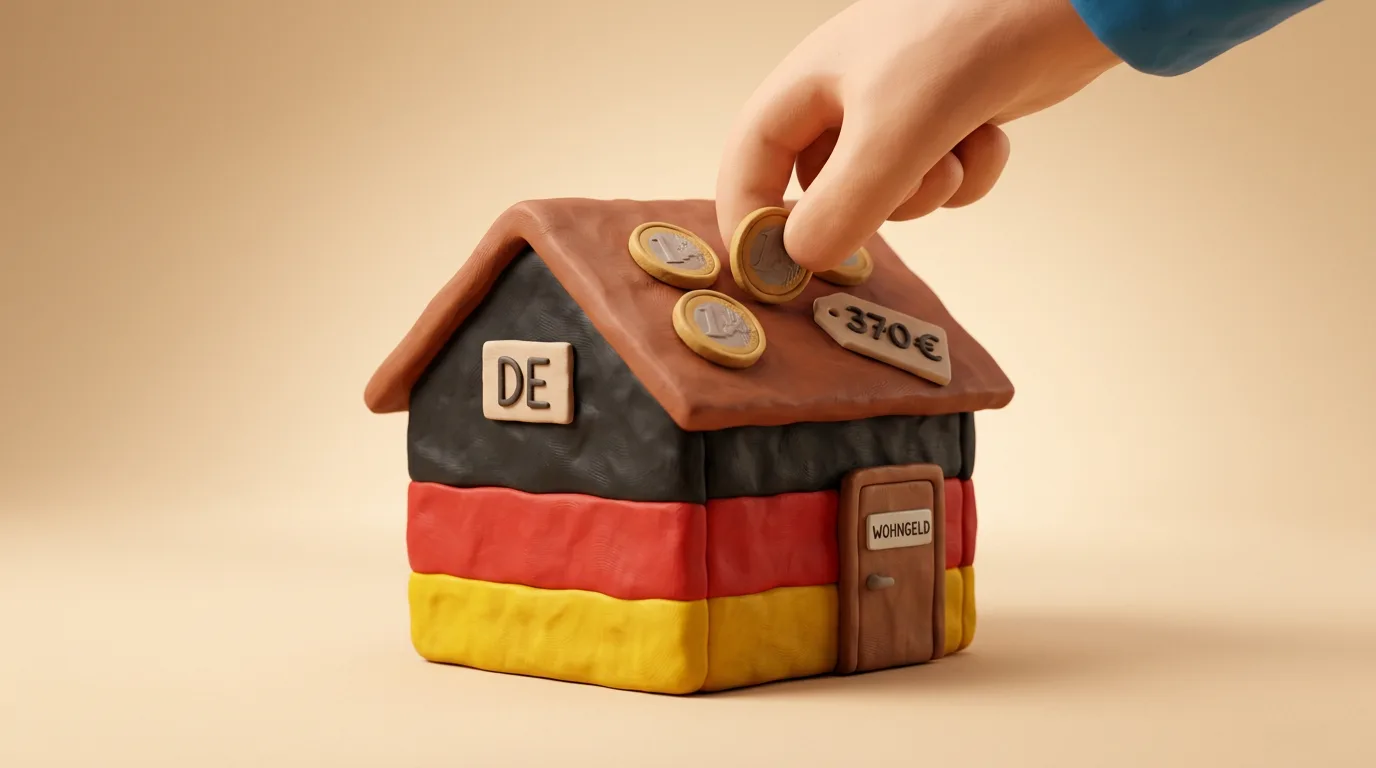
- The Wohngeld-Plus reform raised the average payment for previous recipients by about 190 € — to ~370 €/month (BMWSB data). According to Destatis statistics the actual average at the end of 2024 is about 287 €/month (≈1.2 million households).
- Wohngeld is advantageous for low-income workers: it is a targeted supplement for housing only, without Jobcenter employment requirements.
- The application is submitted to the local Wohngeldstelle; payment starts from the 1st of the month of application, processing takes ~8 weeks, the approval is usually for 12 months (then a Weiterleistungsantrag).
- A change in the law (Rechtskreiswechsel / Leistungsrechtsanpassungsgesetz) is intended to apply to those who entered on 1 April 2025 or later: they are to be moved to AsylbLG. As of June 2026 the law has not yet been finally adopted, so the 1 July 2026 deadline is in question; while a person is on AsylbLG, separate Wohngeld is not available to them.
Wohngeld (housing subsidy) is a state supplement for rent (Mietzuschuss) or for owned housing (Lastenzuschuss) for households with income above the social-assistance level that is not enough for housing. According to Destatis, at the end of 2024 about 1.2 million households received Wohngeld. For Ukrainians this is a real alternative to Bürgergeld — especially if you work and have income.
Which Ukrainians are entitled to Wohngeld
- A §24 AufenthG residence permit (temporary protection) grants the right to Wohngeld under the general conditions — holders of the permit (Aufenthaltstitel) are wohngeldberechtigt under §3 Abs. 5 WoGG (§24 is not among the list of excluded permits). Existing §24 permits have been automatically extended until 4 March 2027 — there is no need to contact the Ausländerbehörde separately, even if the date on the card has already passed. Note: the automatic extension applies only to those who already have §24; if you only have a Fiktionsbescheinigung or have not yet obtained §24 — the permit must be arranged in the usual way.
- You are a tenant, subtenant, member of a housing cooperative or homeowner with a mortgage.
- You have your own income (salary, pension, alimony, etc.) that is enough for basic living needs but not entirely for the rent.
When Wohngeld is not granted (important)
Wohngeld and benefits in which housing costs are already accounted for cannot be combined (§7 WoGG). You will NOT receive Wohngeld if you already receive:
- Bürgergeld (SGB II);
- Sozialhilfe / Grundsicherung (SGB XII);
- benefits under the Asylbewerberleistungsgesetz (AsylbLG);
- BAföG (student assistance).
So the choice is this: either basic social assistance (where housing is already covered), or Wohngeld as a targeted supplement for rent only. Wohngeld is a priority benefit over Bürgergeld, but the obligation to switch to it arises only when Wohngeld (together with Kinderzuschlag) takes the entire household out of Bürgergeld for at least 3 months; otherwise Bürgergeld remains.
Wohngeld or Bürgergeld — what to choose
- If you work and your income is almost enough: Wohngeld is usually more advantageous — it is a supplement for housing only, without Jobcenter requirements regarding job search, interviews and obligations.
- If you have almost no income: Bürgergeld provides broader financial protection (full coverage of the subsistence minimum + housing + health insurance).
How much you can receive
The amount depends on three factors: the number of household members, the size of the rent (Bruttokaltmiete) in your region and the combined income of all members. After the Wohngeld-Plus reform, BMWSB states that the average payment for those who already received Wohngeld rose by about 190 € — to ~370 € per month. This is a reform benchmark, not a guaranteed amount: according to actual Destatis statistics the average payment at the end of 2024 was about 287 € per month (for "pure" Wohngeld households). Calculate your exact amount before submitting the application in the official Wohngeldrechner on the BMWSB website.
How to apply: step by step
- Find your Wohngeldstelle — it is the housing department at the administration of your city, community or district (Gemeinde-, Stadt- or Kreisverwaltung). Many federal states accept applications online via the verwaltung.bund.de portal.
- Calculate your entitlement through the official Wohngeldrechner, so as not to apply in vain.
- Fill in the application (Wohngeldantrag) and attach the documents (list below).
- Submit before the end of the month from which you want to receive the payment: Wohngeld is paid from the 1st of the month of application, even if the decision comes later.
- Wait for the decision — processing takes about 8 weeks depending on the completeness of the documents.
- Reapply (Weiterleistungsantrag) at the end of the term: the approval is usually valid for 12 months, after which a new application is needed.
What documents are needed
- The rental contract (Mietvertrag) and proof of rent payment (account statements);
- the latest 3 salary payslips (Gehaltsabrechnungen) of all household members;
- Bescheide on any benefits (Transferleistungen), pensions, alimony;
- proof of health insurance;
- for the self-employed — a tax return;
- if applicable — a certificate of disability and documents on deductions.
The change in the law for those who entered on 1 April 2025 or later
On 19 November 2025 the cabinet of ministers adopted the draft Leistungsrechtsanpassungsgesetz (Rechtskreiswechsel). Under it, Ukrainians with a §24 permit who entered Germany on 1 April 2025 or later are to receive not Bürgergeld but lower benefits under AsylbLG. The law was planned to be introduced from 1 July 2026, but as of June 2026 it has not yet been finally adopted: the draft (Bundestag printed paper 21/3539 of 12.01.2026) passed its first reading on 15 January 2026, the Bundesrat issued a critical opinion (Stellungnahme, advisory) on 30 January 2026, and on 23 February 2026 a hearing took place in the relevant committee. There has not yet been a final vote, so the 1 July 2026 deadline is in question. Those who entered before 1 April 2025 are not affected. While a person receives AsylbLG, separate Wohngeld is not available to them (housing is already accounted for in the benefit).
In brief
If you are a Ukrainian with §24 AufenthG, work or have other income and do not receive Bürgergeld/Sozialhilfe/AsylbLG/BAföG — apply for Wohngeld at your Wohngeldstelle. First check the amount in the official Wohngeldrechner. The free Wohngeld hotline: 030 20179050 (Mon–Thu 8:00–18:00, Fri 8:00–12:00).
GermanyResidence Permit · requirements
09Questions
6 answers01Can I receive Wohngeld and Bürgergeld at the same time?
No. Wohngeld and Bürgergeld (as well as Sozialhilfe, Grundsicherung, AsylbLG, BAföG) are mutually exclusive, because housing costs are already accounted for in these benefits (§7 WoGG). You need to choose one.
02How much Wohngeld can you receive per month?
The amount is individual and depends on the number of household members, the size of the rent and the income. After the Wohngeld-Plus reform, BMWSB cites a benchmark of ~370 €/month for previous recipients; according to actual Destatis statistics the average at the end of 2024 is about 287 €/month. Calculate your exact amount in the official BMWSB Wohngeldrechner.
03Are Ukrainians with a §24 AufenthG permit entitled to Wohngeld?
Yes, under the general conditions (having your own income, no Bürgergeld/Sozialhilfe/AsylbLG/BAföG). Holders of a §24 permit are wohngeldberechtigt under §3 Abs. 5 WoGG, and §24 is not among the list of excluded permits. Existing §24 permits have been automatically extended until 4 March 2027, and the right to Wohngeld is retained.
04From what point is Wohngeld paid?
From the 1st of the month in which you submitted the application, even if the decision comes later. So submit before the end of the desired month. Processing takes about 8 weeks.
05Where do you apply for Wohngeld?
At the local Wohngeldstelle — the housing department at the administration of your city, community or district. Many federal states accept applications online via the verwaltung.bund.de portal.
06Does the change in the law on moving to AsylbLG concern me?
The change is intended to apply to those who entered Germany on 1 April 2025 or later. Those who entered earlier are not affected. As of June 2026 the law has not yet been finally adopted (the draft is in the Bundestag, printed paper 21/3539; a critical Bundesrat opinion of 30.01.2026), so the 1 July 2026 deadline is in question. While you are on AsylbLG, separate Wohngeld is not available.
10Official sources
- BMWSB — Wohngeld-Plus (офіційно, умови, ~370 €, виключення Bürgergeld/AsylbLG/BAföG, гаряча лінія)
bmwsb.bund.de - Bundesportal verwaltung.bund.de — Wohngeld erstmalig beantragen (документи, виплата з 1-го числа, 12 місяців, обробка ~8 тижнів)
verwaltung.bund.de - Bundesregierung.de — Kabinett beschließt Rechtskreiswechsel (в'їзд після 1.04.2025 → AsylbLG, проєкт 19.11.2025)
bundesregierung.de - Flüchtlingsrat Niedersachsen — Wohnen (Ukrainians with Section 24 status are eligible for Wohngeld)
nds-fluerat.org - Mediendienst Integration — legal status (Section 24 extended until 4 March 2027)
mediendienst-integration.de
Author: Yevhen Kravchenko. Published . Checked against official sources on .
 United KingdomGermany
Baby Passport Photo Rules: Eyes Open? Toys? Dummies? What the UK and Germany Actually Say
For a UK passport the baby must be alone, without toys or dummies; under-1s needn't have eyes open, under-6s needn't look at the camera.
 Germany
Germany's Digital Passport Photo Rule: How the E-Passfoto Process Works Since May 2025
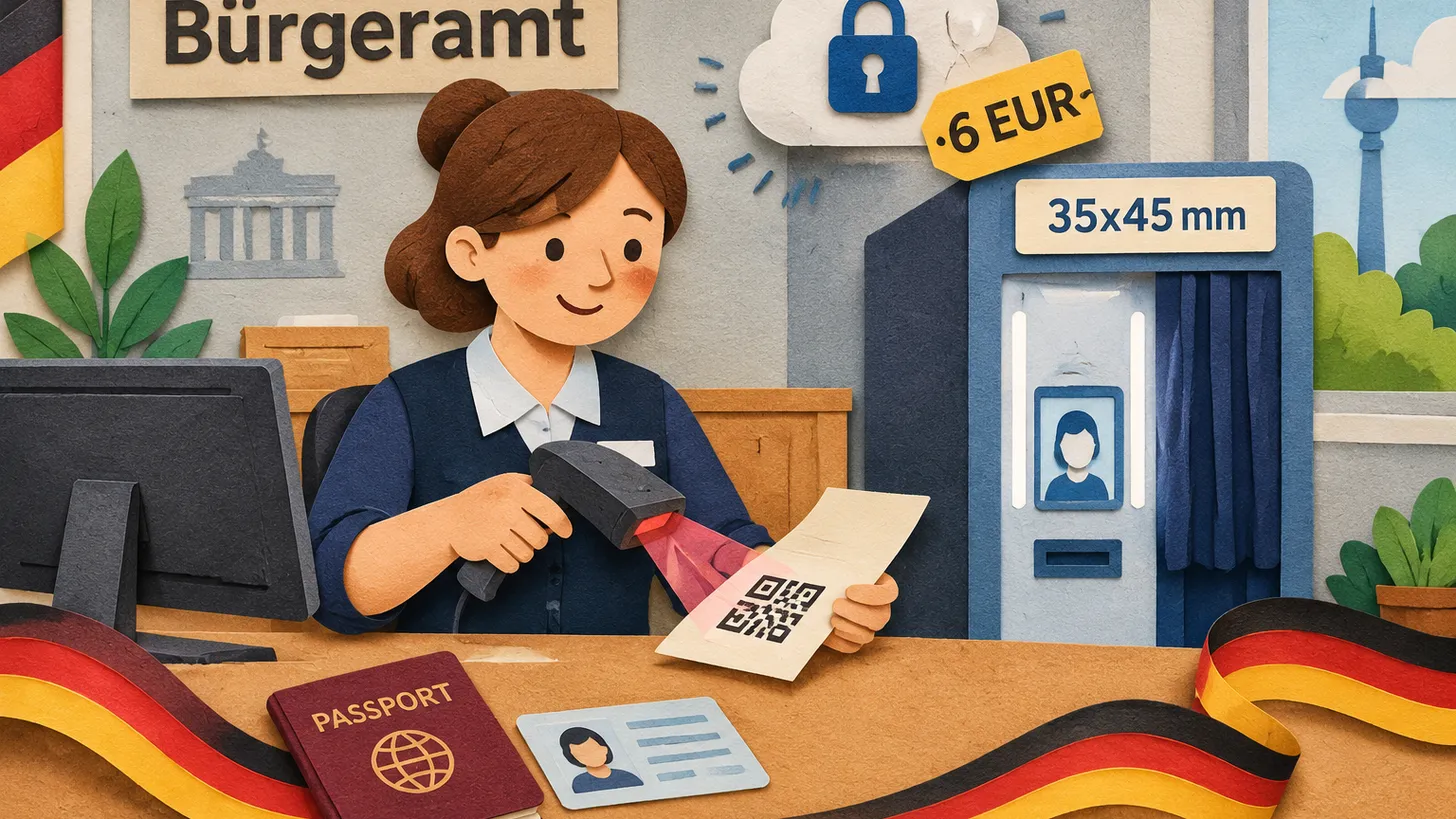
German passports and ID cards now take only digital photos — captured at the office or uploaded by a registered photographer and retrieved via a code.
 USAUnited KingdomGermany+5
Passport Photo Size by Country: 18 Passports, 8 Different Formats — and Why One Photo Never Fits All
Of 18 passports we compared, 8 use 35x45 mm — but the US, Canada, Turkey, China, Spain and others don't, and head size ranges from 26 to 36 mm.
Make the photo for this document
Upload a selfie — we crop it to 35 × 45 mm, replace the background and check it against the document rules. Free.
Residence Permit · GermanyUpload