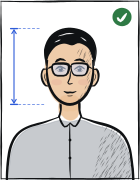
Quick answer: A Canada passport photo must be 50 × 70 mm. White or light uniform background. Head occupies 44–51% of photo height (31–36 mm chin to crown). Neutral expression, clear lenses only, no glare. Last verified .
Canada passport photo: size in mm, cm, inches and pixels
Millimetres
50 × 70 mm
Centimetres
5 × 7 cm
Inches
1.97 × 2.75″
Pixels at 300 dpi
591 × 827 px
Pixels at 600 dpi
1181 × 1654 px
Canada-specific things to know
IRCC warns that Canadian photo requirements differ from those of other countries and will refuse an application whose photos do not meet them: 50 × 70 mm, not 35 × 45 mm.
The photo must be taken by a commercial photographer or studio and professionally printed; IRCC does not accept photos printed at home or on heavy-weight paper.
Black and white is allowed alongside colour, and glasses are accepted when the eyes are visible and the lenses do not glare.
Two photos are submitted and one carries the back-of-photo details: the photographer's date, studio name and address, plus the guarantor's sworn line and signature on a first-time application.
Online renewal has its own digital photo rules (3:2 portrait JPEG, at least 1800 × 1200 px), different from the printed 50 × 70 mm photo.
How passport photos are verified
Canadian passport photographs are set by Immigration, Refugees and Citizenship Canada (IRCC), which says its requirements differ from those of other countries and that it will refuse an application whose photos do not meet them. An application needs 2 identical, unaltered photos, 50 mm wide by 70 mm high (2 × 2¾ inches), with the face 31–36 mm from chin to crown, in colour or black and white, taken in person by a commercial photographer or studio and professionally printed on plain, high-quality photographic paper — photos printed at home or on heavy-weight paper are not accepted.
Read more
They must be taken no more than 6 months before applying, with a neutral expression, the face and shoulders centred and square to the camera, uniform lighting without shadows, and a plain white or light-coloured background. Glasses are accepted if the eyes are visible and there is no glare; sunglasses and tinted lenses are not.
For an online renewal the photo is a digital file instead.
Examples and mistakes
What makes Canada passport photos accepted
One compliant example next to the six most common rejection causes for Canada passport applications. These are the differences that most often determine whether a document photo is accepted.
Accepted
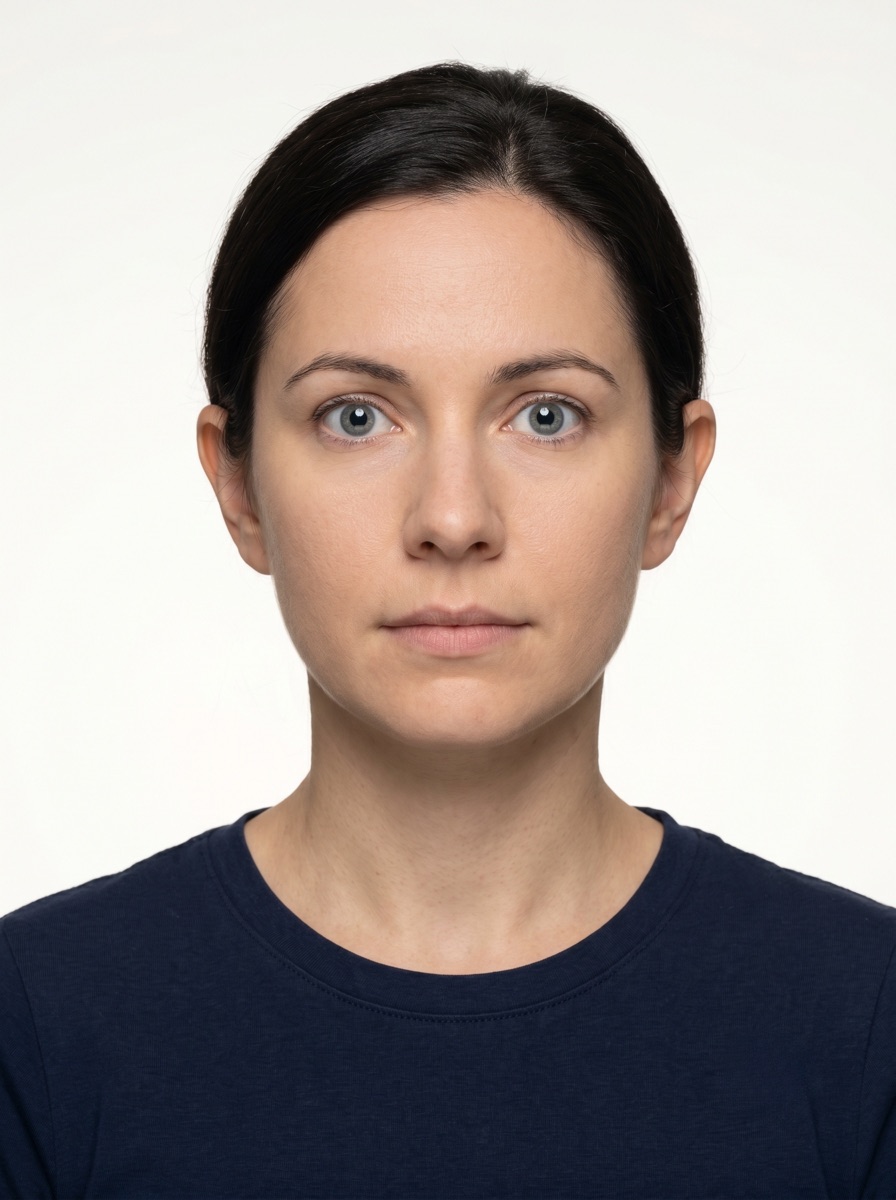
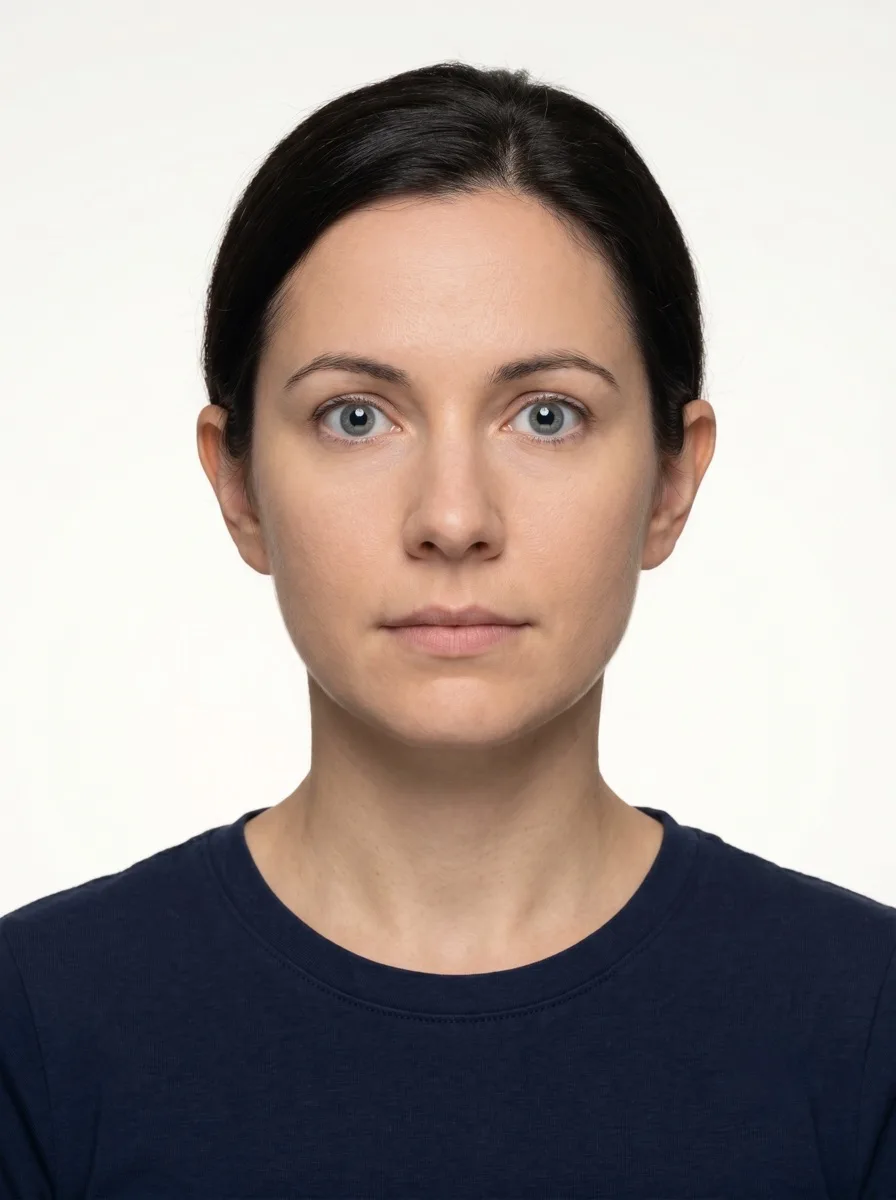
Compliant Canada passport example (50 × 70 mm)
Face centred, looking directly into the lens
Plain background — no shadow, pattern or texture
Neutral expression, eyes open, mouth closed
No glasses, no hair across the face
Top 6 Canada passport rejection causes
Background shadowShadow on the wall behind the head, or background with a visible pattern or gradient
Smile / open mouthVisible smile with teeth or open mouth instead of a neutral expression
Glasses with glareGlasses with a clearly visible light reflection covering part of the eye
Hair across the faceLoose hair strands covering the eyes, eyebrows or part of the face
Eyes off-cameraEyes looking to the side instead of directly into the camera lens
Head tiltedHead tilted so the eye line is no longer horizontal
Typical rejection reasons and how to fix them
Typical reasons a photo is rejected under the rules Government of Canada / IRCC publishes: what is wrong and what to change.
Reason
Fix
Size not 50 × 70 mm, or face height outside 31–36 mm
Ask the photographer for 50 mm wide by 70 mm high with the chin-to-crown height between 31 and 36 mm; IRCC refuses the application when the photos do not meet its requirements.
Photo printed at home or on heavy-weight paper, or not taken by a commercial photographer or studio
Have the photos taken in person at a commercial photographer or studio and professionally printed on plain, high-quality photographic paper.
Altered photo: retouching, cropping around the head and shoulders, changed background, removed red-eye or scars
Submit original photos with no edit of any kind — IRCC counts brightness, contrast, sharpness, cropping and cut-and-paste onto white as alterations.
Sunglasses or tinted lenses (even prescription), glare on glasses, or a hat or head covering not worn daily for religious or medical reasons
Wear clear glasses with the eyes visible and no glare, or take them off; remove hats and any head covering that is not part of your daily religious or medical dress.
Expression not neutral: smiling, frowning or an open mouth; head tilted; shadows on the face, ears or background
Keep the mouth closed with a neutral face, look straight at the camera with the head level, and light the scene evenly so there are no shadows around the ears or behind you.
Photographer's details or the guarantor's line missing on the back of one photo
On the back of 1 photo have the photographer write or stamp the date and the studio's name and complete address, and have your guarantor write the certification line and sign (not needed for an adult renewal).
Top reasons Canada passport photos get rejected
Photo is not from a commercial photographer Canadian passport rules require a commercial photographer or studio. A home print can fail even when the crop looks correct.
Missing photographer or guarantor information on the back For paper passport applications, one photo needs the photographer details and, unless exempt, guarantor certification on the back.
The tool puts in the required background. Stand half a metre from a plain light wall, face a window and shoot without flash — then there are no shadows on your face or on the wall.
Framing
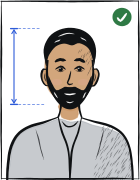
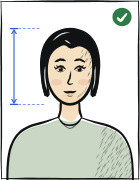
Head: 44–51 % of the photo height (31–36 mm)
Camera at eye level, about a metre away; head and shoulders in the shot. The tool crops it to 50 × 70 mm.
Glasses
Clear lenses only, no glare
If you wear glasses, check the shot: no glare on the lenses, eyes clearly visible.
Expression and gaze
Neutral expression, mouth closed, eyes open
Look straight into the lens with your head level; keep hair away from your eyes and eyebrows.
Print at 100% scale, borderless, and turn off fit-to-page so each photo keeps its exact size.
Where to submit your passport application
IRCC offers several ways to apply for or renew a Canadian passport — online renewal for a limited number of people, in person at a passport service location, and urgent or express service — and its page asks where you are: Canada, the USA or elsewhere abroad. The kind of photo you hand in depends on the route.
Passport service location in Canada (in person, appointment online)in-person
«Find a passport service location» and «Book an appointment online» on canada.ca
Processing
Standard, urgent and express service are listed on the IRCC page; service standards are published there
Cost
Passport fee set by IRCC; see its page
Two identical unaltered 50 × 70 mm prints from a commercial photographer; one carries the photographer's date, studio name and address on the back, and the guarantor's certification line and signature for a first application.
Online passport renewal (limited to some applicants)online
IRCC online renewal; photo requirements are on the digital specification sheet
Processing
Shown by IRCC when you renew
Cost
Passport fee set by IRCC
Digital photo: JPEG saved straight from the camera, 3:2 portrait, 1800 × 1200 to 4500 × 3000 px, chin to crown 45–50 % of the height; the studio's name, address and the photo date are entered at upload. IRCC says to ask the photographer for a digital and a printed copy.
Applying from the USA or elsewhere abroadmail / in-person
Choose «USA» or «International» on the IRCC passports page
Processing
Shown on the IRCC page for your location
Cost
Fee set by IRCC for applications from abroad
The same 50 × 70 mm photo rules apply: a commercial photographer, professional print, two identical unaltered copies. IRCC refuses applications whose photos do not meet the requirements.
IRCC: 2 identical and unaltered photos with each application; 50 mm wide by 70 mm high (2 × 2¾ inches); face height 31–36 mm from chin to crown; colour or black and white; taken no more than 6 months before applying.
Taken in person by a commercial photographer or studio and professionally printed on plain, high-quality photographic paper; IRCC does not accept photos printed at home or on heavy-weight paper, nor any edited photo (including cropping around the head and shoulders or changing the background).
Expression and pose: eyes open and clearly visible, looking straight at the camera, mouth closed, not smiling or frowning; face and shoulders centred and squared to the camera, not tilted; plain white or light-coloured background; uniform lighting without shadows, including around the ears.
Accepted: glasses (eyes clearly visible, no glare on the lenses), hair up or down with the edges of the face visible, hats and head coverings worn daily for religious or medical reasons (full face visible, no shadows). Not accepted: sunglasses or tinted glasses, even prescription ones; red-eye or red-eye alterations; head coverings not worn daily for religious or medical reasons.
On the back of 1 photo the photographer writes or stamps the date and the studio's name and complete address, and the guarantor writes «I certify this to be a true likeness of» followed by the applicant's name and signs; a guarantor is not needed when renewing an adult passport.
Online renewal uses a digital photo (IRCC digital specification sheet): .jpg or .jpeg saved directly from the camera original, not a scan; 3:2 ratio in portrait; at least 1800 × 1200 and at most 4500 × 3000 pixels; 200 KB–4 MB; chin to crown 45–50 % of the photo height; the studio name, address and photo date are entered at upload.
Questions
Frequently asked questions
Two identical, unaltered photos, each 50 mm wide by 70 mm high, with the face 31–36 mm from chin to crown. They may be colour or black and white, must be taken in person by a commercial photographer or studio no more than 6 months before you apply, and be printed professionally on plain, high-quality photo paper — not at home, not on heavy paper. Neutral expression, mouth closed, eyes open; plain white or light background; no shadows or glare. IRCC refuses applications whose photos do not meet these requirements.
For a passport it is 50 mm × 70 mm (2 × 2¾ inches), not 35 × 45 mm; IRCC points out that Canadian passport photo requirements are different from those of other countries. The face height stays between 31 and 36 mm. The 35 × 45 mm frame belongs to visitor-visa photos, which are a separate document with their own page.
No, not for the printed photos. IRCC says the photos must be taken in person by a commercial photographer or studio and professionally printed on plain, high-quality photographic paper, and that it does not accept photos printed at home or on heavy-weight paper. For an online renewal the photo is a digital file, but a professional photographer must still take it, in person, within 6 months before you submit.
Yes. IRCC accepts photos with glasses as long as your eyes are clearly visible and there is no glare on the lenses. It does not accept sunglasses or tinted glasses, and that includes tinted prescription lenses even when the eyes are visible.
Online renewal needs a digital photo, with rules that differ from the printed 50 × 70 mm photo. The IRCC digital specification sheet asks for a .jpg or .jpeg saved directly from the camera original (a scan of a print is not accepted), in a 3:2 ratio in portrait, at least 1800 × 1200 and at most 4500 × 3000 pixels, 200 KB–4 MB, with the chin-to-crown height 45–50 % of the photo height, and no editing, cropping or repeated compression. When you upload it you give the studio's name and address and the date it was taken.
The Canada passport photo must be 50 × 70 mm. The head must occupy 44–51% of the photo height.
White or light uniform background. No gradients, textures, shadows or objects behind the subject are permitted. The tool removes background shadows automatically, but starting with a flat, evenly lit wall gives the best result.
Yes. Stand in front of a flat, plain wall in good natural light, face the light source and use the rear camera of your phone with a 3-second timer. The tool handles the crop, background normalisation and compliance check against the Canada biometric standard.
Most passport authorities require the photo to be taken within the last six months. Do not reuse an older portrait even if your appearance has not changed.
Anfas.Pro provides a 14-day full refund if the photo is rejected by the Canada authority and you supply the official rejection notice. See the refund policy page for the exact process.
Eyes must be fully visible; no tinted lenses or strong reflections. In practice, the biometric scanner at submission points flags even minor lens glare that looks fine to the naked eye. Removing glasses before shooting is the only option that eliminates the risk entirely.
50 × 70 mm = 5 × 7 cm = 1.97 × 2.75 inches. At 300 dpi that is 591 × 827 pixels; at 600 dpi, 1181 × 1654 pixels.
Religious reasons only; must not cover the facial oval. The face must stay fully visible from chin to forehead and on both sides, with no shadow across it.