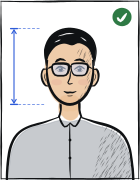
Quick answer: A Canada visa photo must be 35 × 45 mm. White or light uniform background. Head occupies 69–80% of photo height (31–36 mm chin to crown). Neutral expression, clear lenses only, no glare. Last verified .
Canada visa photo: size in mm, cm, inches and pixels
Millimetres
35 × 45 mm
Centimetres
3.5 × 4.5 cm
Inches
1.38 × 1.77″
Pixels at 300 dpi
413 × 531 px
Pixels at 600 dpi
827 × 1063 px
Canada-specific things to know
The frame size is a minimum: at least 35 × 45 mm. Black and white is allowed next to colour, and the background may be white or any light colour.
Glasses are allowed if they are non-tinted prescription glasses with the eyes clearly visible and no part of the eyes covered by the frame; sunglasses are not.
A hairpiece or other cosmetic accessory is accepted as long as it does not disguise your normal appearance.
Photos that do not meet the specification delay the file: IRCC makes you provide new ones before the application can be processed.
How visa photos are verified
Canadian visa photographs are set by Immigration, Refugees and Citizenship Canada (IRCC). For a temporary resident visa (visitor visa) it asks for two identical photographs taken within the last six months, in colour or black and white, clear and well defined, on a plain white or light-coloured background, printed on quality photographic paper.
Read more
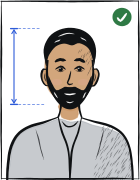
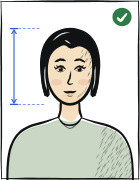
The frame is at least 35 × 45 mm, with a full front view of the head in the middle and the top of the shoulders, and the head from chin to crown between 31 and 36 mm. The face is square to the camera, with a neutral expression — neither frowning nor smiling — and the mouth closed.
Non-tinted prescription glasses are fine if the eyes are clearly visible and the frame covers no part of them; sunglasses are not. Digital photos must not be altered in any way.
If the photos do not meet the specification, IRCC makes you provide new ones before the application can be processed.
Examples and mistakes
What makes Canada visa photos accepted
One compliant example next to the six most common rejection causes for Canada visa applications. These are the differences that most often determine whether a document photo is accepted.
Accepted
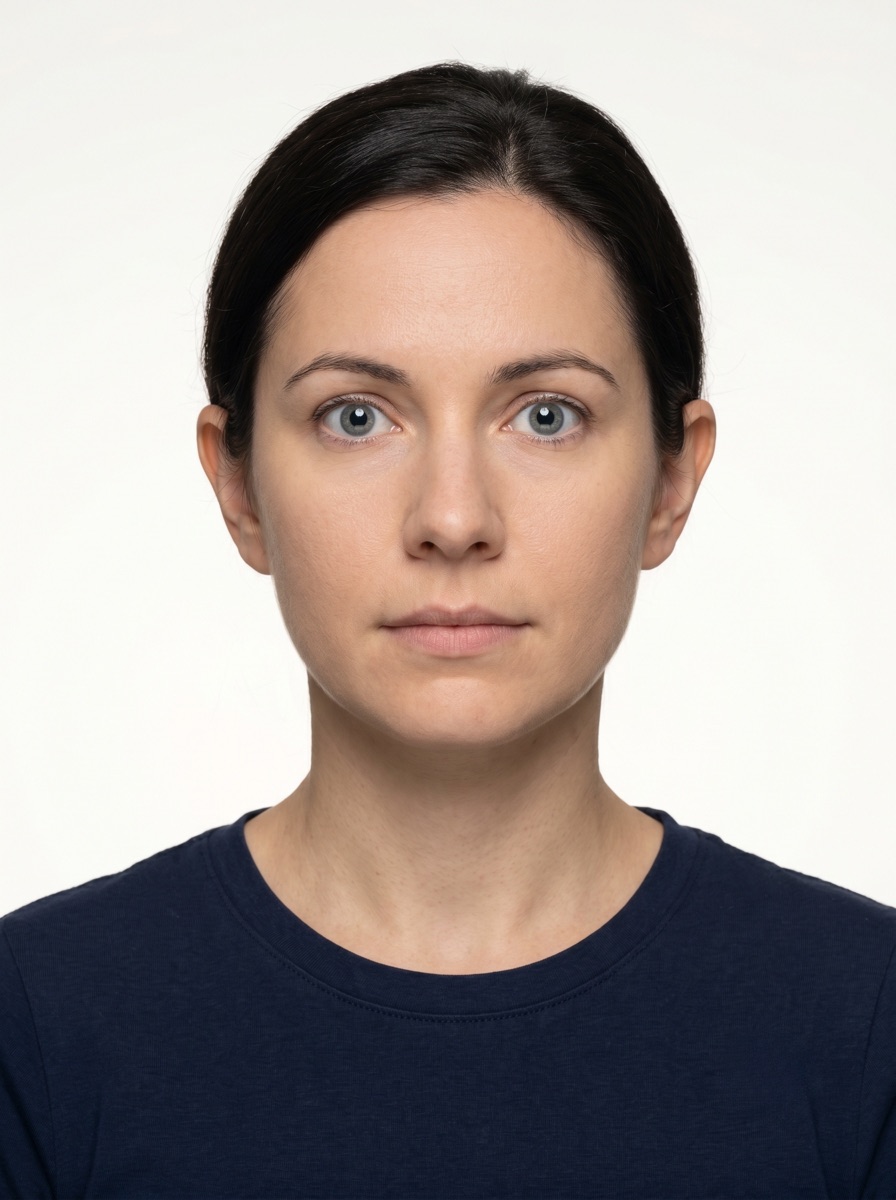
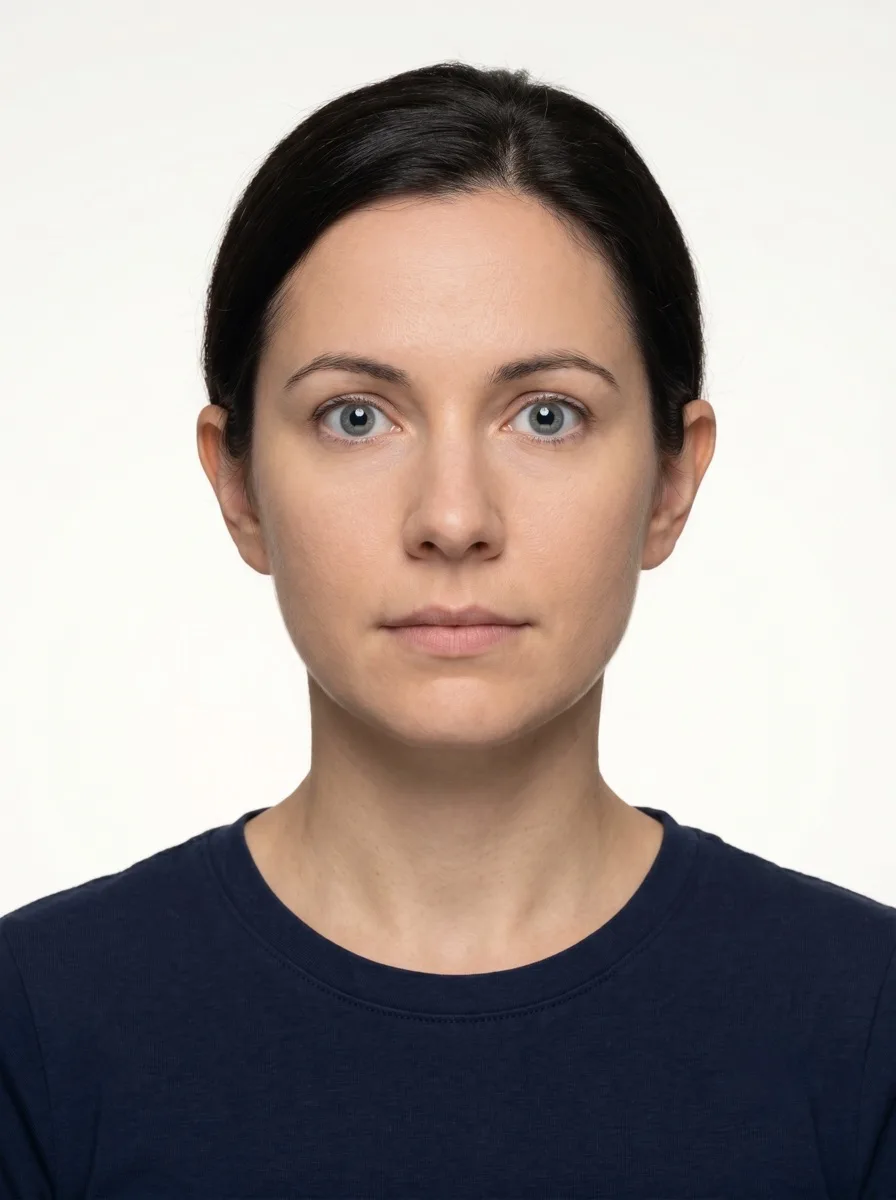
Compliant Canada visa example (35 × 45 mm)
Face centred, looking directly into the lens
Plain background — no shadow, pattern or texture
Neutral expression, eyes open, mouth closed
No glasses, no hair across the face
Top 6 Canada visa rejection causes
Background shadowShadow on the wall behind the head, or background with a visible pattern or gradient
Smile / open mouthVisible smile with teeth or open mouth instead of a neutral expression
Glasses with glareGlasses with a clearly visible light reflection covering part of the eye
Hair across the faceLoose hair strands covering the eyes, eyebrows or part of the face
Eyes off-cameraEyes looking to the side instead of directly into the camera lens
Head tiltedHead tilted so the eye line is no longer horizontal
Typical rejection reasons and how to fix them
Typical reasons a photo is rejected under the rules Government of Canada / IRCC publishes: what is wrong and what to change.
Reason
Fix
Frame smaller than 35 × 45 mm, or head outside 31–36 mm from chin to crown
Use a frame of at least 35 × 45 mm with the full head and the top of the shoulders, and size the head from chin to crown between 31 and 36 mm.
Sunglasses, tinted lenses, or a frame covering part of the eyes
Wear non-tinted prescription glasses whose frame stays clear of the eyes, or take your glasses off.
Smile, frown or open mouth; face not square to the camera
Keep a neutral face — neither smiling nor frowning — with the mouth closed, and square the face to the camera.
Background not plain white or light-coloured, or the photo not clear and well defined
Shoot in front of a plain white or light-coloured wall and make sure the picture is sharp and well defined before you print it.
Digital photo that has been altered, or a photo older than six months
Submit the original digital file without any edit and use a photo taken within the last six months; the two prints must be identical.
The tool puts in the required background. Stand half a metre from a plain light wall, face a window and shoot without flash — then there are no shadows on your face or on the wall.
Framing
Head: 69–80 % of the photo height (31–36 mm)
Camera at eye level, about a metre away; head and shoulders in the shot. The tool crops it to 35 × 45 mm.
Glasses
Clear lenses only, no glare
If you wear glasses, check the shot: no glare on the lenses, eyes clearly visible.
Expression and gaze
Neutral expression, mouth closed, eyes open
Look straight into the lens with your head level; keep hair away from your eyes and eyebrows.
Print at 100% scale, borderless, and turn off fit-to-page so each photo keeps its exact size.
Where to submit your visa application
A Canadian visitor visa is applied for with IRCC, mostly online; on paper applications the two printed photographs go with the file. IRCC says photos that do not meet the specification must be replaced before the application is processed.
IRCC online applicationonline
canada.ca — apply for a visitor visa
Processing
Varies by country; IRCC publishes processing times
Cost
Fees set by IRCC for the visa and biometrics
Digital photos must not be altered. As an example of an IRCC digital specification, the International Experience Canada page gives a frame of at least 35 × 45 mm, at least 420 × 540 pixels, JPEG or JPEG2000, ideally 240 kB.
Paper application with printed photographsmail / in-person
As instructed in the IRCC application package for your country
Processing
Varies by country
Cost
Fees set by IRCC
Two identical photographs on quality photographic paper, taken within the last six months, frame at least 35 × 45 mm, head 31–36 mm, white or light-coloured background.
IRCC, Temporary Resident Visa: two photographs, identical and taken within the last six months; colour or black and white; clear, well defined, on a plain white or light-coloured background; printed on quality photographic paper.
Frame at least 35 × 45 mm; full front view of the head with the face in the middle, including the top of the shoulders; head from chin to crown between 31 mm and 36 mm (crown = top of the head, or where it would be under hair or a head covering).
Face square to the camera, neutral expression — neither frowning nor smiling — mouth closed. Non-tinted prescription glasses are allowed if the eyes are clearly visible and the frame covers no part of the eyes; sunglasses are not acceptable. A hairpiece or cosmetic accessory is fine if it does not disguise the normal appearance; a religious head covering must leave the facial features unobscured.
If the photographs are digital they must not be altered in any way; if they do not meet the specification, new photographs must be provided before the application can be processed.
IRCC digital photo specification (International Experience Canada work-permit page): frame at least 35 × 45 mm, at least 420 × 540 pixels, JPEG or JPEG2000, ideally 240 kB and not less than 60 kB, colour (24 bits per pixel, RGB); a scan of an existing photo at least 600 pixels per inch.
Questions
Frequently asked questions
Two identical photographs taken within the last six months, in colour or black and white, clear and well defined, on a plain white or light-coloured background, printed on quality photographic paper. A frame of at least 35 × 45 mm showing the full head and the top of the shoulders, with the head from chin to crown between 31 and 36 mm. Face square to the camera, neutral expression, mouth closed. Non-tinted prescription glasses are allowed; sunglasses are not.
IRCC gives the frame size as at least 35 mm × 45 mm (1⅜ × 1¾ inches), so 35 × 45 mm is the standard choice and a larger frame is not ruled out. The head, from chin to crown, must measure 31–36 mm. Do not confuse it with the Canadian passport photo, which is 50 × 70 mm.
Yes, non-tinted prescription glasses are allowed as long as your eyes are clearly visible and the frame does not cover any part of your eyes. Sunglasses are not acceptable. If in doubt, take the glasses off.
Yes — IRCC accepts either black and white or colour. For the application you provide two photographs of yourself, identical, printed on quality photographic paper and taken within the last six months. If you provide digital photos, they must not be altered in any way.
IRCC states that you will have to provide new photographs before your application can be processed, so the file waits until you send compliant ones. Check the frame size (at least 35 × 45 mm), the head height (31–36 mm), the background, the expression and the glasses before you submit.
The Canada visa photo must be 35 × 45 mm. The head must occupy 69–80% of the photo height. Many consulates also require a specific digital file size — see the spec table above for full details.
White or light uniform background. The background must be evenly lit with no shadow gradients, especially around the head. Consular automated pre-screening rejects photos with any wall texture before the human reviewer ever sees the application.
Visa authorities typically require the photo to be taken within the last three to six months. Submitting an older photo, even one that looks similar to your current appearance, is a frequent cause of immediate consular rejection.
Not always. Tourist, work, student and transit visa categories sometimes specify different dimensions or background rules. Follow the requirements for your specific visa type rather than assuming one photo fits all Canada visa applications.
Anfas.Pro provides a 14-day full refund if the photo is the cause of rejection and you supply the consular rejection notice. We recommend keeping the consular receipt with rejection reason as proof.
Eyes must be fully visible; no tinted lenses or strong reflections. Consular automated checks flag glasses glare even when it is invisible to the human eye. Removing glasses entirely is the safest choice unless a medical exception is documented in your visa application.
35 × 45 mm = 3.5 × 4.5 cm = 1.38 × 1.77 inches. At 300 dpi that is 413 × 531 pixels; at 600 dpi, 827 × 1063 pixels.
Religious reasons only; must not cover the facial oval. The face must stay fully visible from chin to forehead and on both sides, with no shadow across it.
Yes. The same 35 × 45 mm format and head size apply to: super visa.