SourceService-Public.fr / Ministère de l’Intérieur
Verified
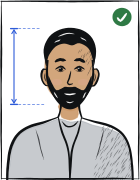
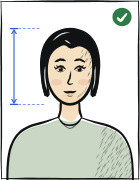
Quick answer: A France passport photo must be 35 × 45 mm. The background must be plain and light — light grey or light blue; a white background is not allowed. Head occupies 71–80% of photo height (32–36 mm chin to crown). Neutral expression, clear lenses only, no glare. Last verified .
France passport photo: size in mm, cm, inches and pixels
Millimetres
35 × 45 mm
Centimetres
3.5 × 4.5 cm
Inches
1.38 × 1.77″
Pixels at 300 dpi
413 × 531 px
Pixels at 600 dpi
827 × 1063 px
France-specific things to know
A white background is forbidden in France; the background must be plain and light, such as light blue or light grey.
Only one photo is required for a passport or an ID card, not two or four.
The photo must be taken by an authorised professional or in a booth using a system approved by the Ministry of the Interior; the ANTS site has a search tool for photographers and booths near you. French consulates repeat this rule and add that the photo must still look like you on the day you collect the document.
Glasses are not compulsory in the photo, and when worn they must have a thin frame, clear lenses and no reflection; earrings and piercings are allowed if the features remain clear.
How passport photos are verified
French passport photographs follow the rules published by Service-Public for the Ministry of the Interior (verified 11 March 2026). One photo is enough, taken less than six months ago and resembling you, by an authorised professional or in a booth using a system approved by the Ministry of the Interior.
Read more
It is 3.5 cm wide and 4.5 cm high, with the face 3.2–3.6 cm from chin to crown excluding hair (70–80 % of the photo), sharp, not folded, correctly exposed and without shadows on the face or the background. The background must be plain and light — light blue or light grey for example — and a white background is forbidden.
The head is bare and straight, facing the lens, with a neutral expression and the mouth closed, eyes open and perfectly visible, hair and fringe off the eyes, ears clear. A photo that does not meet the characteristics is rejected and the identity document is not issued.
Examples and mistakes
What makes France passport photos accepted
A photo that will be accepted, next to the six most common reasons France passport photos get rejected.
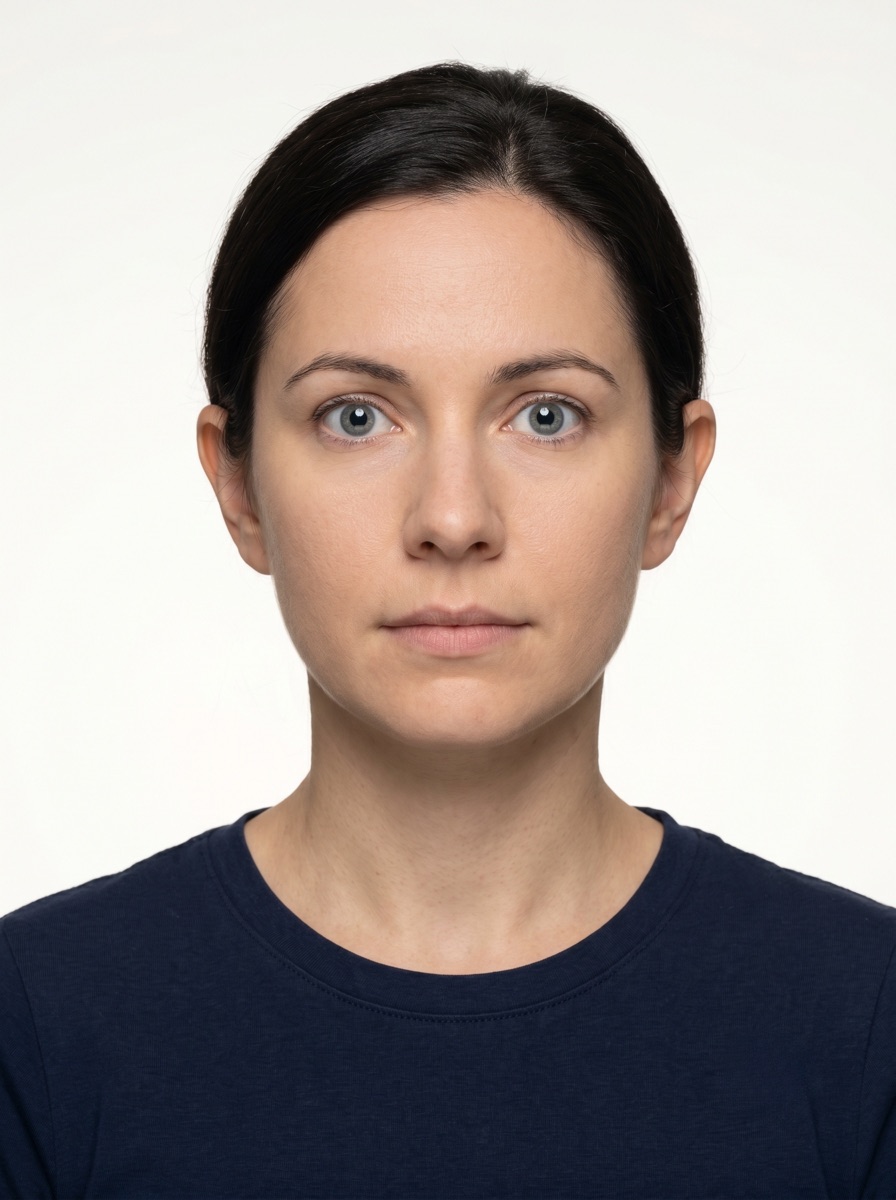
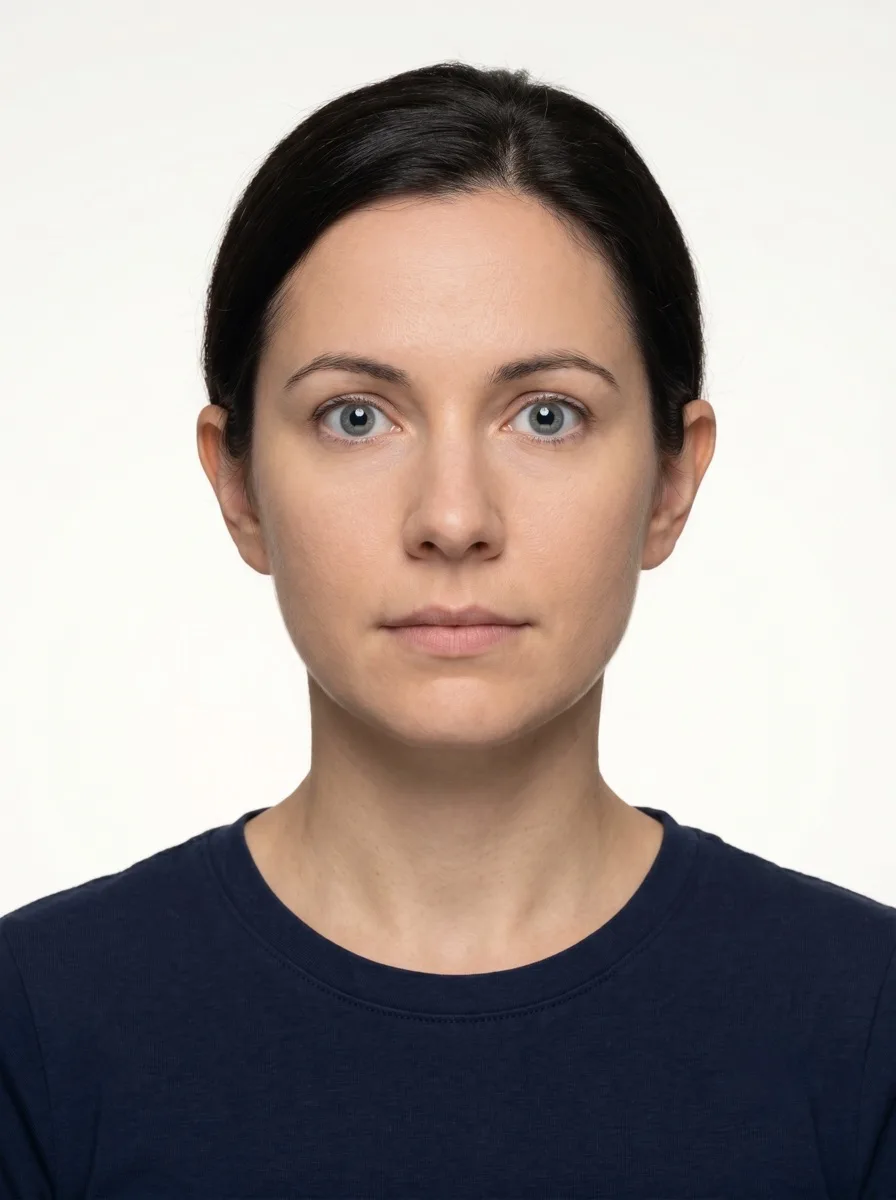
Accepted
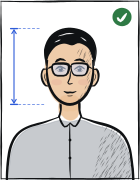
Compliant France passport example (35 × 45 mm)
Face centred, looking directly into the lens
Plain background — no shadow, pattern or texture
Neutral expression, eyes open, mouth closed
No glasses, no hair across the face
Top 6 France passport rejection causes
Background shadowShadow on the wall behind the head, or background with a visible pattern or gradient
Smile / open mouthVisible smile with teeth or open mouth instead of a neutral expression
Glasses with glareGlasses with a clearly visible light reflection covering part of the eye
Hair across the faceLoose hair strands covering the eyes, eyebrows or part of the face
Eyes off-cameraEyes looking to the side instead of directly into the camera lens
Head tiltedHead tilted so the eye line is no longer horizontal
Typical rejection reasons and how to fix them
Typical reasons a photo is rejected under the rules Service-Public.fr / Ministère de l’Intérieur publishes: what is wrong and what to change.
Reason
Fix
White background (forbidden), or a background that is not plain and light
Use a plain light-blue or light-grey background with no shadow behind you; do not use white.
Format not 3.5 × 4.5 cm, or face outside 3.2–3.6 cm from chin to crown
Have the photo cut at 3.5 × 4.5 cm with the face between 3.2 and 3.6 cm, measured without hair.
Hat, scarf or headband; hair covering the face or the eyes; ears hidden
Take off hats and scarves, push hair back so the face and the ears are clear, and keep a fringe above the eyes.
Thick frames, tinted or coloured lenses, or reflections on the glasses
Take the glasses off — they are not compulsory — or wear a thin frame with clear lenses that do not reflect.
Expression not neutral, mouth open, gaze not on the lens, or head not straight
Fix the lens, keep the mouth closed with a neutral face, and hold the head straight and facing the camera.
Blurred, folded or marked print; over- or under-exposed photo; shadows on the face or background; photo older than six months
Get a fresh, sharp print taken within the last six months, evenly exposed, flat and unmarked, without shadows on the face or behind it.
The tool puts in the required background. Stand half a metre from a plain light wall, face a window and shoot without flash — then there are no shadows on your face or on the wall.
Framing
Head: 71–80 % of the photo height (32–36 mm)
Camera at eye level, about a metre away; head and shoulders in the shot. The tool crops it to 35 × 45 mm.
Glasses
Clear lenses only, no glare
If you wear glasses, check the shot: no glare on the lenses, eyes clearly visible.
Expression and gaze
Neutral expression, mouth closed, eyes open
Look straight into the lens with your head level; keep hair away from your eyes and eyebrows.
Print at 100% scale, borderless, and turn off fit-to-page so each photo keeps its exact size.
Where to submit your passport application
In France a passport is applied for in a town hall (mairie) equipped with a biometric station, by appointment; an online pre-application is optional. Abroad it goes through a French consulate. In both cases one photo meeting the standard is handed in.
Mairie with a biometric station (France)in-person (by appointment)
Find an appointment with the search tool of the ANTS (France Titres); online pre-application is optional
Processing
Shown when you book
Cost
€86 in tax stamps bought online (general case, per Service-Public)
One photo under six months old, taken by an authorised professional or in an approved booth, plus proof of address and your previous documents; the pre-application number or QR code if you made one.
The consulate that covers your residence — its page repeats the photo standard
Processing
Set by each consulate
Cost
Consular fee published by the consulate
The consulate of Abidjan states the same rules: a recent photo that resembles you on the day of filing and of collection, taken by a professional or in a booth with a system approved by the Ministry of the Interior; non-compliant photos are rejected.
Service-Public: a photo taken less than 6 months ago and resembling you; only one photo for a passport or ID card application; taken by an authorised professional or in a booth using a system approved by the Ministry of the Interior.
Format and quality: width 3.5 cm, height 4.5 cm; face 3.2–3.6 cm (70–80 % of the photo) from chin to crown excluding hair; sharp, with no folds or marks; neither over- nor under-exposed, well contrasted, no cast shadow on the face or the background; colour strongly recommended.
Background: plain and light-coloured, for example light blue or light grey; the white background is forbidden.
Head, gaze and face: bare head (no hat, scarf or headband), straight, facing the lens; neutral expression, mouth closed, eyes open and perfectly visible; earrings and piercings allowed if the features stay clear; hair must not cover the face, a fringe is accepted if it does not cover the eyes, ears clear.
Glasses are optional; if worn, the frame must not be thick or mask the eyes, and the lenses must be neither tinted nor coloured and show no reflection. If the photo does not meet the characteristics it is rejected and the identity document is not issued.
Questions
Frequently asked questions
One photo less than six months old that looks like you, 3.5 cm wide and 4.5 cm high, with the face 3.2–3.6 cm from chin to crown (70–80 %), sharp and unmarked. A plain light background — light blue or light grey — and not white. Head bare and straight facing the lens, neutral expression, mouth closed, eyes open, hair and ears clear. It must be taken by an authorised professional or in an approved booth. A photo that does not comply is rejected and the document is not issued.
No. Service-Public states that the background must be plain and light-coloured, light blue or light grey for example, and that the white background is forbidden. This is the opposite of many other countries, so a photo made for another document with a white background has to be redone.
The rule on Service-Public is that the photo must be taken by an authorised professional or in a booth using a system approved by the Ministry of the Interior; the ANTS site has a search tool to find photographers and booths near you. French consulates abroad repeat the same wording.
You do not have to wear them. If you do, the frame must not be thick or mask your eyes, and the lenses must be neither tinted nor coloured and must show no reflection. The eyes must be open and perfectly visible; taking the glasses off is the simplest way to meet the rule.
One photo — Service-Public says only one photo is required for a passport or ID card application. In the general case Service-Public lists the passport at €86, paid as a tax stamp bought online, and the appointment is made in an equipped town hall through the ANTS search tool; an online pre-application is optional. Abroad, the consulate sets the procedure and fee.
The France passport photo must be 35 × 45 mm. The head must occupy 71–80% of the photo height.
Most passport offices ask for a photo taken within the last six months. It should look like you today: after a new haircut or beard, take a new one.
We refund the payment in full. Email us within 14 days of purchase with your order number and the rejection notice from the France authority — the refund policy page has the details.
35 × 45 mm = 3.5 × 4.5 cm = 1.38 × 1.77 inches. At 300 dpi that is 413 × 531 pixels; at 600 dpi, 827 × 1063 pixels.
Yes. The same 35 × 45 mm format and head size apply to: ID card.