SourceUK Visas and Immigration (Home Office), GOV.UK
Verified
Quick answer: The recommended UK visa photo size is 35 × 45 mm. Plain neutral background in a light grey or cream shade with clear contrast against the face. Head occupies 64–76% of photo height (29–34 mm chin to crown). Neutral expression, clear lenses only, no glare. Last verified .
The UK asks for a different photo from your passport one: it must not be the same photo as in your passport or identity card, and it is a digital portrait of head, shoulders and upper body — not a passport-style close crop.
The background is «plain light-coloured», not strictly white, but it has to be in clear contrast with you; glasses are the exception, not the rule — do not wear them unless you have to.
A photo of a screen or print is refused — it must not be a scan or photo of another photo of you — and filters or edits are not allowed.
How visa photos are verified
A UK visa photograph is digital, set out by UK Visas and Immigration on GOV.UK: a photo of your face, in colour, clear and in focus, taken in a well-lit room and not altered by software or a filter, as a JPG or JPEG file at least 600 pixels wide and 750 pixels tall, between 50 KB and 6 MB, vertically orientated and not mirrored or flipped. It shows your head, shoulders and upper body against a plain light-coloured background in clear contrast, with no other objects or people and no red eye.
Read more
You face the camera and look straight at it with a plain expression and the mouth closed, eyes open and visible, no hair in front of the eyes, no shadows on the face or behind you, no head covering unless for religious or medical reasons, and your shoulders and torso clothed. Do not wear glasses unless you have to; if you must, they cannot be sunglasses or tinted, and the frames, glare, reflection or shadow must not cover the eyes. The photo can come from a phone or tablet, but it must not be a scan or photo of another photo and not the same photo as in your passport or identity card; the guidance advises having another person take it.
Children under 6 need not look at the camera or have a plain expression, and children under one need not have open eyes.
Examples and mistakes
What makes UK visa photos accepted
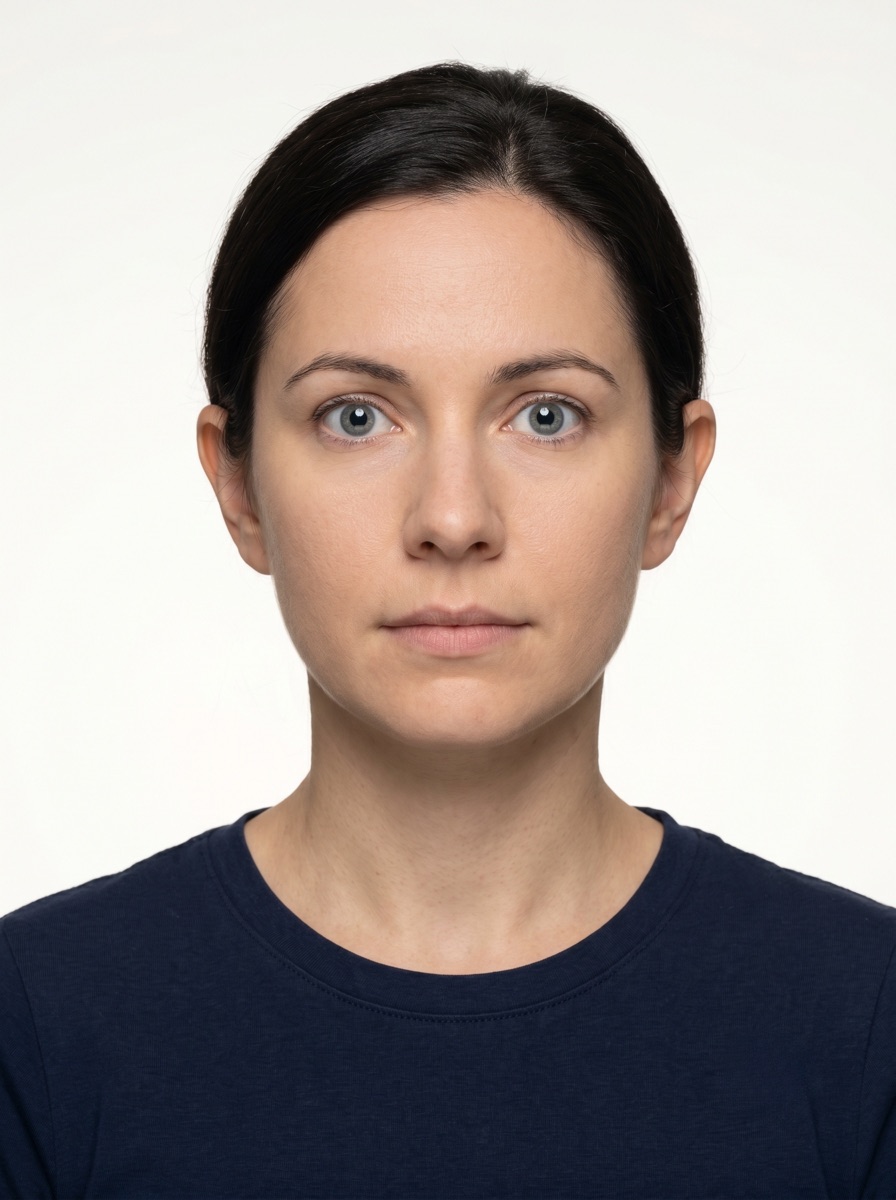
A photo that will be accepted, next to the six most common reasons UK visa photos get rejected.
Accepted
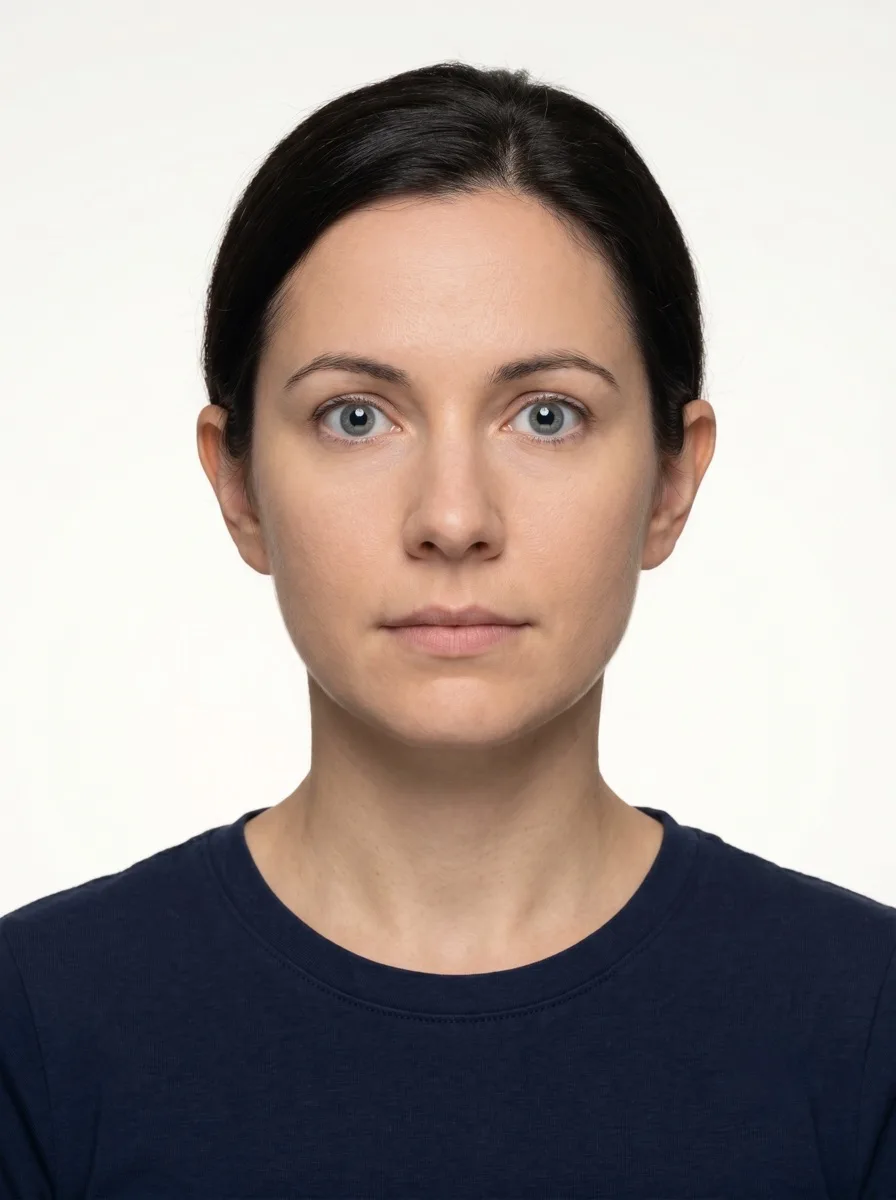
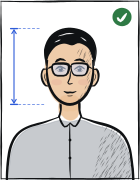
Compliant UK visa example (35 × 45 mm)
Face centred, looking directly into the lens
Plain background — no shadow, pattern or texture
Neutral expression, eyes open, mouth closed
No glasses, no hair across the face
Top 6 UK visa rejection causes
Background shadowShadow on the wall behind the head, or background with a visible pattern or gradient
Smile / open mouthVisible smile with teeth or open mouth instead of a neutral expression
Glasses with glareGlasses with a clearly visible light reflection covering part of the eye
Hair across the faceLoose hair strands covering the eyes, eyebrows or part of the face
Eyes off-cameraEyes looking to the side instead of directly into the camera lens
Head tiltedHead tilted so the eye line is no longer horizontal
Typical rejection reasons and how to fix them
Typical reasons a photo is rejected under the rules UK Visas and Immigration (Home Office), GOV.UK publishes: what is wrong and what to change.
Reason
Fix
A file smaller than 600 × 750 pixels, under 50 KB or over 6 MB, or not a JPG
Use a vertical JPG of at least 600 × 750 pixels, between 50 KB and 6 MB.
A background that is not plain and light-coloured, shadows on the face or behind you, red eye
Stand in a well-lit room in front of a plain light wall, with no shadows.
Glasses with glare or reflection, sunglasses or tinted lenses, frames over the eyes
Take the glasses off unless you must wear them; then keep the eyes clear.
A photo of a photo, a scan, or the same picture as in your passport
Take a new photo of your face, not of a document or print.
A filter or edit, a smile or open mouth, closed eyes, hair in front of the eyes
Use an unaltered photo with a plain expression, mouth closed and eyes open.
The tool puts in the required background. Stand half a metre from a plain light wall, face a window and shoot without flash — then there are no shadows on your face or on the wall.
Framing
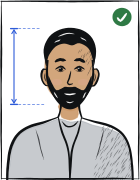
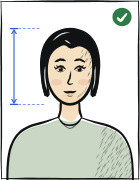
Head: 64–76 % of the photo height (29–34 mm)
Camera at eye level, about a metre away; head and shoulders in the shot. The tool crops it to 35 × 45 mm.
Glasses
Clear lenses only, no glare
If you wear glasses, check the shot: no glare on the lenses, eyes clearly visible.
Expression and gaze
Neutral expression, mouth closed, eyes open
Look straight into the lens with your head level; keep hair away from your eyes and eyebrows.
Print at 100% scale, borderless, and turn off fit-to-page so each photo keeps its exact size.
Where to submit your visa application
A UK visa is applied for online on GOV.UK; the digital photograph is uploaded in the application, or taken at the appointment at the visa application centre that takes your biometrics.
UK visa application online (GOV.UK)online application, then biometrics at a visa application centre
gov.uk — apply for the visa that fits your plan
Processing
Set by the visa type
Cost
Set by the visa type
Digital colour JPG, at least 600 × 750 pixels, 50 KB to 6 MB, plain light background.
GOV.UK, quality and format: the photo must be clear and in focus, in colour and taken in a well-lit room; it must not be altered by computer software or other means (for example by adding a filter); at least 600 pixels wide and 750 pixels tall; at least 50 KB and no more than 6 MB; a jpg or jpeg file; vertically orientated; not mirrored or flipped.
GOV.UK, what the photo must show: no other objects or people; a plain light-coloured background in clear contrast; no red eye; head, shoulders and upper body. The photo can be from a phone or tablet. It must not be a scan or photo of another photo of you, nor the same photo as the one in your passport or identity card, nor a photo of your identity document.
GOV.UK, in the photo you must: make your facial features clearly visible; face towards and look straight at the camera; have a plain expression and your mouth closed; have your eyes open and visible; not have hair in front of your eyes; not have shadows on your face or behind you; not have a head covering unless it is for religious or medical reasons; be dressed appropriately with your shoulders and torso clothed. You should try to arrange for another person to take your photo.
GOV.UK, glasses: «Do not wear glasses in your photo unless you have to. If you have to wear glasses they cannot be sunglasses or tinted glasses, and your eyes cannot be covered by the frames or glare, reflection or shadow. Your eyes must be seen clearly.» Babies and children: children on their own in the picture; babies not holding toys or using dummies; children under 6 need not look directly at the camera or have a plain expression; children under one need not have their eyes open, may be supported by a hand that is not visible, and lie on a plain light-coloured sheet photographed from above.
Questions
Frequently asked questions
A digital colour photo of your face, clear, in focus and unaltered, as a vertical JPG of at least 600 × 750 pixels and between 50 KB and 6 MB, showing head, shoulders and upper body against a plain light-coloured background, with a plain expression and the mouth closed, eyes open, no shadows and no glasses unless you have to wear them.
Digital: at least 600 pixels wide and 750 pixels tall, a file of 50 KB to 6 MB, vertically orientated. GOV.UK gives no printed size in millimetres for this route.
No: GOV.UK says the photo must not be the same photo as the one in your passport or identity card, nor a scan or photo of another photo of you.
Not unless you have to. If you do, they cannot be sunglasses or tinted, and the frames, glare, reflection or shadow must not cover your eyes.
The recommended size for the UK visa photo is 35 × 45 mm. The head occupies 64–76% of the photo height. For digital upload, use 600 × 750 px.
Plain neutral background in a light grey or cream shade with clear contrast against the face. The wall should be evenly lit, with no shadow around the head and no pattern. You don’t need a studio backdrop: the tool sets the right background colour.
Consulates usually ask for a photo taken within the last six months, sometimes within three. Take a new one that looks like you today.
Often yes, but not always: tourist, student, work and transit visas can have different size or background rules. Compare the requirements of each UK visa — if they match, one photo will do.
We refund the payment in full. Email us within 14 days of purchase with your order number and the consulate’s rejection notice.
35 × 45 mm = 3.5 × 4.5 cm = 1.38 × 1.77 inches. At 300 dpi that is 413 × 531 pixels; at 600 dpi, 827 × 1063 pixels.
Religious or medical reasons only; must not cover the facial oval. The face must stay fully visible from chin to forehead and on both sides, with no shadow across it.
Yes. The same 35 × 45 mm format and head size apply to: electronic travel authorisation (ETA).