 EU
EU Germany
 Poland
EU Blue Card Reform: Lower Salary Thresholds and Easier Movement Between Countries — What It Means for Ukrainians
The reformed EU Blue Card (Directive 2021/1883, implementation deadline — 18 November 2023) allows a salary threshold of only 1.0–1.6 of the average annual salary, a contract from 6 months and a move to another EU country after just 12 months. In Germany, from 1 January 2026 the threshold is €50,700 (for shortage occupations — €45,934.20).
Key points
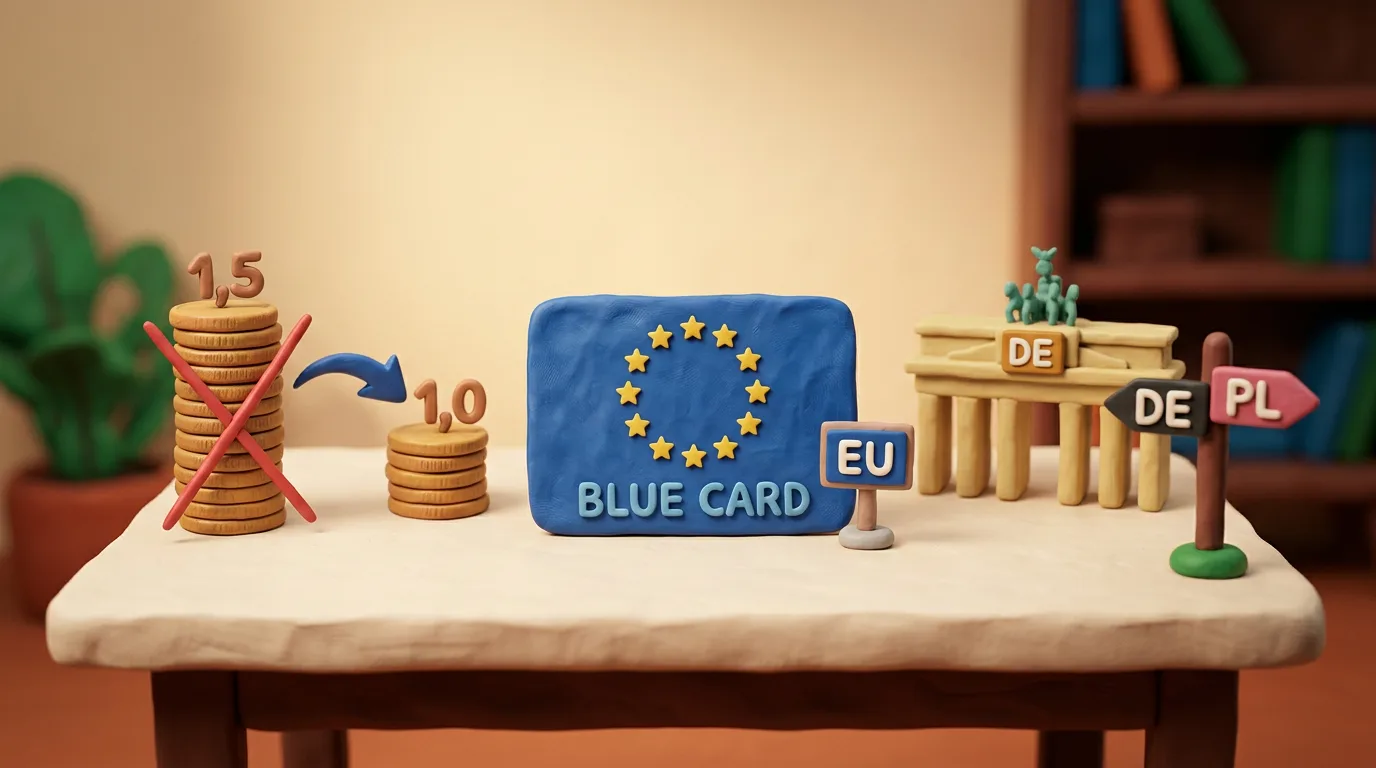
6 points- The salary threshold is now within 1.0–1.6 of the country's average annual gross salary (previously a fixed 1.5), and for shortage occupations and recent graduates (a diploma no older than 3 years) the state may lower it to 80% — this is the minimum bar permitted by the directive.
- The minimum employment contract has been reduced to 6 months; the card is valid for at least 24 months.
- A Blue Card holder may move to work in another EU country after just 12 months under a simplified procedure; in some countries a labor-market test may still apply.
- In the IT field, instead of a diploma, qualification can be confirmed by professional experience (for IT — at least 3 years).
- The directive applies in 25 EU countries; Denmark and Ireland do not participate.
- For Ukrainians under temporary protection, the card provides a legal path to remain in the EU after the status ends, but the two statuses cannot be held at the same time.
The reform of one of the key EU work cards — the Blue Card — has gradually come into force in the member states and makes it much more accessible for qualified specialists, including Ukrainians. The changes are set out in Directive (EU) 2021/1883, which states had to implement into national law by 18 November 2023. Most countries have already done so, so the new rules apply in practice.
What the Blue Card is and whom it concerns
The EU Blue Card is a residence and work permit for highly qualified foreigners from outside the EU. According to the European Commission, the card applies in 25 EU countries; Denmark and Ireland do not participate in the scheme. For Ukrainians this is relevant as a path to legal employment, and for those currently under temporary protection — as a way to remain in the EU on a more stable basis.
The main changes of the reform
- Lower salary threshold. Previously the salary had to be at least 1.5 of the country's average annual gross salary. Now states may set the threshold in the range of 1.0 to 1.6 of the average salary. For shortage occupations and recent graduates (a diploma obtained no more than 3 years ago) the threshold may be lowered to 80% — this is the minimum bar permitted by the directive.
- Shorter contract. The minimum duration of an employment contract or a binding job offer has been reduced to 6 months.
- Longer validity of the card. The Blue Card is issued for at least 24 months (or for the term of the contract plus 3 months, if the contract is shorter).
- Easier movement between EU countries. After 12 months of legal residence in the first country, the card holder may move to work in another EU country under a simplified procedure. However, the second country may, under certain conditions, still apply a labor-market test (Article 21 of the directive), so the conditions should be clarified in the chosen country.
- Experience instead of a diploma in IT. In the field of information and communication technologies, qualification can be confirmed by professional experience (for IT — at least 3 years), not only by higher education.
- Faster family reunification. Family members can join the card holder and have the right to work in the EU.
A specific example: Germany 2026
Germany is the largest issuer of the Blue Card. From 1 January 2026, the following minimum annual salaries apply in Germany:
- Standard Blue Card — €50,700 per year;
- Shortage occupations (IT, engineering, natural sciences, medicine) — €45,934.20 per year.
The reduced German threshold (€45,934.20) is about 90.6% of the standard one (€50,700), not 80%: the 80% mark is the pan-European minimum under the directive, which each country sets at its own discretion. Bottom line: national thresholds now differ noticeably, and for shortage specialties the bar is lower.
Why this matters specifically for Ukrainians under temporary protection
Temporary protection for Ukrainians in the EU has been extended until 4 March 2027. In September 2025, the Council of the EU adopted a recommendation on the transition from temporary protection to other legal statuses — among them the Blue Card and other EU legal-migration instruments are explicitly named.
An important nuance: temporary protection and a permit under EU law (in particular the Blue Card) cannot be held at the same time — this is a general principle of EU law, confirmed by the Council's recommendation. That is, switching to the card means giving up temporary protection, so the decision should be weighed and the conditions clarified with the migration service of the specific country.
What to do now
- Check whether your profession is among the shortage ones in the country where you plan to work — there the salary threshold is lower.
- If you are an IT specialist without a relevant diploma — gather evidence of professional experience (at least 3 years).
- Clarify the current salary threshold in the chosen country specifically: it now varies (from 1.0 to 1.6 of the average salary).
- If you are under temporary protection — find out in advance from the migration service how the transition to the Blue Card works and what the consequences are for your status.
The reform does not guarantee automatic receipt of the card, but it makes it a more realistic option for Ukrainian specialists than before 2023.
06Questions
5 answers01What is the minimum salary threshold for the EU Blue Card after the reform?
The salary must be from 1.0 to 1.6 of the average annual gross salary in the country of employment (previously a fixed 1.5). For shortage occupations and recent graduates, the threshold may be lowered to 80% (this is the minimum under the directive). The specific amount depends on the country: for example, in Germany from 1 January 2026 it is €50,700 per year, and for shortage occupations — €45,934.20.
02Can I move with a Blue Card to another EU country?
Yes. After 12 months of legal residence in the first country that issued the card, you can move to work in another EU country under a simplified procedure. This is easier than a new application, but the second country may, under certain conditions, still apply a labor-market test (Article 21 of the directive), so the conditions should be clarified in advance. Denmark and Ireland do not participate in the Blue Card scheme.
03Can a Blue Card be obtained without higher education?
In the field of information and communication technologies (IT), the reform allows qualification to be confirmed by relevant professional experience (for IT — at least 3 years) instead of a higher-education diploma. For other fields, higher education or a recognized qualification is usually required.
04I am under temporary protection. Can I switch to a Blue Card?
Yes, the Council of the EU's recommendation of September 2025 explicitly provides for the Blue Card as one of the paths for transition from temporary protection. But temporary protection and a status under EU law cannot be held at the same time, so the transition means giving up temporary protection. The conditions should be clarified with the migration service of the specific country.
05When did the new Blue Card rules come into force?
The deadline for implementing Directive (EU) 2021/1883 into national law was 18 November 2023. Most countries have already introduced the changes; some (for example, Poland — from 1 June 2025) did so with a delay. The specific salary thresholds are updated annually — for example, in Germany the new amounts apply from 1 January 2026.
07Official sources
- European Commission — EU Blue Card: Attracting Highly Qualified Talent to the EU
home-affairs.ec.europa.eu - EUR-Lex — EU Blue Card: entry and residence of highly qualified workers (from 2023)
eur-lex.europa.eu - Council of the EU (Consilium) — Council adopts recommendation about transition out of temporary protection (16 Sep 2025)
consilium.europa.eu - Tafapolsky & Smith LLP — Germany: Updated EU Blue Card Salary Thresholds Effective 1 January 2026
tandslaw.com - Permits Foundation — Status of Transposition of Revised EU Blue Card Directive
permitsfoundation.com
Author: Yevhen Kravchenko. Published . Checked against official sources on .
EU Ukraine
EU Temporary Protection: New Exit-Stamp Requirement for Men of Military Age
Alongside extending temporary protection to March 2028, EU countries agreed on a new condition: men of military age applying for the first time must prove they left Ukraine legally.
 EUPoland
 Hungary+2
Old residence cards and ID cards in the EU expire on August 3, 2026
In accordance with EU Regulation 2019/1157, from August 3, 2026, all old formats of residence permits for family members of EU citizens and national ID cards that do not contain biometric data will become invalid. This applies to documents issued in Poland, Denmark, Hungary, Greece, and other EU countries. Holders of such documents must contact migration authorities in advance to replace them with new biometric cards. In addition, in Poland, the application procedure changes from April 27, 2026 — it becomes fully electronic via the MOS 2.0 portal.
 EU
EUEU 'Travel to Europe' App: Passport Scan and Selfie Guide for EES
A comprehensive guide on how to use the new Frontex 'Travel to Europe' mobile app for the EU Entry/Exit System (EES). Learn the step-by-step process for scanning your biometric passport's NFC chip, the strict requirements for taking a compliant facial recognition selfie, and how to avoid common errors before your Schengen border crossing.

Make your photo to the current rules
Pick your document and upload a selfie — we crop it to size, replace the background and check it. Free. The sizes come from the same official sources as the news.