 Poland
 Czech Republic
 Germany
 Hungary
Enrolling Ukrainian children in school in the EU in 2026: documents, deadlines, language support
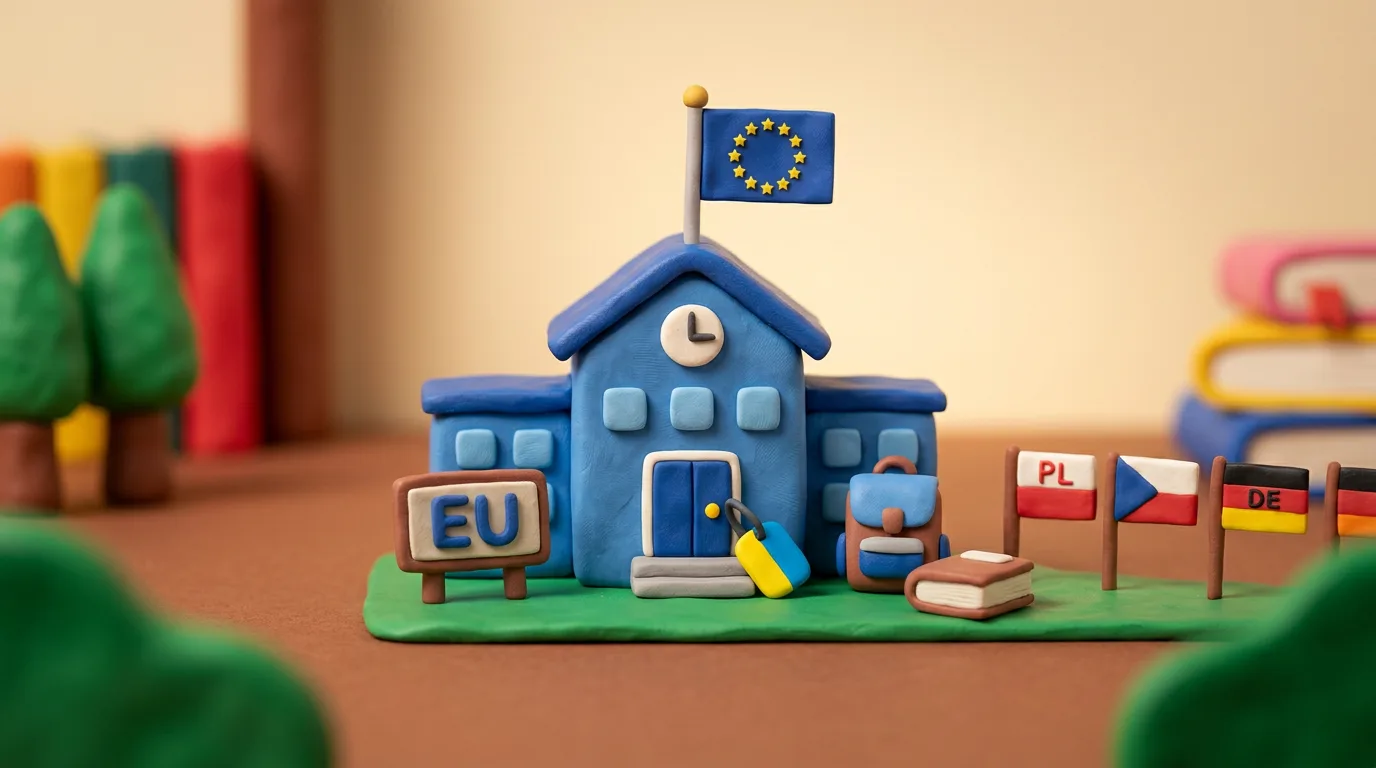
In the EU, children with temporary protection have the right to school on equal terms with citizens (Directive 2001/55/EC, protection extended to 4 March 2027). In Poland and Czechia schooling is compulsory; in Poland the 800+ and 300 zł benefits are tied to in-person attendance at a Polish school. Prepare a passport/birth certificate, temporary protection card, vaccinations and previous school reports. The remote "Ukrainian component" is registered at ukrainian.studies.mon.gov.ua.
Key points
6 points- The right to school on equal terms with the country's citizens is guaranteed by EU Directive 2001/55/EC; temporary protection has been extended to 4 March 2027 (EU Council political agreement 13 June 2025, formal Council decision — 15 July 2025).
- In Poland, from 1 September 2024 attending a Polish school is compulsory; from 1 June 2025 the 800+ and Good Start (300 zł) benefits depend on the child's in-person attendance at a Polish school/kindergarten, and from 2026 they are additionally tied to the official employment of one parent in Poland — check the current conditions with ZUS.
- In Czechia, from 1 September 2025 the updated School Act applies: enrolment in the standard April deadlines, free Czech language preparation of up to 400 hours / 20 months, a ban on separate classes for Ukrainians only.
- In Germany education is compulsory (Schulpflicht), but rules differ by federal state (Bundesland); integration is through Willkommensklassen.
- In Hungary kindergarten is from age 3, school from age 6; the school year starts on 1 September, free meals for 6 months, free textbooks, a minimum of 5 hours of support per week.
- The basic set of documents is similar everywhere: a passport or birth certificate, temporary protection card, vaccinations, previous school reports/certificates from Ukraine.
Who has the right to school. Children with temporary protection have the right to education on equal terms with citizens of the host country — this is guaranteed by EU Directive 2001/55/EC (Art. 14: children under 18 study under the same conditions as locals). On 13 June 2025 the EU Council reached political agreement to extend temporary protection for Ukrainians until 4 March 2027, and the Council adopted the formal decision on 15 July 2025 — so access to education is preserved. As of 30 September 2025, 4.3 million people held the status, of whom almost a third (31.0%) were children.
What to prepare: the basic set of documents
The list differs by country and specific school, but almost everywhere they ask for:
- a passport or birth certificate of the child;
- a card or confirmation of temporary protection;
- a document of one of the parents and proof of address of residence;
- details of medical insurance and information about vaccinations;
- previous school reports / certificates from the Ukrainian school (to determine the class).
If there are no school documents from Ukraine, the school usually enrols the child by age and assigns an interview or tests.
Poland
From 1 September 2024, attending a Polish school is compulsory for children from Ukraine on equal terms with Polish pupils (obowiązek szkolny). Key rule: from 1 June 2025 the 800+ and Good Start (300 zł) benefits depend on fulfilling the obligation to study — the child must attend a Polish school, kindergarten or official home schooling in person; an exception is made for pupils in the final year of a Ukrainian school, who may complete their studies remotely. Separately, under the "special law" (specustawa) leaving Poland for more than 30 days terminates the UKR status, and with it the right to these benefits.
Changes in 2026: after the phased repeal of the "special law" (from 5 March 2026), the right to 800+ for Ukrainians is additionally tied to the official employment of one parent and payment of social contributions in Poland, and checks on fulfilment of the school obligation began in February 2026. Check the exact conditions and exceptions with ZUS — they may change.
- Language support: at least 4 hours of Polish per week, free of charge, for up to 36 months; a preparatory unit (oddział przygotowawczy) is available for newcomers.
- Good Start: the application is submitted from 1 July to 30 November via Emp@tia, a bank or ZUS PUE; submitting in July–August guarantees payment by 30 September.
Czechia
Education is compulsory from age 6 and lasts 9 years. From 1 September 2025 the updated School Act applies, which changes the rules for foreign children:
- Ukrainian children are enrolled in the standard April deadlines, like Czech children;
- free Czech language preparation is expanded to 400 hours / 20 months (the entitlement — up to 24 months for school-age children);
- creating separate classes for Ukrainian children only is prohibited — the course is towards integration into ordinary classes;
- when entering secondary schools, Ukrainians with temporary protection have a number of concessions: the Czech exam can be replaced by an interview, mathematics — taken in Ukrainian on request; and if the test is conducted in Czech only, the child gets +25% time and a translation dictionary.
Germany
Schulpflicht applies — schooling is compulsory. Education is the competence of the federal states (Bundesland), so the enrolment procedure and documents differ by region — contact your local Schulamt. Integration takes place through Willkommensklassen (introductory classes with intensive German) followed by transfer to ordinary classes. In the 2nd quarter of 2025, more than 227,000 Ukrainian children were studying in German schools.
Hungary
- Kindergarten — from age 3, school — from age 6; the school year starts on 1 September, enrolment of first-graders — in spring.
- Free meals for the first 6 months after enrolment, free textbooks;
- schools receive funding for a minimum of 5 hours of individual lessons per week (language or catch-up);
- in Budapest there are two free schools with Ukrainian as the language of instruction.
Parallel study at a Ukrainian school
A child can combine the local school with a simplified "Ukrainian component" remotely (Ukrainian language, literature, history, geography). Registration — through the single window ukrainian.studies.mon.gov.ua, operating since 2 June 2025. In 2025 the programme was expanded: in addition to Ukrainian studies, other subjects (mathematics, English) are also available by choice.
Order of actions
- Identify the local school by your address of residence and contact it or the education authority.
- Gather the basic set of documents (passport/certificate, protection card, vaccinations, reports).
- Clarify the enrolment deadlines: in Czechia and Hungary — in spring; in Poland — throughout the year, but in person.
- Sign up for language support (preparatory class / Willkommensklasse).
- If needed, register the "Ukrainian component" at ukrainian.studies.mon.gov.ua.
- In Poland — submit the application for Good Start (1.07–30.11), confirm in-person attendance and clarify the employment conditions for keeping 800+.
08Questions
6 answers01Is it compulsory to enrol a child in a local school in an EU country?
In Poland and Czechia school education is compulsory (obowiązek szkolny / povinná školní docházka) for children with temporary protection on equal terms with locals. In Germany Schulpflicht applies. That is, school-age children are obliged to attend a local school. In Poland, from 1 June 2025, failure to fulfil this obligation leads to loss of the 800+ and Good Start benefits, and from 2026 the right to 800+ additionally depends on the official employment of one parent — check the current conditions with ZUS.
02What documents are needed for enrolment?
The basic set: a passport or birth certificate of the child, a card/confirmation of temporary protection, a parents' document, medical insurance details, vaccination data and previous school reports/certificates from Ukraine. The exact list depends on the country and the specific school.
03Can a child study at a local and a Ukrainian school at the same time?
Yes. Ukraine offers a simplified "Ukrainian component" remotely (Ukrainian language, literature, history, geography) in parallel with the local school. Registration — through the single window ukrainian.studies.mon.gov.ua, operating since 2 June 2025.
04What language support is there for children?
Poland: at least 4 hours of Polish per week, free of charge for up to 36 months. Czechia: free Czech up to 400 hours / 20 months (entitlement up to 24 months). Germany: Willkommensklassen with intensive German. Hungary: a minimum of 5 hours of individual lessons per week.
05By what deadline must documents be submitted?
In Czechia, from 2025/2026 Ukrainian children are enrolled in the standard April deadlines. In Hungary the school year starts on 1 September, enrolment of first-graders — in spring. In Poland enrolment is possible throughout the year, but schooling must be in person; the application for Good Start (300 zł) is submitted from 1 July to 30 November.
06Has the right to education been extended in 2026?
Yes. On 13 June 2025 the EU Council reached political agreement, and on 15 July 2025 formally adopted the decision to extend temporary protection for Ukrainians until 4 March 2027. This means access to education, healthcare and social protection is preserved in all host countries.
09Official sources
- Eurostat — Temporary protection decisions (10.11.2025)
ec.europa.eu - European Commission — Czechia: Amendment to the Education Act (01.09.2025)
home-affairs.ec.europa.eu - UNHCR Poland — Education in Poland
help.unhcr.org - UNHCR Poland — Benefits and subsidies (800+, Good Start)
help.unhcr.org - UNHCR Hungary — Enrollment to kindergarten and schools
help.unhcr.org - European School Education Platform — Education and support for Ukrainian pupils
school-education.ec.europa.eu
Author: Yevhen Kravchenko. Published . Checked against official sources on .
 Schengen AreaGermany
 Austria+5
National D visa photo requirements: set by each country, not the EU
A type D visa photo is governed by the national laws of the specific country, not the EU Visa Code: the Czech Ministry of Foreign Affairs, for example, requires a 35x45 mm size with a 32–36 mm face height.
 Poland
Ukrainians Who Settled in Poland Before the War: Legal Stay Extended Only Until 4 March 2027
Poland has ended the wartime Special Act system: Ukrainians who already held a valid residence document before 24 February 2022 and are not temporary protection beneficiaries had their stay extended only until 4 March 2027. After that date, they need a separate legal basis to stay.
 EUPolandHungary+2
Old residence cards and ID cards in the EU expire on August 3, 2026
In accordance with EU Regulation 2019/1157, from August 3, 2026, all old formats of residence permits for family members of EU citizens and national ID cards that do not contain biometric data will become invalid. This applies to documents issued in Poland, Denmark, Hungary, Greece, and other EU countries. Holders of such documents must contact migration authorities in advance to replace them with new biometric cards. In addition, in Poland, the application procedure changes from April 27, 2026 — it becomes fully electronic via the MOS 2.0 portal.
Make your photo to the current rules
Pick your document and upload a selfie — we crop it to size, replace the background and check it. Free. The sizes come from the same official sources as the news.