What is ETIAS?
Definition
ETIAS
ETIAS (European Travel Information and Authorisation System) is a pre-travel authorisation that visa-free nationals will have to obtain before visiting Europe. It is not a visa — it is a security pre-screening, similar to the US ESTA. It has not started yet: the EU has scheduled the launch for the last quarter of 2026 and will announce the exact date separately.
Key facts
| Status | Not running yet. Scheduled to start in the last quarter of 2026; the exact date has not been named. |
|---|---|
| Operator | European Border and Coast Guard Agency (Frontex) under EU Regulation 2018/1240. |
| Fee | €20 per application. Free for applicants under 18 or over 70, and for some family members of EU citizens. The fee was raised from €7 to €20 in July 2025. |
| Validity period | 3 years from issuance or until the passport expires, whichever comes first; multiple entries within that window. |
| Processing time | Most applications are approved within minutes. Some take up to 4 days, up to 14 more days if extra documents are requested, and up to 30 days if you are invited to an interview. |
| Who will need it | Citizens of the 59 visa-free countries — including the US, UK, Canada, Australia, Japan and South Korea — travelling to any of the 30 European countries covered, for stays of up to 90 days. |
| Checked against primary sources. | |
Who needs ETIAS
Citizens of countries that have visa-free access to Schengen (US, UK, Canada, Australia, Japan, etc.). Citizens who already need a Schengen C visa do not need ETIAS — they apply for the visa directly. EU and Schengen-state citizens never need ETIAS.
Is a photo needed for ETIAS?
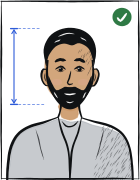
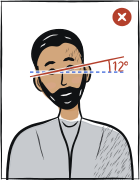
No physical photo is required for ETIAS application. The application is online with personal data and passport details. The Schengen border check at first entry compares the live face against the photo in the passport chip — that is the ICAO 9303 biometric photo, not a separate ETIAS photo.
Difference between ETIAS and a Schengen visa
A Schengen visa (Type C) is for nationals of countries without visa-free access. It costs €90, takes weeks, and requires biometric capture and a full document set. ETIAS is for visa-free nationals: €20, minutes to days, just a passport check. ETIAS does not guarantee entry — the border officer makes the final decision.
ETIAS and EES are not the same thing
The two are constantly mixed up. The Entry/Exit System (EES) is already running — it started in stages on 12 October 2025 and has been fully in force across every Schengen country since 10 April 2026. It records your face and fingerprints at the border and replaces the ink stamp in your passport with an electronic record. You apply for nothing and you pay nothing. ETIAS is the separate one: applied for online before you travel, paid for, and not yet launched. Citizens of the EU, Iceland, Liechtenstein, Norway and Switzerland are exempt from EES, as are their family members holding a residence card.
Frequently asked questions
01When does ETIAS become mandatory?
It is scheduled for the last quarter of 2026, and as of August 2026 the EU has still not named the exact start date. It says it will announce the date several months in advance. The launch has been postponed several times since 2021.
02Do I need a new photo for ETIAS?
No. ETIAS is an online pre-screening based on your existing passport details — no photo upload is required. The passport chip photo is what gets compared at the border on arrival.
03What countries are exempt from ETIAS?
EU and Schengen-area nationals never need ETIAS. Nationals of countries that already require a Schengen visa (Russia, China, India, most African nations) continue to need the visa and do not use ETIAS.