How to take a newborn or infant passport photo at home, step by step
A newborn cannot hold a position, look at a camera on command or keep a neutral expression — but the photo still has to meet the same biometric size and background rules as an adult passport photo. This guide is the practical method: when to shoot, how to light it, how to hold the camera, and how to get a usable frame from a baby who will not cooperate.
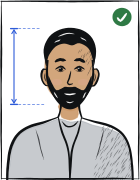
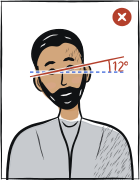
Quick answer
Time it after a feed, shoot overhead in daylight, take 20+ frames
Shoot 30 to 45 minutes after a feed, when the baby is calm but not asleep. Lay the baby on a plain white sheet on a firm, flat surface near a window, camera held directly overhead at 50 to 70cm. Use burst mode to capture 20 to 30 frames in a few seconds, then review on a full-size screen to pick the one with open eyes, a level head and no shadows.
Step-by-step
Time the shoot around feeds and naps
The calmest window is 30 to 45 minutes after a feed — full enough to avoid fussiness, awake enough to hold eyes open for a few seconds. Right before a nap the baby is often too drowsy; right after waking, many babies are unsettled for the first few minutes.
Use a firm, flat surface, not a soft mattress
Lay a plain white or light sheet over a firm surface — a changing table, a play mat on the floor, or a table with a folded towel underneath for padding. A soft mattress or sofa lets the baby sink and tilt to one side, which distorts the head angle in every frame.
Light from a window, not overhead or flash
Position the setup near a window with indirect daylight — late morning or early afternoon gives the most even light. Overhead room lighting casts shadows under the chin and in the eye sockets on a small face; flash is too harsh at the close distance a newborn photo needs and often causes red-eye.
Hold the camera overhead at 50 to 70cm, not closer
Shoot directly above the baby’s face from about 50 to 70cm away, using the camera’s zoom rather than moving physically closer. Getting closer than that with a phone’s standard lens introduces wide-angle distortion that exaggerates a newborn’s already large forehead and rounded face even more than it would an adult’s.
Support the head without hands in frame
Tuck a rolled towel or small nursing pillow the same colour as the background just under the shoulders, out of frame, to stop the head lolling sideways. Holding the head with your hand is allowed — the hand simply must not appear in the frame. A parent’s hand or arm visible anywhere in the shot is one of the most common reasons these photos are rejected.
Shoot in burst mode, not single frames
Hold down the shutter, or use burst or continuous mode, to capture 20 to 30 frames in a few seconds rather than timing single shots by guesswork. A newborn’s eyes, mouth and head position change every fraction of a second, so a burst dramatically increases the odds of one usable frame.
Review on a full-size screen before choosing
A phone’s small preview makes it hard to judge whether the eyes are fully open or the head is level. Transfer the burst to a computer or tablet and zoom in on each candidate frame before picking one — this catches half-open eyes and slight head tilts the phone screen hides.
Crop to the exact head-height ratio, and know when to stop
Crop tightly to the target country’s head-height ratio rather than rotating a tilted frame straight — rotation shifts the crop and can clip the chin or crown. If two or three sessions produce nothing usable, stop and try again after the next feed-and-nap cycle rather than forcing dozens of attempts on an overtired baby.
Frequently asked questions
01Can my newborn’s eyes be closed in the photo?
It depends on the country and on the document. For a UK passport, yes: children under one do not have to have their eyes open, and children under six do not have to look directly at the camera. For a USA passport it is also acceptable if a baby’s eyes are not entirely open — but for a USA visa the rule is stricter, and the child has to look at the camera with the eyes open. Some countries publish no infant exception at all; there, the general rule applies.
02How many attempts does a newborn passport photo usually take?
More than one session is normal. Many parents need several short sessions across a few days before a single frame has open eyes, a closed mouth and a level head at the same time — burst mode reduces this but rarely eliminates it.
03Is a phone camera good enough for a newborn passport photo?
Yes, the resolution is more than sufficient. Technique matters far more than the camera — overhead distance, daylight and burst shooting solve most of the problems parents run into.
04What if none of my home photos are usable?
Some pharmacies and photo studios specialise in infant passport photos and can often get a usable frame faster than repeated home attempts, since they have practised techniques and sometimes two people working together.
Related guides
Skip the manual steps
Upload a portrait — Anfas.Pro applies the country-specific crop, background and biometric framing automatically. Free preview before payment.