 Germany
Germany: The Bezahlkarte Payment Card for Benefit Recipients — What It Means for Ukrainians in 2026
The Bezahlkarte is a payment card for benefit recipients under AsylbLG. In 2026 it applies in all states except Berlin, with a cash limit mostly of €50/month. It does not yet affect Ukrainians with temporary protection (they are on Bürgergeld), but this may change for those who arrived after 1 April 2025: the switch was initially planned for 1 July 2026, but as of June 2026 the law has not yet been adopted and the date is uncertain.
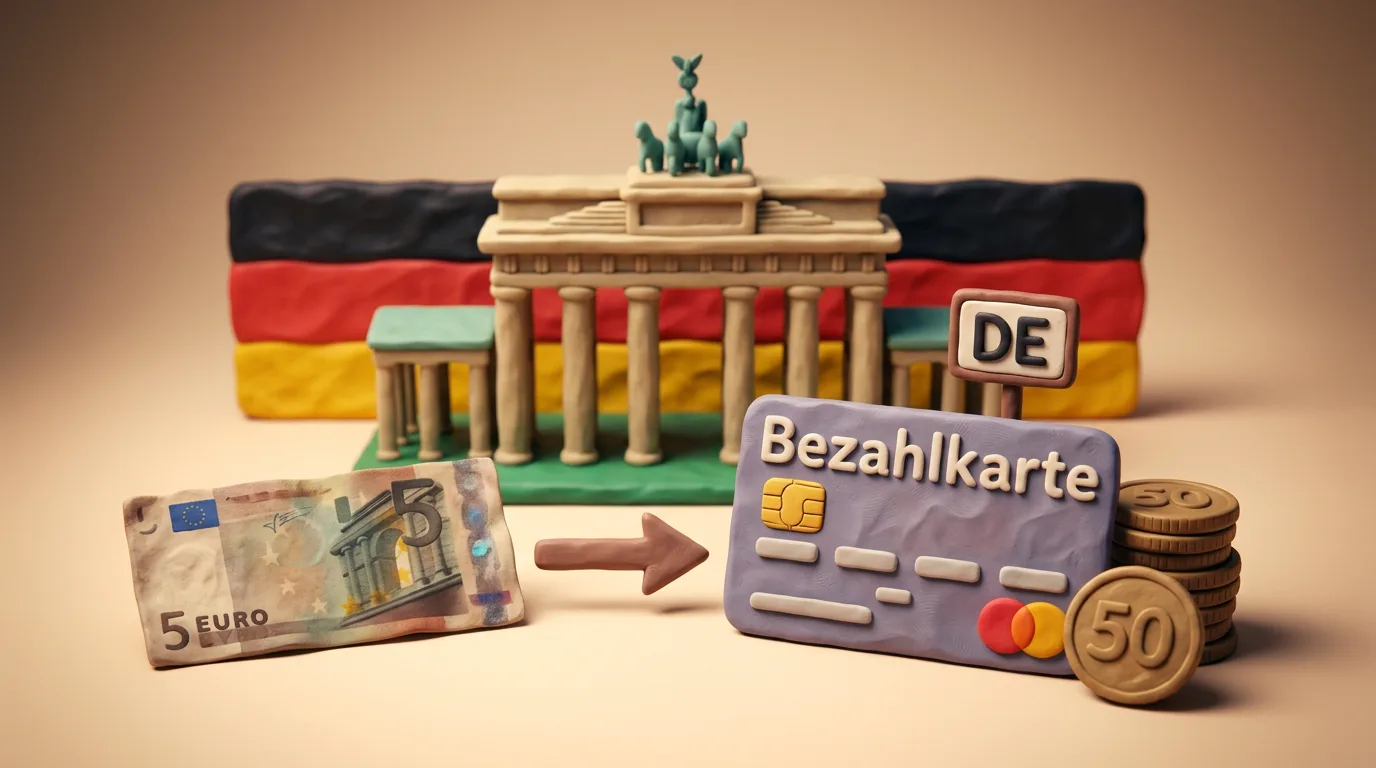
Key points
5 points- The Bezahlkarte is a payment card onto which part of the benefit is credited; its legal basis is laid down in the Asylum Seekers' Benefits Act (AsylbLG), and the federal states decide the details themselves.
- In 2026 the card has been introduced in all 16 states except Berlin; Berlin plans to start in 2026 (according to various sources — in the 1st or 2nd quarter), the exact date has not yet been fixed; some municipalities have opted out of it.
- The standard cash withdrawal limit is €50 per person per month in 13 states; Bremen and Thuringia — up to €120, Rhineland-Palatinate recommends €130, in Brandenburg for children — €25.
- Ukrainians with temporary protection currently receive Bürgergeld and the Bezahlkarte does NOT apply to them.
- The Leistungsrechtsanpassungsgesetz bill may move Ukrainians who arrived after 1 April 2025 to AsylbLG (and to the Bezahlkarte). The switch was initially planned for 1 July 2026, but as of June 2026 the law has not yet been finally adopted — it is stuck in the Bundesrat, and this date remains uncertain.
The Bezahlkarte is a payment card that the German authorities issue to recipients of social benefits under the Asylum Seekers' Benefits Act (Asylbewerberleistungsgesetz, AsylbLG). Part of the benefit due is credited to the card as a cashless balance, and another part is issued in cash. The aim is to simplify the administration of payments and, according to politicians' statements, to limit transfers of funds abroad.
What the legal basis is
The Germany-wide legal framework for the Bezahlkarte was adopted by the Bundestag on 12 April 2024, and the Bundesrat approved it on 26 April 2024 within the Act on Adapting the Provisions on Data Transmission in Foreigners' Law and Social Law (DÜV-AnpassG). The relevant provisions were incorporated into AsylbLG (in particular § 3 paras. 2 and 3 and § 2 para. 2 AsylbLG). At the same time, the federal states decide for themselves whether to introduce the card and exactly how to configure it.
Where the card applies in 2026
According to a survey of the relevant ministries of all 16 states, as of 2026 the Bezahlkarte has been introduced in all states except Berlin. Berlin plans to start issuance in 2026 (according to various sources — in the 1st or 2nd quarter; the exact date has not yet been fixed) and only for newcomers; the delay is explained by IT security and data protection requirements. The card was first introduced by Hamburg (back in 2024). Some municipalities have refused to apply it — among them Potsdam, Düsseldorf, Münster and Krefeld.
Cash limits and restrictions
The key practical restriction is how much cash can be withdrawn from the card per month:
- €50 per person per month — the standard in 13 of the 16 states;
- up to €120 — in Bremen and Thuringia;
- €130 recommended — in Rhineland-Palatinate;
- €25 — for children in Brandenburg.
In addition to cash limits, the states may add other restrictions: in some, online purchases are prohibited (for example, Bavaria, Saxony-Anhalt, Mecklenburg-Western Pomerania, Thuringia), in a number of states domestic transfers are prohibited, and international transfers are blocked everywhere. In some states there is a «whitelist» of merchants where the card can be used.
Whether this affects Ukrainians
For now — mostly no. Ukrainians with temporary protection under the Mass Influx Directive receive Bürgergeld (under SGB II) through the Jobcenter, not benefits under AsylbLG. Therefore the card for asylum seekers does not affect them.
This may change. On 19 November 2025 the German government approved a bill on adapting the law on benefits (Leistungsrechtsanpassungsgesetz). It provides for a change of legal regime (Rechtskreiswechsel): Ukrainians who arrived after 1 April 2025 will, if in need, receive lower benefits under AsylbLG instead of Bürgergeld — and will therefore also fall under the Bezahlkarte system. The switch was initially planned for 1 July 2026, but this date is not officially fixed: the government calls it only planned, and the Bundestag speaks of entry into force «in the summer».
Whether this is already in effect
As of June 2026 the law has not yet been finally adopted — it is stuck in the Bundesrat, where the states have not reached agreement on the distribution of costs and the administrative burden. Therefore the initially planned date of 1 July 2026 remains uncertain and may be postponed. The public hearing of the Bundestag's Committee on Labour and Social Affairs took place on 23 February 2026; social associations (Caritas, Paritätischer, DGB) and the Association of German Cities spoke out against the change. For those who arrived before 1 April 2025 and already receive Bürgergeld or social assistance, protection of acquired rights (Bestandsschutz) is provided.
What you should do
- If you arrived before 1 April 2025 — under the current plans the Bezahlkarte does not affect you; you remain on Bürgergeld.
- If you arrived after 1 April 2025 — follow the decision on the law and the notifications from the Jobcenter and the foreigners' authorities; a switch to AsylbLG/Bezahlkarte is possible no earlier than the date of entry into force, which has not yet been fixed.
- Check the official sources of your federal state, because cash limits and restrictions vary depending on the state and municipality.
GermanyGerman Passport · requirements
07Questions
6 answers01What is the Bezahlkarte?
It is a payment card for recipients of benefits under the Asylum Seekers' Benefits Act (AsylbLG). Part of the benefit is credited to the card cashlessly, and part is issued in cash. The legal basis is laid down in § 2 and § 3 AsylbLG, and the details are determined by each federal state.
02How much cash can be withdrawn from the card?
In 13 of the 16 states the standard limit is €50 per person per month. In Bremen and Thuringia — up to €120, Rhineland-Palatinate recommends €130, in Brandenburg for children — €25. The exact rules depend on the state and municipality.
03Will Ukrainians with temporary protection receive the Bezahlkarte?
For now, no. Ukrainians with temporary protection receive Bürgergeld (under SGB II), not benefits under AsylbLG, so the card for asylum seekers does not apply to them. This may change if the law on changing the legal regime is adopted.
04Who will be affected by the change of legal regime (Rechtskreiswechsel)?
The bill concerns Ukrainians who arrived in Germany after 1 April 2025. If in need, they will receive lower benefits under AsylbLG instead of Bürgergeld and will fall under the Bezahlkarte system. The switch was initially planned for 1 July 2026, but this date is not officially fixed.
05Is this change already in effect as of June 2026?
No. As of June 2026 the Leistungsrechtsanpassungsgesetz has not yet been finally adopted — the law is stuck in the Bundesrat. The hearing in the Bundestag took place on 23 February 2026. The initially planned date of 1 July 2026 is not officially fixed and may be postponed.
06In which states does the card already apply?
In 2026 the Bezahlkarte has been introduced in all 16 states except Berlin, which plans to start in 2026 (according to various sources — in the 1st or 2nd quarter); the exact date has not yet been fixed. Some municipalities (for example, Potsdam, Düsseldorf, Münster, Krefeld) have refused to apply it.
08Official sources
- Mediendienst Integration — Bezahlkarte für Asylbewerber
mediendienst-integration.de - Mediendienst Integration — Wo gilt was bei der Bezahlkarte?
mediendienst-integration.de - Bundesregierung.de — Kabinett beschließt Rechtskreiswechsel
bundesregierung.de - BMAS — Leistungsrechtsanpassungsgesetz
bmas.de - Deutscher Bundestag — Sozialverbände gegen Rechtskreiswechsel für Ukrainer (kw09/2026)
bundestag.de - asyl.net — Übersicht zu den gesetzlichen Änderungen aufgrund der Bezahlkarte
asyl.net - Haufe — Bundestag beschließt Bezahlkarte für Geflüchtete und Asylbewerber
haufe.de
Author: Yevhen Kravchenko. Published . Checked against official sources on .
 United KingdomGermany
Baby Passport Photo Rules: Eyes Open? Toys? Dummies? What the UK and Germany Actually Say
For a UK passport the baby must be alone, without toys or dummies; under-1s needn't have eyes open, under-6s needn't look at the camera.
 Germany
Germany's Digital Passport Photo Rule: How the E-Passfoto Process Works Since May 2025
German passports and ID cards now take only digital photos — captured at the office or uploaded by a registered photographer and retrieved via a code.
 USAUnited KingdomGermany+5
Passport Photo Size by Country: 18 Passports, 8 Different Formats — and Why One Photo Never Fits All
Of 18 passports we compared, 8 use 35x45 mm — but the US, Canada, Turkey, China, Spain and others don't, and head size ranges from 26 to 36 mm.
Make the photo for this document
Upload a selfie — we crop it to 35 × 45 mm, replace the background and check it against the document rules. Free.
German Passport · GermanyUpload