 Uzbekistan
 Armenia
 Vietnam
 Hungary
 Italy
 Bulgaria+2
Consular document photos: digital errors, paper procedures and background requirements
Consular requirements are often stricter than domestic rules: for the US or a German passport, you may need a paper print even when applying electronically.
In this article · 9 sections
- 01Summary table of consular photo parameters
- 02Why consulates reject photos: strict limits and hidden requirements
- 03Paper photos with digital submission: when to bring a print
- 04Application procedure: a step-by-step guide for people abroad
- 05Requirements of individual missions and database statistics
- 06What agencies do not publish
- 07Frequently asked questions
- 08Questions
- 09Sources
Key points
6 points- The Italian consulate accepts only photos that meet ICAO standards (35×45 mm, 70–80% face from chin to forehead).
- Germany accepts a borderless 45×35 mm paper print only abroad and only if electronic capture is impossible, recording "not verifiable" in the register.
- A white background is not universal: India (OCI) explicitly requires a light, plain, but not white background.
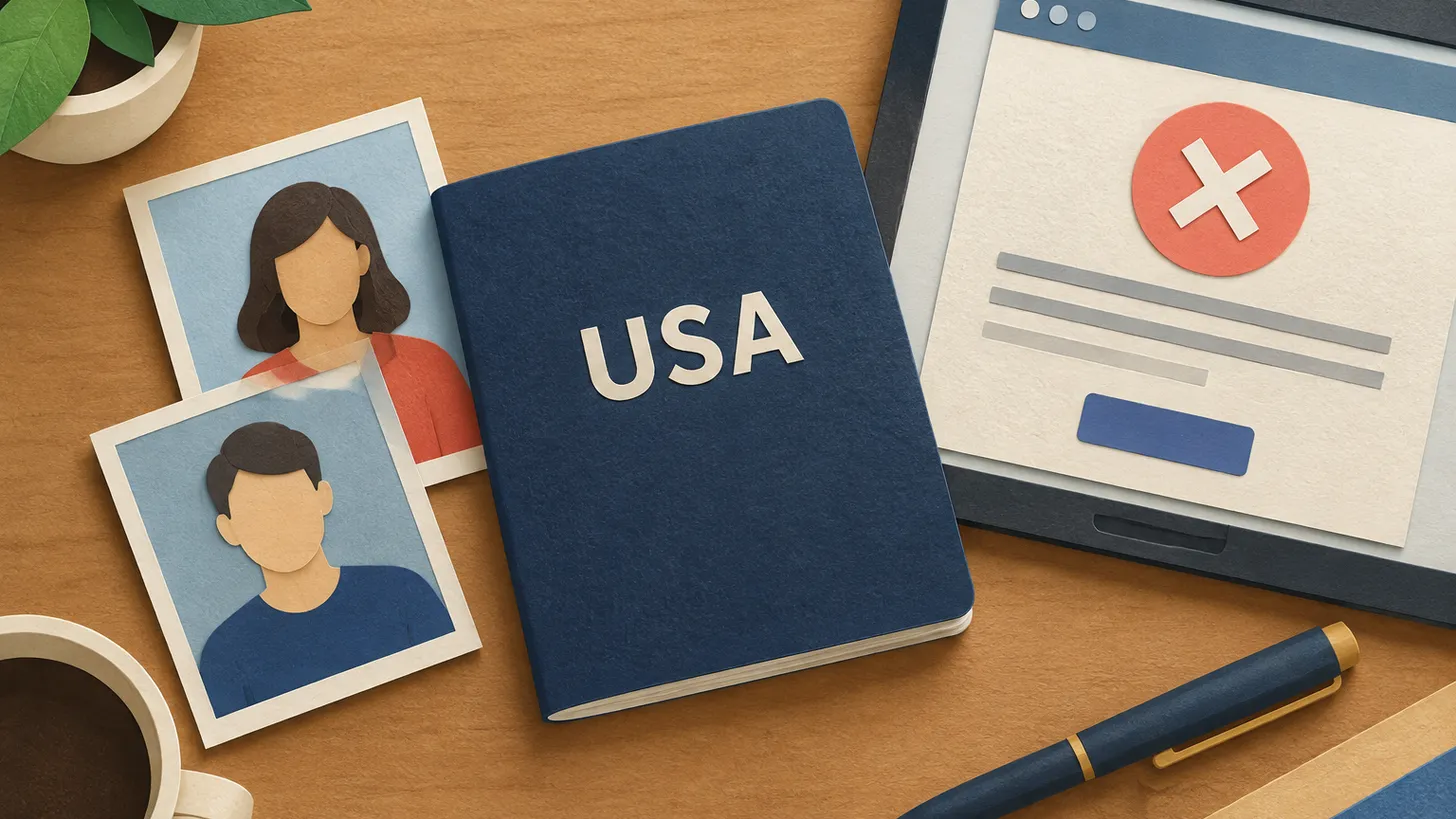
- An "X" in the DS-160 form (USA) means the digital photo was not uploaded, and you need to bring a 5×5 cm paper photo to the interview.
- At Chinese visa centres (CVASC), after three failed digital uploads the system will remind you to bring a paper photo, which staff will upload when you submit your application.
- No consular fee is charged for a certificate of identity for return to Ukraine for persons under 16.
Short answer
Requirements for consular photos often differ from agencies' domestic rules, and people living abroad have to follow the strict regulations of specific diplomatic missions. In our database of 241 document profiles, 229 contain print size requirements, covering 17 different formats. The most common size remains 35×45 mm (148 profiles), followed by 51×51 mm (16 profiles), 30×40 mm (14 profiles) and 40×60 mm (11 profiles). Consular wording can be stricter than the domestic version in terms of how photos are submitted and whether paper prints are acceptable. In Germany, for example, paper photos are not accepted at all within the country, and the consulate is the only place where the rules allow a borderless 45×35 mm print if electronic capture is impossible. Digital submission does not always eliminate paper either: the US Embassy states plainly that the system's approval of a photo while filling in the DS-160 form does not guarantee it will be used, and recommends bringing a print to the interview. Background requirements are not universal: while 52 profiles in our database strictly specify white, 23 profiles name a specific non-white shade, and India's OCI portal explicitly requires the background to be light but not white. Database figures as of 22 Sep 2026, the date of this article.
Summary table of consular photo parameters
Below are verified parameters for consular applications to various countries, based on data from official agencies and our profile database.
| Country / Document | Print size | Background requirements | Face proportion | Maximum age |
|---|---|---|---|---|
| Italy (Passport) | 35 × 45 mm | White, even lighting | 70–80% (32–35 mm) | No older than 6 months |
| Germany (Passport) | 45 × 35 mm (portrait) | No borders | — | Current |
| USA (Visa) | 5 × 5 cm | White or off-white | About 60% | No older than 6 months |
| India (OCI) | At least 51 × 51 mm | Light, plain (not white) | 80% | — |
| Azerbaijan (Visa) | 3 × 4 cm (2 pcs.) | — | — | — |
| Ukraine (Certificate of identity for return) | 3.5 × 4.5 cm / 10 × 15 cm | — | — | — |
UzbekistanInternational Passport · requirements · check a photo
ArmeniaArmenian Passport · requirements · check a photo
VietnamVietnamese Passport · requirements · check a photo
HungaryPassport · requirements · check a photo
Why consulates reject photos: strict limits and hidden requirements
Applications are often rejected because applicants apply familiar "domestic" rules to consular procedures. Consular wording can be much stricter. Italy's Ministry of Foreign Affairs, for example, does not list tolerances on its embassy page but announces a closed list: ONLY and EXCLUSIVELY photos that comply with ICAO standards can be accepted ("Si possono accettare SOLO ed ESCLUSIVAMENTE fotografie conformi alle norme ICAO"). Arguing over a specific point at the consular counter is pointless, as a single, non-negotiable criterion applies. Italian rules strictly prohibit flash reflections on the face and red eyes. Prescription glasses must not be sunglasses (no tinted lenses), and the frame must not be heavy or cover any part of the eyes. The photo must show the person alone, with no other objects or people in the background. The face must take up 70–80% of the frame from chin to forehead, and the photo itself is printed on high-quality, high-resolution paper. The person must have a neutral expression and keep their mouth closed. Head coverings are allowed only for religious reasons, in which case the outline of the face from chin to forehead and both sides of the face must be clearly visible.
Germany shows the opposite kind of strictness. Within the country, paper photos are not accepted at all. Under the Passport Ordinance (§ 16), a consulate abroad is the only place where the rules allow you to bring a print, and only if electronic capture with the authority's equipment is impossible. The format of this photo is specified as 45 mm × 35 mm in portrait orientation and without borders. The usual "35 × 45" order is reversed here, and the "no borders" requirement means that the white margin left by printing services is a violation. Accepting a paper photo has a direct consequence: in the passport register, the entry for the authority that took the photo reads "nicht verifizierbar" (not verifiable).
Backgrounds for consular procedures are not universal, and one set of prints will not work for every mission. While Italy and the US require a white or off-white background, India's Ministry of Home Affairs sets the opposite rule for OCI: the background must be plain and light, but NOT white ("plain light color background (not white)"). The photo must be square, at least 51 × 51 mm, without a frame, with the face taking up 80% of the frame.
Paper photos with digital submission: when to bring a print
Submitting a form online does not always remove the need for physical prints; often it merely postpones that step. The US Embassy in Poland states directly that the system's approval of a photo while completing the DS-160 application does not guarantee that the photo can be used for the visa if it does not meet the listed requirements. The embassy recommends bringing one photo that meets visa rules to the interview. The photo must have been taken within the last 6 months to reflect your current appearance, against a plain white or off-white background, and glasses are not allowed in new visa photos.
The US Embassy's official Russian-language instructions for the DS-160 form contain a precise visual test of whether you need to bring a paper photo. If an "X" appears in the photo field after uploading, the photo was not uploaded. In that case, together with the confirmation page, you must provide a printed 5×5 cm colour photo on a white background in which the face takes up about 60%. If your photo appears on the confirmation page, the upload was successful and no paper photo is needed.
The Chinese Visa Application Service Center (CVASC) provides a standard paper fallback for when digital upload fails. Its official instructions state that if an applicant has tried to upload a photo 3 times without success, the system will remind them to bring a suitable photo. When submitting the application at the centre, you need to have a recent photo with a white or near-white background that meets the standards, and a visa centre employee will upload it for you.
You may need a paper duplicate to get through the interview; prepare your consular document photo in strict accordance with the requirements of your chosen embassy.
Application procedure: a step-by-step guide for people abroad
- Find out who takes the photo. For a biometric Uzbek passport for travel abroad, the applicant must go to the embassy (for example, in Belgium) by appointment, where the consular section will collect the biometric data itself. In Bulgaria, a consular officer takes a digital image of the applicant's face, and for a Hungarian passport the photo is taken during the application process.
- Put together the physical document package (Azerbaijan). Azerbaijan's Ministry of Foreign Affairs requires two 3×4 biometric photos for a visa. These are submitted together with the original and a copy of the passport, which must be valid for at least 3 months beyond the expected visa (the passport must have a blank page). For a private visit, you need an original notarised invitation in Azerbaijani with a copy of the inviting person's ID, plus a copy of a hotel booking for the dates of stay.
- Take into account exceptions for children and people with limited mobility (Ukraine). Under Cabinet of Ministers of Ukraine Resolution No. 285 on the certificate of identity for return to Ukraine, the consular officer enters a digitised image of the applicant's face into the application form. However, a parent who expects both of them to be photographed is mistaken: to enter a child's details into the legal representative's certificate, you need to bring two 3.5 × 4.5 cm colour photos of the child. For those under 12, those who cannot move independently due to a long-term health condition, or those who for valid reasons cannot come to the diplomatic mission, one 10 × 15 cm colour photo is required so that the digitised image can be entered by scanning. A consular fee is charged for processing (the double rate does not apply), but it is not charged for persons under 16, when a child's details are entered into a representative's certificate, or at the request of a competent authority of a foreign state.
- Prepare the originals (India OCI). After submitting the complete online application, including documents, photo and signature, applicants are required to bring only the original supporting documents to the Indian mission abroad for preliminary verification. They are not required to bring paper copies, printouts of the form or photocopies of the uploaded documents. The consular fee is 275 US dollars per applicant (paid by demand draft) or the equivalent in local currency.
Requirements of individual missions and database statistics
According to our database of 241 profiles, only 32 profiles specify a maximum photo age (30 profiles: 6 months, 2 profiles: 3 months); the absence of this limit in the remaining profiles is a gap in the published data, not evidence that older photos are allowed. Figures as of 22 Sep 2026.
What agencies do not publish
Many parameters are left to the discretion of the individual consulate, and agencies do not make this information publicly available:
- There is no universal figure for how many copies each consulate asks for. Even within one country, different missions may request different numbers of prints.
- None of the official sources checked states whether the consulate keeps the photo for reuse when the document is renewed later.
- Consular fees in national currencies (apart from India's fixed OCI fee of 275 US dollars) are not published on the photo requirements pages.
Frequently asked questions
What should I do if the photo did not upload to the DS-160 form?
Check the photo field in the DS-160: if it shows an "X", the file did not upload, and you will have to attach a printed 5×5 cm colour photo on a white background to the confirmation page.
Do I have to bring my child's photo to the Ukrainian consulate if I, the parent, am applying?
Yes. Under CMU Resolution No. 285, entering a child's details into the legal representative's certificate requires two 3.5 × 4.5 cm colour photos of the child, even if the parent is photographed on site.
Can I bring a printout of the form when applying for an Indian OCI?
No. The rules of the Online OCI Services portal state explicitly that applicants must bring only the original supporting documents to the Indian mission for verification. Printouts of the form or photocopies of uploaded documents do not need to be brought.
What does the "nicht verifizierbar" entry in a German passport mean?
This entry means "not verifiable". Under the Passport Ordinance (§ 16), it is entered in the passport register if a consulate abroad accepted a 45×35 mm paper print because electronic capture with the authority's equipment was impossible.
Is it true that all consular photos need a white background only?
No. India, for example, explicitly requires a light, plain colour (not white) for OCI applications. In our profile database, 23 documents also require a specific non-white shade.
08Questions
5 answers01What should I do if the photo did not upload to the DS-160 form?
If the photo field shows an "X", the file did not upload. In that case, bring the confirmation page and a printed 5×5 cm colour photo on a white background to the interview.
02Do I have to bring my child's photo to the Ukrainian consulate if I, the parent, am applying?
Yes. Under CMU Resolution No. 285, entering a child's details into the legal representative's certificate requires two 3.5 × 4.5 cm colour photos of the child, even if the parent is photographed on site.
03Can I bring a printout of the form when applying for an Indian OCI?
No. Only the original supporting documents are brought to the Indian mission for verification (as set out in the rules of the Online OCI Services portal); printouts and copies are not needed.
04What does the "nicht verifizierbar" entry in a German passport mean?
This entry means "not verifiable". Under the Passport Ordinance (§ 16), it is entered in the passport register if a consulate abroad accepted a 45×35 mm paper print because electronic capture with the authority's equipment was impossible.
05Is it true that all consular photos need a white background only?
No. India, for example, explicitly requires a light, plain colour (not white) for OCI applications. In our profile database, 23 documents also require a specific non-white shade.
09Sources
- Ambasciata d'Italia, Ministry of Foreign Affairs of Italy
ambvienna.esteri.itopened - Bundesministerium della Justiz (Gesetze im Internet)
gesetze-im-internet.deopened - Ministry of Foreign Affairs of the Republic of Azerbaijan
canberra.mfa.gov.azopened - Cabinet of Ministers of Ukraine (LIGA:ZAKON system)
ips.ligazakon.netopened - U.S. Mission Poland, U.S. Department of State
pl.usembassy.govopened - U.S. Department of State (DS-160 instructions)
common.usembassy.govopened - Chinese Visa Application Service Center (CVASC)
visaforchina.cnopened - Ministry of Home Affairs of India (MHA)
ociservices.gov.inopened
Author: Yevhen Kravchenko. Published . Checked against official sources on .
 KazakhstanUzbekistan
 Kyrgyzstan+2
Kazakhstan visa photo: 3.5x4.5 cm size, VMP pitfalls and the headwear-to-passport rule
The Kazakh visa application form requires a 3.5 x 4.5 cm photo.
 RussiaUzbekistan
 Tajikistan+1
The hidden 30×40 mm standard: full photo requirements for a Russian work patent
A Russian work patent requires one 30×40 mm photo.
 Russia
 BelarusKazakhstan+5
Driver's license photos in Russia: bring a 35×45 mm matte photo for an international permit; for a national license you are photographed at the office
A 35×45 mm photo on matte paper is required for an international driving permit.

Make the photo for this document
Upload a selfie — we crop it to 35 × 45 mm, replace the background and check it against the document rules. Free preview.
International Passport · UzbekistanUpload