 EU
EU Germany
 Poland
 Czech Republic
Family reunification for Ukrainians under temporary protection in the EU in 2026: who counts as family and how to bring relatives over (DE, PL, CZ)
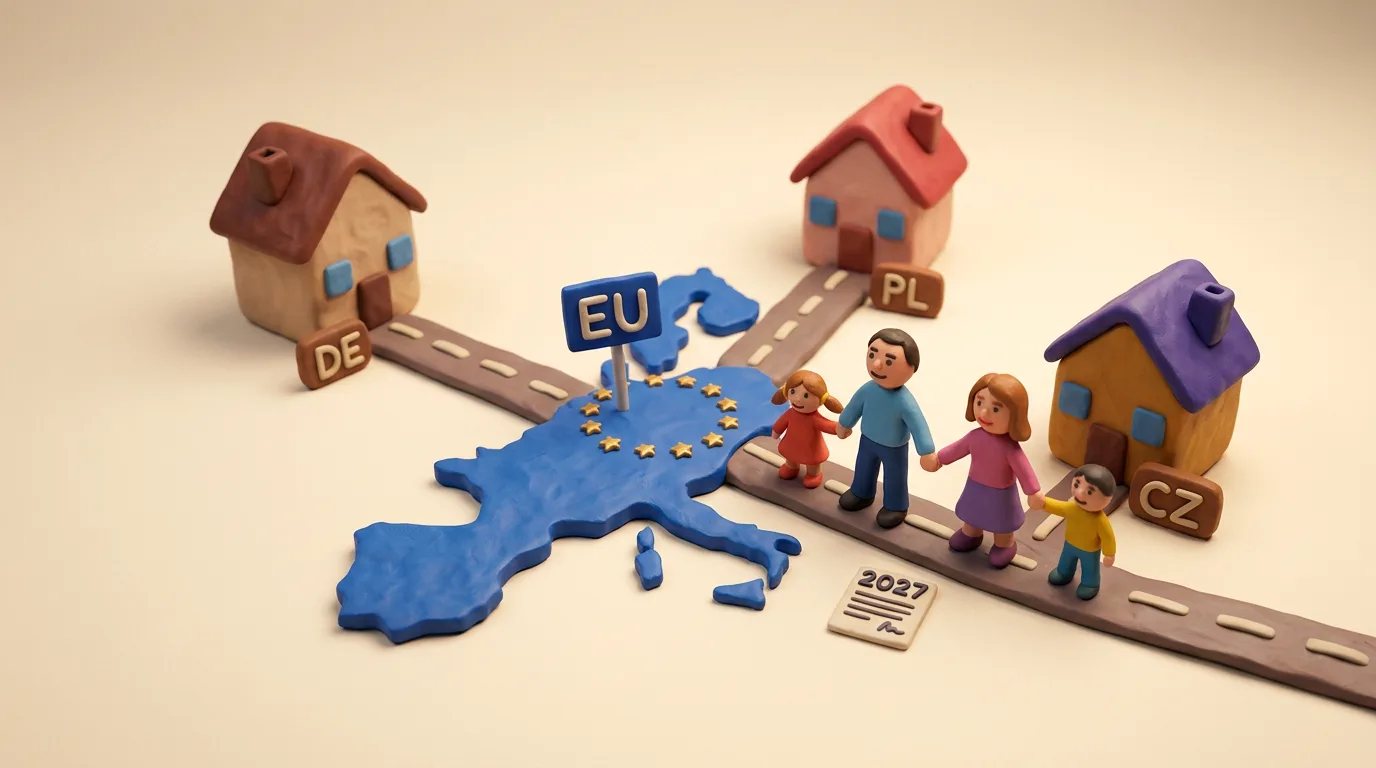
A family member = spouse/stable partner, minor unmarried children, dependent close relatives who lived together in Ukraine before 24.02.2022. Protection runs until 4 March 2027. You can bring relatives over only if they fall under the Directive; the steps and documents differ by country.
In this article · 9 sections
Key points
6 points- Temporary protection for Ukrainians in the EU has been extended until 4 March 2027. Automatic extension without a visit applies only in Germany (permits valid as of 1 February 2026 extended to 4 March 2027); Poland and Czechia require active steps.
- A family member under Directive 2001/55/EC (Art. 15) is: the spouse or an unmarried partner in a stable relationship; minor unmarried children (biological, born out of wedlock or adopted); other close relatives who lived as one family and were wholly or mainly dependent on the applicant.
- Key condition: the family must have existed in Ukraine before the events of 24 February 2022 — new marriages or relationships formed after departure do not fall under protection.
- Germany: protection under §24 AufenthG, application at the Ausländerbehörde; permits valid as of 1 February 2026 are automatically extended to 4 March 2027 — without a visit to the authority.
- Poland: PESEL UKR status is valid until 4 March 2027; from 4 May 2026 you can apply for a 3-year CUKR card (right to work and run a business) if you held PESEL UKR as of 4 June 2025 continuously for at least 365 days; the application is submitted by 4 March 2027.
- Poland: those who registered PESEL UKR only on the basis of a declaration (especially children previously entered against a photo in a parent's passport) had to obtain a valid travel document by 31 August 2026. Czechia: registration through KACPU, reunification through OAMP MV, photo 45×35 mm.
Temporary protection for Ukrainians in the EU has been extended until 4 March 2027. Family reunification is possible only for relatives who fall under Council Directive 2001/55/EC and Council Decision 2022/382. Below is the exact definition of a “family member,” the key condition about the date of 24 February 2022, and the specific steps in Germany, Poland and Czechia.
Who counts as a family member (Article 15 of Directive 2001/55/EC)
The family members of an applicant who has temporary protection are:
- The applicant's spouse or unmarried partner in a stable relationship — provided that the legislation or practice of the host country treats unmarried couples on a par with married ones.
- The minor unmarried children of the applicant or their spouse — biological, born out of wedlock or adopted.
- Other close relatives who lived as one family at the time of the mass influx events and were wholly or mainly dependent on the applicant.
Key condition: the family must have existed in Ukraine before the events of 24 February 2022 and been separated by the circumstances of the war. Marriages, partnerships or other family ties formed after departure do not fall under temporary protection on the basis of reunification. Reunification is impossible for relatives who are not covered by the Directive at all.
General eligibility conditions for protection
- Ukrainian citizens who left because of Russian aggression; or foreigners/stateless persons who had international protection or permanent residence in Ukraine.
- Presence in Ukraine as of 24 February 2022 or earlier — the main requirement for the applicant and their family.
- Persons who already have temporary protection in another EU country usually cannot obtain it again after relocating (for example, in Poland).
Germany: §24 AufenthG
Protection is granted under §24 of the Residence Act (AufenthG). Spouses and unmarried partners, minor unmarried children, as well as close relatives under additional conditions fall under protection — even if they are not Ukrainian citizens.
- Contact the local foreigners' authority (Ausländerbehörde) or apply online through the Germany4Ukraine portal.
- During registration, one of the following documents is issued: an arrival certificate (Ankunftsnachweis), a temporary certificate (Fiktionsbescheinigung) or a reception facility certificate (Anlaufbescheinigung).
- Temporary protection permits valid as of 1 February 2026 are automatically extended to 4 March 2027 (by an ordinance extending the validity of permits) — a visit to the authority is not required for this.
Poland: PESEL UKR and the CUKR card
Protection is arranged through the PESEL UKR status. It is available to Ukrainian citizens who arrived after 24 February 2022 and their family members (spouse, minor children) who do not have another legal status.
- Submit a PESEL UKR application at the local Urząd Miasta. Those who entered after 4 March 2026 must register within 30 days of entry; without timely registration, the stay may lose its legality.
- Prepare biometric photos, originals and copies of identity documents; fingerprints are taken. The application is available in Ukrainian.
- PESEL UKR status is valid until 4 March 2027; the legal basis from 4 March 2026 is the Ustawa o udzielaniu cudzoziemcom ochrony na terytorium Rzeczypospolitej Polskiej (Act on granting protection to foreigners on the territory of the Republic of Poland).
- From 4 May 2026 you can apply for a 3-year CUKR residence card with the right to work and run a business — provided that you held PESEL UKR status as of 4 June 2025 continuously for at least 365 days. The application is submitted by 4 March 2027.
- Persons registered for PESEL UKR only on the basis of a declaration had to obtain and present a valid travel document by 31 August 2026 at the nearest urząd gminy — this applies in particular to children under 18 previously entered against a photo in a parent's passport.
Czechia: KACPU and OAMP MV
Recognized as family members are the spouse, registered partner, unmarried minor child and a dependent relative who lived in the same household. As a rule, relatives must have been with the applicant in Ukraine before 24 February 2022 and left together.
- Register in person at a Regional Assistance Centre for Help to Ukraine (KACPU). To extend protection in 2026, online re-registration was in place from 8 January to 15 March 2026.
- Prepare documents: a completed application; a valid biometric passport (if available); evidence of presence in Ukraine before 24.02.2022 and of departure (stamps, confirmation of a humanitarian crossing); proof of housing (a notarized statement from the owner on the official form, or a rental/sublease contract); a photo 45×35 mm.
- For family reunification later — contact the Department for Asylum and Migration Policy (OAMP MV).
- Temporary protection extends to those arriving in connection with family reunification with a person who already has protection, or in exceptional cases.
What after 2027: transition to other statuses
In September 2025, the EU Council adopted a Recommendation on a coordinated transition out of temporary protection. Member states are encouraged to issue national residence permits on the grounds of employment, study, education or family circumstances, if the person meets the conditions. It is also possible to apply for statuses under EU law, in particular for highly qualified employment. Czechia, for example, introduced a five-year residence permit for those who have lived in the country under protection for at least two years and are economically self-sufficient.
Practical summary
- Check whether your relative falls under the definition of a “family member” and whether the relationship existed before 24.02.2022.
- Gather evidence of presence in Ukraine before 24.02.2022 and of departure (stamps, confirmation of crossing).
- Register on time: Poland — 30 days for those who entered after 4 March 2026; Czechia — in person at KACPU; Germany — Ausländerbehörde.
- For reunification details, contact the relevant authority: OAMP MV (Czechia), Ausländerbehörde (Germany), Urząd Miasta / Urząd ds. Cudzoziemców (Poland).
PolandResidence Permit · requirements
08Questions
6 answers01Who counts as a family member for temporary protection in the EU?
Under Article 15 of Directive 2001/55/EC these are: the applicant's spouse or an unmarried partner in a stable relationship (if the country's legislation treats such couples on a par with married ones); minor unmarried children of the applicant or their spouse (biological, born out of wedlock or adopted); other close relatives who lived as one family at the time of the mass influx and were wholly or mainly dependent on the applicant. The family must have existed in Ukraine before 24 February 2022.
02Can parents or adult children be brought over under temporary protection?
Only as “other close relatives,” if they lived as one family in Ukraine before 24.02.2022 and were wholly or mainly financially dependent on the applicant. Independent adult children or self-sufficient parents usually do not fall under this category. Czechia explicitly recognizes a “dependent relative who lived in the same household”; the decision is made by the authority of the host country.
03Does a marriage concluded after leaving Ukraine fall under protection?
No. The Directive applies only to families that already existed in the country of origin and were separated by the circumstances of the mass influx. Marriages and partnerships concluded after 24 February 2022 do not fall under temporary protection on the basis of family reunification.
04Until what date is temporary protection valid and is it extended automatically?
The EU Council extended temporary protection until 4 March 2027. Only Germany extends it automatically, without a visit (permits valid as of 1 February 2026 — until 4 March 2027). In Poland, PESEL UKR status is valid until 4 March 2027 by law, but the CUKR card must be requested separately. In Czechia, online re-registration was required (8 January – 15 March 2026), and the temporary protection visa is extended within the EU decision until 4 March 2027.
05How do I bring a family member to Poland?
The family member registers for PESEL UKR at the local Urząd Miasta: submit the application (available in Ukrainian), biometric photos, originals and copies of identity documents; fingerprints are taken. Those who entered after 4 March 2026 must register within 30 days. From 4 May 2026 you can apply for a 3-year CUKR card if you held PESEL UKR as of 4 June 2025 continuously for at least 365 days (application by 4 March 2027).
06What happens after temporary protection ends in 2027?
In September 2025 the EU Council adopted a Recommendation on a coordinated transition: member states are encouraged to issue national residence permits on the grounds of employment, study, education or family circumstances for those who meet the conditions. It is also possible to apply for statuses under EU law, for example for highly qualified employment.
09Official sources
- European Commission — Temporary protection
home-affairs.ec.europa.eu - EUR-Lex — Council Directive 2001/55/EC (Article 15)
eur-lex.europa.eu - Council of the EU — Recommendation on transition out of temporary protection (16 Sep 2025)
consilium.europa.eu - Germany4Ukraine — Residence permit and registration
germany4ukraine.de - UNHCR Poland — Legal changes from 4 March 2026
help.unhcr.org - UNHCR Czechia — Temporary protection
help.unhcr.org
Author: Yevhen Kravchenko. Published . Checked against official sources on .
EU Ukraine
EU Temporary Protection: New Exit-Stamp Requirement for Men of Military Age
Alongside extending temporary protection to March 2028, EU countries agreed on a new condition: men of military age applying for the first time must prove they left Ukraine legally.
 EUPoland
 Hungary+2
Old residence cards and ID cards in the EU expire on August 3, 2026
In accordance with EU Regulation 2019/1157, from August 3, 2026, all old formats of residence permits for family members of EU citizens and national ID cards that do not contain biometric data will become invalid. This applies to documents issued in Poland, Denmark, Hungary, Greece, and other EU countries. Holders of such documents must contact migration authorities in advance to replace them with new biometric cards. In addition, in Poland, the application procedure changes from April 27, 2026 — it becomes fully electronic via the MOS 2.0 portal.
 EU
EUEU 'Travel to Europe' App: Passport Scan and Selfie Guide for EES
A comprehensive guide on how to use the new Frontex 'Travel to Europe' mobile app for the EU Entry/Exit System (EES). Learn the step-by-step process for scanning your biometric passport's NFC chip, the strict requirements for taking a compliant facial recognition selfie, and how to avoid common errors before your Schengen border crossing.

Make the photo for this document
Upload a selfie — we crop it to 35 × 45 mm, replace the background and check it against the document rules. Free.
Residence Permit · PolandUpload