What is an anfas (full-face) photo?
Definition
anfas (en face)
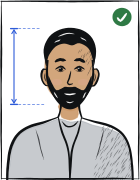
Anfas (from the French phrase "en face" — facing forward) is the head position in which the face is turned squarely to the camera: both edges of the face are equally visible, the nose sits on the centre line and the eyes look straight into the lens. It is the opposite of a profile view, where the head is turned to the side. Every passport, visa and ID photo is taken anfas.
Key facts
| Origin of the term | The French phrase "en face" — "facing, from the front". Russian, Ukrainian and some other languages borrowed it as a single word: anfas. |
|---|---|
| Opposite pose | Profile — the head turned fully to the side, so only one side of the face is visible. The position between the two is called a three-quarter view, or semi-profile. |
| Where required | All biometric document photos: passports, visas, national ID cards, residence permits, driving licences. |
| Why it matters | Face-recognition systems compare the geometry of a frontal face. A turned or tilted head changes the measured distances between the eyes, the nose and the face edges, and the automated check fails. |
| Quick self-check | Both edges of the face are equally visible, the tip of the nose does not overlap either cheek, and the line through the eyes is horizontal. |
| Checked against primary sources. | |
Anfas, profile and three-quarter view — the difference
Anfas means the face looks straight into the camera and both halves of the face are shown equally. Profile means the head is turned fully to the side, so the camera sees only one side of the face — the classic pose of medical and forensic photography. The three-quarter view sits between the two: portrait photographers love it because it makes the face look slimmer, and that is exactly why document photography forbids it — a flattering angle hides the geometry the border systems need.
Why every document photo is taken anfas
International biometric standards describe the document portrait as a frontal view: face to the camera, head straight, neutral expression. Automated face matching at borders and e-gates measures the distances between facial features, and those measurements only line up when both the document photo and the live camera see the face from directly in front. A photo taken at an angle would make the stored reference useless for the machine.
Common mistakes: a turned or tilted head
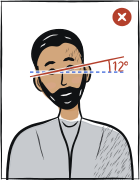
The head position that feels straight to the person in front of the camera often is not. A slight turn towards the "better side", a chin lifted or tucked, a head leaning towards one shoulder — each of these is enough for an automated check to reject the photo, and head position is one of the standard rejection reasons in most countries' requirements. The Anfas.Pro tool checks head position before payment, so a turn or tilt is visible before you print.
Frequently asked questions
01What does "full face" mean in photo requirements?
It is the same thing as anfas: the whole face photographed from the front — forehead to chin, both edges of the face in view — with the eyes open and looking into the lens. Requirement lists use "full face", "front view", "facing the camera" and "en face" interchangeably.
02What is the difference between anfas and profile?
Anfas shows the face from the front; profile shows it from the side. Document photos are always anfas. Profile shots survive mainly in forensic records and medical photography, where the side view carries the information.
03Can I turn my head slightly in a passport photo?
No. Even a small turn or tilt changes the facial geometry that the automated check measures, and the photo can be rejected for it. Keep the head straight, turn the shoulders to the camera and look directly into the lens.
04Is "en face" the same as anfas?
Yes. "En face" is the original French phrase, "anfas" is the single-word borrowing used in Russian, Ukrainian and some other languages, and English requirement lists usually write "full face" or "front view". All four describe the same pose.