What is a Schengen visa C?
Definition
Schengen visa C
A Schengen visa C is the standard short-stay visa for travel inside the Schengen Area for up to 90 days in any 180-day period. It is valid for travel across all 29 member states and is the visa most tourists, business travellers and short-term visitors need.
Key facts
| Maximum stay | 90 days in any 180-day period. |
|---|---|
| Coverage | All 29 Schengen states under a single visa sticker. Bulgaria and Romania joined in full on 1 January 2025. |
| Standard fee | €90 (€45 for children 6–12, free for under-6). |
| Processing time | 15 calendar days standard; up to 45 days for further review. |
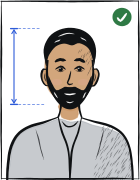
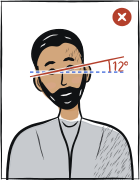
| Photo size | 35 × 45 mm biometric, identical across all 29 member states. |
| At the border | The Entry/Exit System (EES) has been running in every Schengen country since 10 April 2026. Your face and fingerprints are recorded at the crossing and the passport stamp is replaced by an electronic record. Nothing has to be applied for in advance. |
| Checked against primary sources. | |
Schengen visa types — C vs D vs A
A "C visa" is the short-stay visa (up to 90 days). A "D visa" is a national long-stay visa issued by one specific country (typically for study, work or family reunification, valid 90 days or longer). An "A visa" is the airport transit visa — only allows passage through the international transit zone of a Schengen airport, not entry to the territory.
Single-entry vs multiple-entry
A single-entry C visa allows one trip into Schengen. Once you leave you cannot re-enter on the same visa. A multiple-entry C visa allows unlimited trips during its validity. Consulates issue multiple-entry visas more often after one or two successful single-entry applications.
The 90/180 rule explained
The 90-day limit counts cumulatively over a rolling 180-day window. If you spent 60 days in Schengen in the past 90 days and want to come back, you have 30 days left until the window rolls. The official "Schengen calculator" on the EU Home Affairs site does the maths automatically.
Frequently asked questions
01Is the Schengen C visa the same as the European Union visa?
Not exactly. The Schengen Area has 29 members: 25 EU countries plus Iceland, Norway, Switzerland and Liechtenstein. Bulgaria and Romania joined in full on 1 January 2025. Two EU countries are still outside it — Ireland (opt-out) and Cyprus. The Schengen C visa works only in the 29 Schengen states.
02Which Schengen country should I apply through?
The country that is your main destination — measured by how long you stay or by the purpose of the trip. If there is no main destination, apply through the country whose external border you cross first. Applying through a country you do not actually visit ("visa shopping") is detected by the VIS database and leads to refusal.
03What photo do I need for a Schengen C visa?
35 × 45 mm biometric photo with plain light background, head about 70–80% of frame, neutral expression. See our Schengen pillar guide for the full specification and country-by-country handling.
04What is the EES and do I have to apply for it?
The Entry/Exit System is the border database that has replaced passport stamping across the Schengen Area since 10 April 2026. You do not apply for it and you pay nothing: at your first crossing the border officer records your face and fingerprints, and later crossings are matched against that record. EU, Icelandic, Liechtenstein, Norwegian and Swiss citizens are exempt, as are their family members holding a residence card.