 Estonia
 Finland
Estonia vs Finland: a 40x50 mm file or a police code for your ID photo
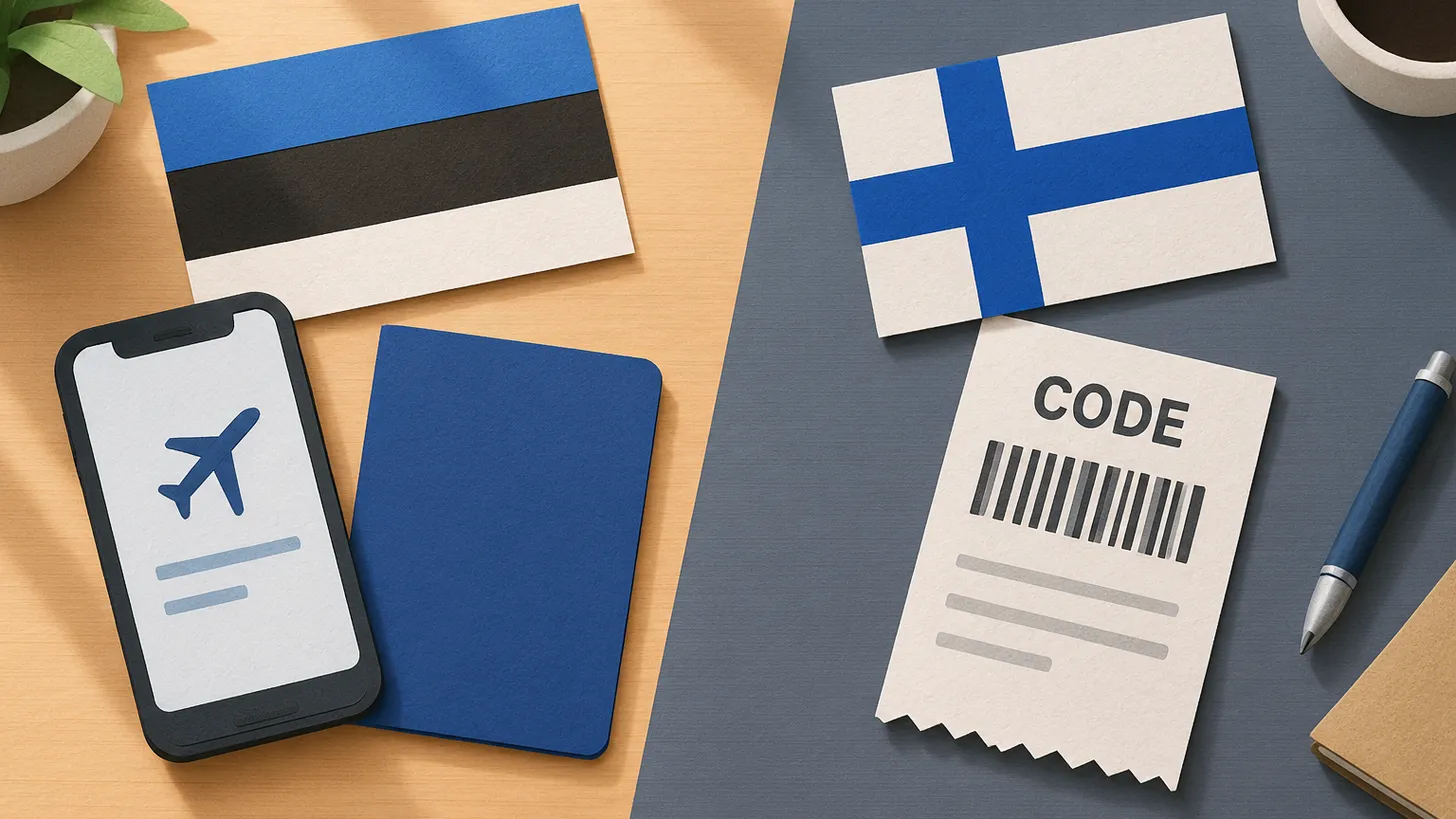
In Estonia you can upload your own photo of between 1 MB and 5 MB, while Finland accepts passport and ID card photos through an electronic code issued by a photo studio.
In this article · 9 sections
- 01Comparing the parameters: two different ecosystems
- 02How the Estonian system works: from megabytes to free booths
- 03How the Finnish system works: a code instead of a file
- 04The procedure step by step
- 05Consequences of application errors (from the authorities' practice)
- 06Rules for children and teenagers
- 07Context: what our database shows
- 08Questions
- 09Official sources
Key points
5 points- Estonia requires a file of at least 1300 × 1600 pixels and between 1 and 5 megabytes in size.
- An online application for a Finnish passport or ID card cannot be submitted without a photo retrieval code from a photo studio.
- An Estonian photo taken in a police booth is valid for 183 days, while your own photo is valid for 6 months.
- The Estonian police recommend using a smartphone's main camera, because the front camera distorts facial proportions.
- Submitting a first application for a Finnish residence permit from inside the country may lead to a negative decision.
Short answer
Estonia and Finland handle electronic photos in different ways. In Estonia the standard passport size is 40 × 50 mm, and you can upload a digital photo yourself as long as the file meets the requirements: between 1 and 5 megabytes in size and a resolution of at least 1300 × 1600 pixels. In Finland, by contrast, an online application cannot be submitted without a digital photo delivered directly from the photographer to the police, and the applicant receives a unique retrieval code. This code is required to submit an online application for a Finnish passport or ID card. Because of these technical and procedural differences, a self-made Estonian file cannot be used in the Finnish online procedure.
Comparing the parameters: two different ecosystems
The requirements of the two neighbouring countries differ at every stage, from taking the photo to its processing by the authority. Below is a summary table based on verified data from our database and official police instructions.
| Parameter | Estonia (Passport / Consular photo) | Finland (Passport / ID card) |
|---|---|---|
| Print size | 40 × 50 mm | Not specified |
| Digital dimensions | Minimum 1300 × 1600 pixels | Not specified |
| File size | From 1 MB to 5 MB | Not specified |
| Face share of the frame | 70–80% of frame height | Not specified |
| Background | Light, plain, without patterns | Light, neutral, plain, without shadows |
| Maximum age of the photo | 183 days (booth) or 6 months (own photo) | Not specified |
| Who sends the file to the authority? | The applicant (uploads the file themselves) | The photo studio (sends it electronically, issues a code) |
EstoniaDocument Photo · requirements · check a photo
FinlandPassport · requirements · check a photo
FinlandID Card · requirements · check a photo
EstoniaConsular Photo · requirements · check a photo
How the Estonian system works: from megabytes to free booths
In Estonia the photo submission process is designed for self-service, but it sets strict quality requirements for the digital file. The Estonian Police and Border Guard Board (Politsei- ja Piirivalveamet) and the Ministry of Foreign Affairs set the standard for passport and consular photos at 40 × 50 mm, with the face taking up 70–80% of the frame height. If you decide not to use a police photo booth and plan to submit the file yourself, you can prepare a photo for an Estonian document online so that it meets the official criteria.
Strict file limits and a ban on editing
The Estonian standard is written mainly in file units. A digital photo must have a resolution of at least 1300 × 1600 pixels. A notable feature is the file size: it must be between 1 MB and 5 MB. Submitting a non-compliant photo will extend the time it takes to receive the document.
The police state that the photo must be in colour and must not be edited. The rules prohibit submitting a scanned photo, as well as a screenshot from a computer or mobile phone screen.
Two different validity periods
The system distinguishes where a photo comes from, and its validity depends on this. A photo taken in a police photo booth is digital and can be used in the self-service portal for 183 days (for applications other than a weapons permit). A photo you took and uploaded yourself, by contrast, must not be older than six months.
Rules for taking photos at home
The Estonian authority allows the photo to be taken with a mobile phone, but gives clear instructions. The police advise using the rear camera of the device, explaining that the front camera distorts the shape of the face. You should ask a family member, friend or acquaintance for help. The person in the frame must look straight into the camera, with the eyes level (head not tilted) and the face centred in the photo. The eyes must be visible through the frames of any glasses, and the glasses themselves must not reflect light. Hats and headphones are also not allowed.
Free photo booths in service offices
For those who do not want to risk a home-made photo, the Police and Border Guard Board offers an alternative. A document photo can be taken free of charge in a photo booth at any service office in Estonia. You can do this even if you do not plan to submit an application at that office on that day. Depending on the type of application, you can also give fingerprints and a signature sample in the same booth. If the applicant sends the photo by email, the police ask that the first name and surname of the person in the photo, as well as their personal identification code or date of birth, be included in the body of the email.
How the Finnish system works: a code instead of a file
Unlike Estonia, Finland uses a different mechanism for submitting photos.
The photo studio monopoly and electronic delivery
The main difference in the Finnish approach is that the applicant works with a photo retrieval code. The official public services portal Suomi.fi explains the mechanism: the photo must be taken at a photo studio that is able to send it to the police electronically. After the shoot, the photographer gives you a special photo retrieval code. You enter this code in your online application on the police portal. An online passport application cannot be submitted without a digital photo delivered directly from the photographer to the police.
The same code mechanism applies to both passports and identity cards (ID cards). In the Finnish system, submitting a passport photo is a separate topic within Suomi.fi e-authorizations: this action can be delegated to another person.
Passports and residence permits (Migri)
In normal cases a Finnish passport is valid for five years. Once issued, the new passport is delivered in a sealed envelope to the chosen DSV (formerly Schenker) pick-up point or the office of its subcontractor. When collecting it, you must prove your identity and present the tracking number.
For foreign nationals, including Ukrainians, the process of obtaining a residence permit card is important. The Finnish Immigration Service (Migri) requires a new card when the personal details in your passport change, when the card expires, or if it is lost or damaged. The application is submitted in the Enter Finland system or at a service point, and applying online is cheaper. For a residence permit you will also need a valid passport and a passport photo, and you must book an in-person appointment to verify your identity. The Enter Finland service warns that, as a rule, a first residence permit application should be submitted outside Finland, and applying from inside the country may lead to a negative decision. In addition, a rule applies to Ukrainians: if you hold a permit based on temporary protection and you receive a permit on any other grounds, your temporary protection permit ceases to be valid.
The procedure step by step
Submitting a digital photo in Estonia
- Check the lighting: find a bright room with a light, plain background without objects or patterns.
- Ask an acquaintance or family member to take the photo (the police advise using the rear camera, as the front camera distorts the shape of the face).
- Make sure you are not wearing headphones or a hat and that your glasses do not cause reflections.
- Check the saved file: it must not be edited, its resolution must be at least 1300 × 1600 pixels, and its size between 1 and 5 MB.
- Upload the finished file to the police self-service portal no later than six months after the photo was taken.
Submitting a digital photo in Finland
- Find a photo studio that is integrated with the Finnish police electronic system.
- Have your photo taken at the studio.
- Get a photo retrieval code from the photographer.
- Log in to the police e-service and start filling in the passport or ID card application.
- Enter the code you received in the corresponding field of the form. You do not need to upload any files yourself.
- Book an in-person appointment to give fingerprints if the system requires it.
Consequences of application errors (from the authorities' practice)
An analysis of official materials and warnings from the authorities reveals specific reasons why problems with photos or applications arise. In the words of the Estonian police, submitting a non-compliant photo will extend the time it takes to receive the document.
- Uploading a photo smaller than 1 MB in Estonia. The permitted file size is between 1 and 5 MB. Submitting a non-compliant file will extend the time it takes to receive the document.
- Taking the photo with the front camera. The police advise using the rear camera, as the front camera distorts the shape of the face.
- Taking a screenshot or scanning a paper photo. Both options are listed as prohibited in the Estonian rules.
- Confusing the two Estonian validity periods. A photo from a police booth is valid for 183 days, and your own file for six months.
- Paying for a document photo in Estonia. The booth is free at every service office, and you can give fingerprints and a signature sample there too.
- Going to a photographer in Finland who does not send photos electronically. You need a studio that sends the photo to the police electronically; without this, the online application cannot be submitted.
- Expecting a file from a Finnish photographer. You are given a photo retrieval code, which you enter in the application.
- Taking a child under 12 to give fingerprints in Finland. Fingerprints are not taken at this age. You also need to obtain the written consent of all guardians for an applicant under 18.
- Submitting a first Finnish residence permit application from inside the country. The Enter Finland service warns that this may lead to a negative decision.
- Planning on "one photo for two countries". Estonia works with your own 1300 × 1600 pixel file (from 1 to 5 MB), while in Finland an online application cannot be submitted without a photo delivered directly from the photographer. A self-made Estonian file will not make it into the Finnish procedure.
Rules for children and teenagers
Both countries have specific rules for minors. In Estonia the police advise parents to take young children under 7 to a professional photo studio rather than trying to photograph them in a police photo booth. The reason is practical: in the booth a child may not be able to keep looking at the camera for as long as needed. Large hair accessories and other objects, such as toys, should also be kept out of the frame.
In Finland the procedure for children's documents involves biometrics and parental consent. In general, two fingerprints are taken with a scanner, but fingerprints are not taken from children under 12. This rule also applies to people applying for an identity card that is not valid for travel (for example, a child's identity card, an alien's identity card or a temporary identity card). In addition, an applicant under 18 needs the written consent of all their guardians.
Context: what our database shows
To understand how common the Estonian size (40 × 50 mm) is, it is worth looking at practice worldwide. Of the 241 document profiles in our database, 229 records specify a print size. In total, authorities use 17 different sizes. The most common format worldwide is 35 × 45 mm, used in 148 profiles. Next in frequency are 51 × 51 mm (16 profiles), 30 × 40 mm (14 profiles) and 40 × 60 mm (11 profiles). As this shows, the size required by Estonia is not among the most widespread global standards. Database figures as of 23 Sep 2026, the date of this article.
Background requirements also vary: 52 of the 241 profiles specify a white background, 23 authorities require a specific non-white shade (for example, light grey), and the rest state that the background must be plain and light without specifying an exact colour. Figures as of 23 Sep 2026.
As for the maximum age of the photo, only 32 of the 241 profiles in the database specify a concrete limit. 2 profiles set a limit of 3 months, and 30 profiles (including Estonia) require a photo no older than 6 months. The remaining profiles simply do not record one; this is a gap in our data, not evidence that no limit exists. Figures as of 23 Sep 2026.
08Questions
5 answers01Can I upload my own selfie for a Finnish passport?
No. An online application for a Finnish passport or ID card requires the digital photo to be delivered to the police directly by a photo studio, and you receive a retrieval code.
02How old can an Estonian document photo be?
A photo from a police photo booth is valid for 183 days, while a photo you took and uploaded yourself must not be older than 6 months.
03Is a scanned photo acceptable for Estonian documents?
No. The Estonian police prohibit submitting scanned photos or screenshots from a computer or mobile phone screen.
04How much does a police photo booth cost in Estonia?
Nothing. Photo booths at all Estonian service offices are free of charge, even if you are not submitting an application that day.
05Are children fingerprinted in Finland?
Not under the age of 12. Fingerprints are also not taken from people applying for an identity card that is not valid for travel.
09Official sources
- Estonian Police and Border Guard Board — "Requirement and instructions for the document photo"
politsei.eeopened - Suomi.fi, Finland's official public services directory — "Passport application (Poliisi)"
suomi.fiopened - Politsei- ja Piirivalveamet (Estonia) — Dokumendifoto nõuded ja juhised (Checked 2026-09-22)
politsei.eeopened - Ministry of Foreign Affairs of Estonia — Photo requirements 2024 (Checked 2026-05-17)
vm.eeopened - Finnish Police — Passport photograph instructions by the police (Checked 2026-05-17)
poliisi.fiopened - Suomi.fi (Finland) — Identity card (The Police) (Checked 2026-09-22)
suomi.fiopened - Suomi.fi (Finland) — New residence permit card (Migri) (Checked 2026-09-22)
suomi.fiopened - Enter Finland — Residence permits section (Checked 2026-09-22)
enterfinland.fiopened
Author: Yevhen Kravchenko. Published . Checked against official sources on .
EstoniaEstonia long-term residence permit photo: a digital photo, a €185 fee, five years and B1 Estonian
Estonia’s long-term resident permit needs a digital photo, a €185 fee, five years on a residence permit and B1 Estonian.
 Estonia
n driving licence photo: free at a Transport Administration office, or reused if under 5 years old
For an Estonian driving licence the photo comes from a state database if under 5 years old, or is taken free at a Transport Administration office.
 Estonia
 D visa photo: one 35 × 45 mm colour photo, glued on the form, not stapled; the fee is EUR 120
An Estonian D visa needs one 35 × 45 mm colour photo that meets ICAO rules, is not older than six months and is glued, not stapled, on the form.
Make the photo for this document
Upload a selfie — we crop it to 40 × 50 mm, replace the background and check it against the document rules. Free preview.
Document Photo · EstoniaUpload