SourceMinistero degli Affari Esteri e della Cooperazione Internazionale
Verified
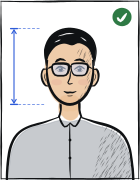
Quick answer: A Italy passport photo must be 35 × 45 mm. Even plain background without shadows. Head occupies 71–78% of photo height. Neutral expression, glasses only if no glare. Last verified .
Italy passport photo: size in mm, cm, inches and pixels
Millimetres
35 × 45 mm
Centimetres
3.5 × 4.5 cm
Inches
1.38 × 1.77″
Pixels at 300 dpi
413 × 531 px
Pixels at 600 dpi
827 × 1063 px
Italy-specific things to know
In Italy you hand over two identical photos at the Questura; the Consulate General in Toronto asks for one, because fingerprints and the signature are taken at the appointment.
The consulate's band for the face is 32–35 mm from chin to crown on a 45 mm frame, inside the 70–80 % of the ministry's ICAO guideline.
The ministry's guideline wants a white background, while the Toronto consulate also accepts a light one if it is plain. White is the safe choice in every office.
The print must be on high-quality, high-definition photo paper; a home print on office paper does not match the ministry's wording.
Glasses are not forbidden: the eyes must be clearly visible with no flash reflection on the lenses (tilt the head slightly); sunglasses are not allowed. The Questura form lets glasses wearers take them off.
How passport photos are verified
Italian passport photographs are governed by the Ministero degli Affari Esteri e della Cooperazione Internazionale (MAECI, the Farnesina) for consulates abroad and by the Polizia di Stato (the Questura) in Italy; both follow ICAO. The ministry's guideline asks for a colour photo of 35 × 45 mm taken within 6 months, with the face covering 70–80 % of the frame, a white evenly lit background, a neutral expression with the mouth closed, no flash reflections or red eyes, and a print on high-quality, high-definition paper.
Read more
The Consulate General in Toronto narrows the face to 32–35 mm from chin to crown and allows a white or light plain background. The number of prints differs: the Questura form asks for two identical recent photos, while the consulate in Toronto asks for one when fingerprints are taken at the appointment.
Examples and mistakes
What makes Italy passport photos accepted
One compliant example next to the six most common rejection causes for Italy passport applications. These are the differences that most often determine whether a document photo is accepted.
Accepted
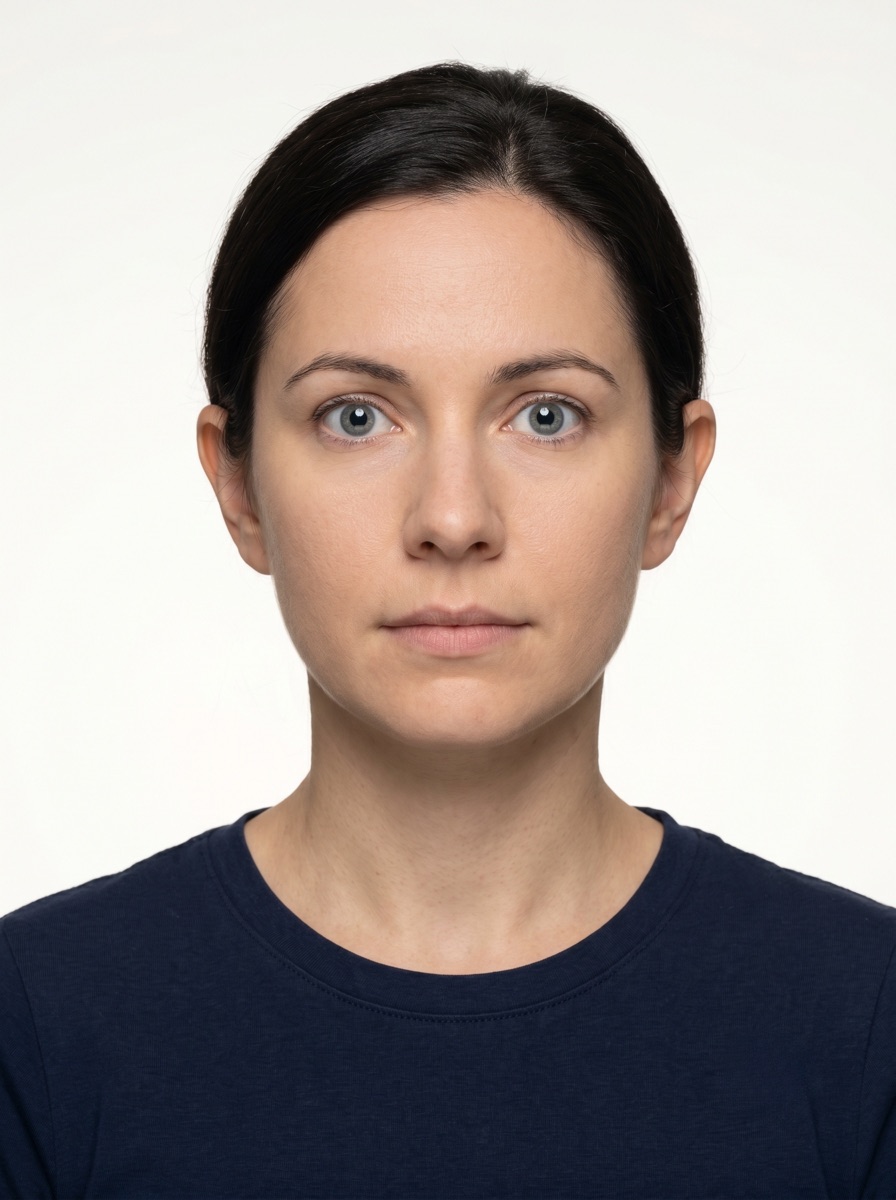
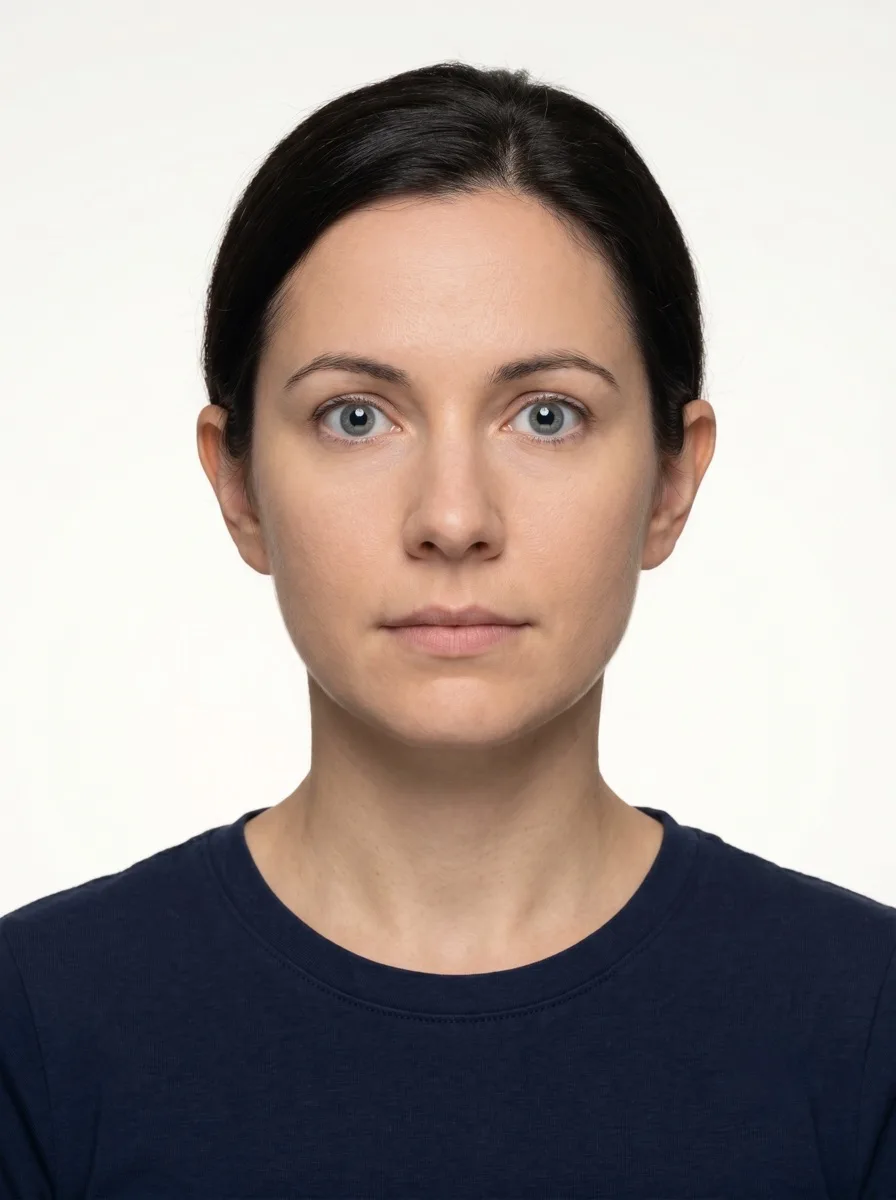
Compliant Italy passport example (35 × 45 mm)
Face centred, looking directly into the lens
Plain background — no shadow, pattern or texture
Neutral expression, eyes open, mouth closed
No glasses, no hair across the face
Top 6 Italy passport rejection causes
Background shadowShadow on the wall behind the head, or background with a visible pattern or gradient
Smile / open mouthVisible smile with teeth or open mouth instead of a neutral expression
Glasses with glareGlasses with a clearly visible light reflection covering part of the eye
Hair across the faceLoose hair strands covering the eyes, eyebrows or part of the face
Eyes off-cameraEyes looking to the side instead of directly into the camera lens
Head tiltedHead tilted so the eye line is no longer horizontal
Typical rejection reasons and how to fix them
Typical reasons a photo is rejected under the rules Ministero degli Affari Esteri e della Cooperazione Internazionale publishes: what is wrong and what to change.
Reason
Fix
Photo not 35 × 45 mm, or the face outside the 32–35 mm band the consulate gives
Print at 35 × 45 mm and keep the head from chin to crown at 32–35 mm (70–80 % of the height).
Background not white or not plain; shadows, objects or other people behind you
Stand in front of a white wall with even light and nobody else in the shot; the ministry asks for a white background with uniform light and the person alone in the picture.
Photo older than 6 months
Take a new photo within the 6 months before the appointment; both the ministry's guideline and the Toronto page use that limit.
Reflections on glasses, flash glare or red eyes; eyes not clearly visible
Shoot without flash, tilt the head slightly if you keep your glasses on, or take them off — the Questura form allows it. Eyes open, mouth closed.
Print on ordinary paper or of low resolution; only one print where two are required
Print on high-quality photo paper and bring two identical prints to a Questura (one at the Toronto consulate — check the number your office asks for).
The tool puts in the required background. Stand half a metre from a plain light wall, face a window and shoot without flash — then there are no shadows on your face or on the wall.
Framing
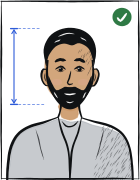
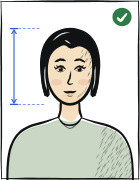
Head: 71–78 % of the photo height
Camera at eye level, about a metre away; head and shoulders in the shot. The tool crops it to 35 × 45 mm.
Glasses
Glasses only if no glare
If you wear glasses, check the shot: no glare on the lenses, eyes clearly visible.
Expression and gaze
Neutral expression, mouth closed, eyes open
Look straight into the lens with your head level; keep hair away from your eyes and eyebrows.
Print at 100% scale, borderless, and turn off fit-to-page so each photo keeps its exact size.
Where to submit your passport application
An Italian passport is issued to Italian citizens: at a Questura of the Polizia di Stato in Italy, or at the consulate (or an honorary vice-consul) abroad. The photo is handed in at the appointment together with the form and the payment.
Questura (Polizia di Stato) in Italyin-person (by appointment)
Book the date, time and place on passaportonline.poliziadistato.it
Processing
Usually 15–30 days, depending on the checks needed
Cost
€73.50 administrative stamp + €42.50 payment (about €116; confirm the amount on your Questura's page)
Two recent identical photos, valid ID with a photocopy, the printed form (adult or minor), proof of payment and the stamp. Some offices quote the payment at €42.70 through PagoPA.
MAECI «Linee guida foto ICAO» (passport and identity card): colour, 35 × 45 mm, at most 6 months old, neutral expression with the mouth closed, eyes open and clearly visible, white background with uniform light, face 70–80 % of the photo from the base of the chin, no flash reflections or red eyes, sharp focus, person alone in the picture.
Same guideline: the photo must be printed on high-quality, high-definition paper and show the face well centred and not in profile, looking straight at the camera.
Consulate General of Italy in Toronto: one frontal colour photo, 35 × 45 mm, with the face from chin to crown 32 to 35 mm, taken at most 6 months earlier, on a white or at least light plain background; fingerprints are taken at the appointment booked through Prenot@mi.
Questura (Polizia di Stato), form «Modello 308» and Questura pages: two recent, identical, frontal photos, face uncovered, white background, ICAO format; people who wear glasses may take them off for the photo to avoid reflections or shadows over the eyes.
Questions
Frequently asked questions
A recent colour photo (at most 6 months old), 35 × 45 mm, taken facing the camera, with a neutral expression, mouth closed and eyes open and visible. White background with uniform light, no flash reflections or red eyes, nobody else in the picture. The face fills 70–80 % of the frame (the Toronto consulate gives 32–35 mm from chin to crown). Print it on high-quality, high-definition photo paper.
35 × 45 mm (3.5 × 4.5 cm), in portrait. This is the size in the ministry's ICAO guideline and in the consulate page; the Questura asks for the ICAO format. Neither source gives a pixel or file size, because the printed photo is handed in at the appointment.
At a Questura in Italy, two identical recent photos. At the Consulate General in Toronto, one photo, since fingerprints are taken at the appointment. Other consulates may differ, so read the list on yours before printing.
Prescription glasses are allowed if the eyes are clearly visible and there is no flash reflection on the lenses — tilting the head slightly helps. Sunglasses are not allowed. The Questura form even says glasses wearers may take them off to avoid reflections or shadows over the eyes; taking them off is the simplest way to be sure.
In Italy you book the appointment on passaportonline.poliziadistato.it and apply at a Questura: the forms and Questura pages show a €73.50 administrative stamp plus a €42.50 payment, about €116 (one office quotes €42.70 through PagoPA, so check the amount on yours). Abroad you apply at the Italian consulate by appointment on Prenot@mi, and the consulate sets the fee.
The Italy passport photo must be 35 × 45 mm. The head must occupy 71–78% of the photo height.
Even plain background without shadows. No gradients, textures, shadows or objects behind the subject are permitted. The tool removes background shadows automatically, but starting with a flat, evenly lit wall gives the best result.
Yes. Stand in front of a flat, plain wall in good natural light, face the light source and use the rear camera of your phone with a 3-second timer. The tool handles the crop, background normalisation and compliance check against the Italy biometric standard.
Most passport authorities require the photo to be taken within the last six months. Do not reuse an older portrait even if your appearance has not changed.
Anfas.Pro provides a 14-day full refund if the photo is rejected by the Italy authority and you supply the official rejection notice. See the refund policy page for the exact process.
Eyes must be fully visible without strong reflections. In practice, the biometric scanner at submission points flags even minor lens glare that looks fine to the naked eye. Removing glasses before shooting is the only option that eliminates the risk entirely.
35 × 45 mm = 3.5 × 4.5 cm = 1.38 × 1.77 inches. At 300 dpi that is 413 × 531 pixels; at 600 dpi, 827 × 1063 pixels.