Australia visa photo requirements and Home Affairs biometrics
The Australian Department of Home Affairs uses one shared photo specification across all major visa categories: 35 × 45 mm, plain light background, head 32 to 36 mm chin to crown. This pillar covers the shared photo standard, biometric capture handling, and links to dedicated pages for the 6 most common visa categories.

Quick answer
35 × 45 mm, plain light background, head 32-36 mm
An Australian visa photo is 35 × 45 mm portrait orientation with the head measuring 32 to 36 mm chin to crown on a plain neutral or light grey that contrasts with the face, even illumination. Neutral expression, eyes open, no glasses, taken within the last 6 months. Biometric capture at the VAC for most nationalities. Last reviewed .
The Australian visa photo specification
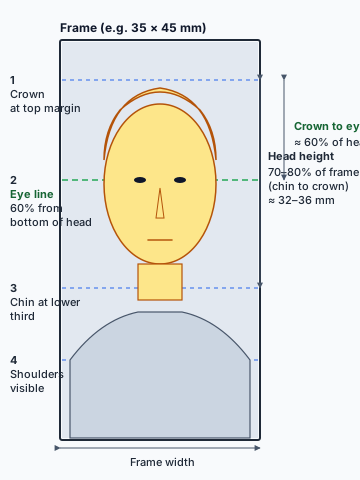
| Size | 35 × 45 mm portrait |
|---|---|
| Head height | 32 to 36 mm chin to crown |
| Background | plain neutral or light grey that contrasts with the face, even illumination |
| Pose | Front-facing, head level, both ears typically visible |
| Expression | Neutral, mouth closed (no smile preferred) |
| Glasses | Discouraged; banned at most VACs due to glare. See full rules → |
| Head covering | Religious or medical head coverings allowed; facial features must be visible |
| Age of photo | Taken within the last 6 months |
| Digital file | JPEG, 70 KB to 3.5 MB; 1200 × 1600 px is the preferred resolution. A scan of a print or a photo of a photo is not accepted. |
| Checked against primary sources. Updated . Sources | |
Choose your Australian visa category
The photo specification is identical across these categories. The application route — fee, processing time and supporting evidence — varies by category.
No such country in the list.
Australian visa categories at a glance
| Visa | Processing | Biometrics |
|---|---|---|
| Visitor visa (subclass 600) | 50% within 21 days | Yes for certain nationalities — at a Visa Application Centre (VFS Global) |
| Student visa (subclass 500) | 50% within 4 weeks | Yes for most nationalities — at a VAC |
| Skills in Demand visa (subclass 482) | Variable | Yes for most nationalities — at a VAC |
| Skilled Independent (subclass 189 / 190) | 50% within 6-12 months from invitation | Yes for most nationalities — at a VAC |
| Working Holiday (subclass 417 / 462) | 50% within 18 days | Yes for some nationalities — at a VAC |
| Partner visa (subclass 820 / 801) | 50% within 14 months for 820 | Yes — at a VAC |
There is no fee column here on purpose: Home Affairs indexes every visa application charge on 1 July, so a number printed here would be wrong within months. The current amount for your category is in the Visa Pricing Table ↗.
Home Affairs biometrics
Biometric capture is mandatory for many Australian visa applicants. The Visa Application Centre (VFS Global in most markets) captures a biometric photo and 10 fingerprints. There is no separate biometrics fee — it is included in the visa application service fee.
Once captured, biometrics remain on file at Home Affairs. Subsequent visa applications within a reasonable window can reuse the existing data. The exact reuse policy depends on the time since the original capture and the visa category. Visitors using ETA (subclass 601) or eVisitor (subclass 651) generally do not need biometrics.
Australia does not issue a permanent resident card: a visa — including a permanent one — is recorded electronically against your passport and checked through Visa Entitlement Verification Online (VEVO). Your photo is therefore never printed onto a card; it stays in the Department's identity record. Choose an image that matches how you look now anyway, because that record is what border control compares your face against on arrival.
Frequently asked questions
01What size is an Australia visa photo?
An Australian visa photo is 35 × 45 mm — the same size as a Schengen and an Australian passport photo. The head measures 32 to 36 mm chin to crown chin to crown. Department of Home Affairs uses this specification across nearly every visa category.
02Is the Australia visa photo the same as an Australian passport photo?
Yes — both use 35 × 45 mm with identical head ratio, background and expression rules. The DFAT passport photo specification and the Home Affairs visa specification are aligned.
03Do I need biometrics for an Australian visa?
Most nationalities require biometric capture (photo and fingerprints) at a Visa Application Centre. Once captured, biometrics remain on file. Citizens of low-risk countries applying for ETA (subclass 601) or eVisitor (subclass 651) often skip biometrics.
04Can I smile in an Australia visa photo?
No. Home Affairs requires a neutral expression with mouth closed. A subtle closed-lip smile is technically tolerated but biometric scoring penalises it — fully neutral is the safer choice.
05Can I wear glasses in an Australia visa photo?
Glasses with clear lenses are permitted only if the eyes are fully visible without glare. In practice, biometric checks at the VAC reject most photos with glasses because of reflection risk. Remove glasses before the shot.
06What if Home Affairs ImmiAccount rejects my photo?
ImmiAccount runs an automated geometry check on upload. Common rejection causes: head not centred, wrong head ratio, background not uniform, file format issues. Reshoot under natural light against a plain wall, then re-upload through ImmiAccount.
Related cross-country guides
Sources
- Australian Department of Home Affairs, Photo requirements for citizenship applications — the Department's published photo specification: neutral or light grey background, JPEG from 70 KB to 3.5 MB, 1200 × 1600 px preferred, photo no more than 6 months old. homeaffairs.gov.au ↗
- ICAO Doc 9303 Machine Readable Travel Documents, Part 9 — portrait quality and biometric framing. Australia adopts ICAO 9303 as the underlying standard for visa photo geometry. ICAO 9303 ↗
Verified . We monitor homeaffairs.gov.au for changes. We deliberately do not print visa application charges here: Home Affairs indexes them every 1 July, so a figure copied into a guide is wrong within months — open the Visa Pricing Table ↗ for today's amount. Processing times are recalculated continuously, so the figures on the category pages are indicative rather than a promise.
Prepare your Australian visa photo
Upload a portrait — Anfas.Pro applies the Home Affairs 35 × 45 mm format and biometric framing automatically, and sets the file size.