Canada visa photo requirements and IRCC biometrics
Immigration, Refugees and Citizenship Canada (IRCC) does not use one shared photo specification. A visa application needs a frame of at least 35 × 45 mm, a plain light background and a head measuring 31 to 36 mm chin to crown. A PR card needs 50 × 70 mm on paper, or 715 × 1000 to 2000 × 2800 pixels online; a Canadian passport uses 50 × 70 mm and bans glasses outright. This pillar covers the visa specification, biometrics handling and links to a dedicated page for each of the 6 most common visa categories.

In this article · 8 sections
Quick answer
At least 35 × 45 mm, plain light background, head 31-36 mm
A Canadian visa photo needs a frame of at least 35 × 45 mm in portrait orientation, with the head measuring 31 to 36 mm chin to crown on a plain white or light grey, even illumination. Neutral expression, eyes open, clear prescription glasses allowed, taken within the last 6 months. Biometric capture at the VAC for most nationalities. Last reviewed .
The Canadian visa photo specification
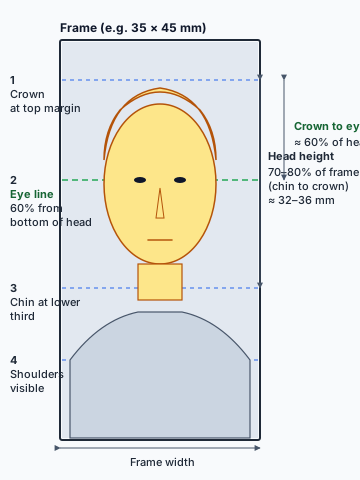
| Size | at least 35 × 45 mm portrait |
|---|---|
| Head height | 31 to 36 mm chin to crown |
| Background | plain white or light grey, even illumination |
| Pose | Front-facing, head level, both ears typically visible |
| Expression | Neutral, mouth closed (no smile) |
| Glasses | Clear, non-tinted prescription glasses allowed if the eyes stay visible and the frame does not cover them; no sunglasses. See full rules → |
| Head covering | Religious or medical head coverings allowed; facial features must remain visible |
| Age of photo | Taken within the last 6 months |
| Digital file | JPEG or JPEG2000, 420 × 540 pixels minimum, aim for about 240 KB and not less than 60 KB |
| Checked against primary sources. Updated . Sources | |
Choose your Canadian visa category
The photo specification is identical across these categories. The application route — fee, processing time and supporting evidence — varies by category.
No such country in the list.
Canadian visa categories at a glance
| Visa | Fee | Processing | Biometrics |
|---|---|---|---|
| Visitor visa (TRV) | CAD $100 per applicant | 20-60 days standard | Yes for most nationalities — at a Visa Application Centre |
| Study Permit | CAD $150 study permit fee | Variable by country | Yes for most nationalities — biometric photo and fingerprints captured at the VAC |
| Work Permit | CAD $155 work permit fee | 4-16 weeks depending on country and LMIA status | Yes for most nationalities — captured at the VAC |
| Express Entry (Federal PR) | see the current IRCC fee list — amounts were re-indexed on 30 April 2026 | 6 months standard from ITA to final decision | Yes — captured at the VAC |
| Family Sponsorship | see the current IRCC fee list — amounts were re-indexed on 30 April 2026 | 12-24 months for spouse/partner sponsorship from outside Canada | Yes — captured at the VAC |
| Super Visa | CAD $100 application fee | 2-8 weeks | Yes — captured at the VAC |
IRCC biometrics and the 10-year window
Biometric capture is mandatory for most Canadian visa, study and work permit applicants. The VAC captures a biometric photo plus 10 fingerprints. The biometrics fee is CAD $85 (CAD $170 for a family of 2 or more applying together).
Once captured, your biometrics remain on file at IRCC for 10 years. Any subsequent Canadian visa application within that window reuses the existing biometrics — no second capture required. This applies regardless of category: a TRV applicant whose biometrics expire in 2034 can later apply for a Study Permit, Work Permit or PR without re-capturing biometrics until 2034.
The practical implication: the biometric photo captured for your first Canadian visa will be the reference image used for every Canadian application over the next decade. Treat the first capture as the photo that represents you for 10 years.
Frequently asked questions
01What size is a Canada visa photo?
A Canadian visa photo uses a frame of at least 35 × 45 mm — the same minimum as the Schengen format. IRCC measures the head separately at 31 to 36 mm chin to crown, and that is what usually forces a reshoot. The 50 × 70 mm figure quoted on many sites belongs to the Canadian passport and to printed PR card photos, not to visa applications.
02Is the Canada visa photo the same as a Canadian passport photo?
No. A Canadian passport photo is 50 × 70 mm and does not accept glasses at all. A visa photo needs a frame of at least 35 × 45 mm and does allow clear prescription glasses. The PR card has yet another specification of its own. So a passport photo cannot be reused unchecked for a visa application.
03Do I need biometrics for every Canadian visa?
Most nationalities require biometric capture at a Visa Application Centre (VAC) for a first Canadian visa or work/study permit. Once captured, the biometrics are valid for 10 years — reused for subsequent applications without re-capture. The biometrics fee is CAD $85.
04Can I smile in a Canada visa photo?
No. IRCC requires a neutral expression with mouth closed. A faint smile is rejected by IRCC's automated photo check at the upload stage.
05Can I wear glasses in a Canada visa photo?
Yes. IRCC allows non-tinted prescription glasses on a visa photo as long as your eyes stay clearly visible and the frame does not cover any part of your eyes. Sunglasses and tinted lenses are not accepted. Canadian passport photos are stricter — there, glasses are not accepted at all.
06What if the IRCC portal rejects my uploaded photo?
IRCC runs an automated geometry check on upload. Common rejection causes: head not centred, eyes not at the right height, background not uniform, or a file smaller than 420 × 540 pixels. The file may be up to 4 MB — IRCC suggests aiming for about 240 KB and not going below 60 KB, so heavy compression is unnecessary and costs detail around the eyes. Reshoot under daylight against a plain wall.
Related cross-country guides
Sources
- Immigration, Refugees and Citizenship Canada (IRCC), Temporary Resident Visa application photograph specifications — official photo specification for Canadian visa applications (frame, head height, glasses). canada.ca ↗
- ICAO Doc 9303 Machine Readable Travel Documents, Part 9 — portrait quality and biometric framing. Canada adopts ICAO 9303 as the underlying standard for visa photo geometry. ICAO 9303 ↗
Verified . We monitor canada.ca for changes; visa fees and processing times shown for individual categories are sourced from each category page (see sub-pages for direct links).
Prepare your Canadian visa photo
Upload a portrait — Anfas.Pro applies the IRCC visa format from 35 × 45 mm and biometric framing automatically.