 Schengen Area
EES Is Live: The Face Photo and Fingerprints Taken at the Schengen Border
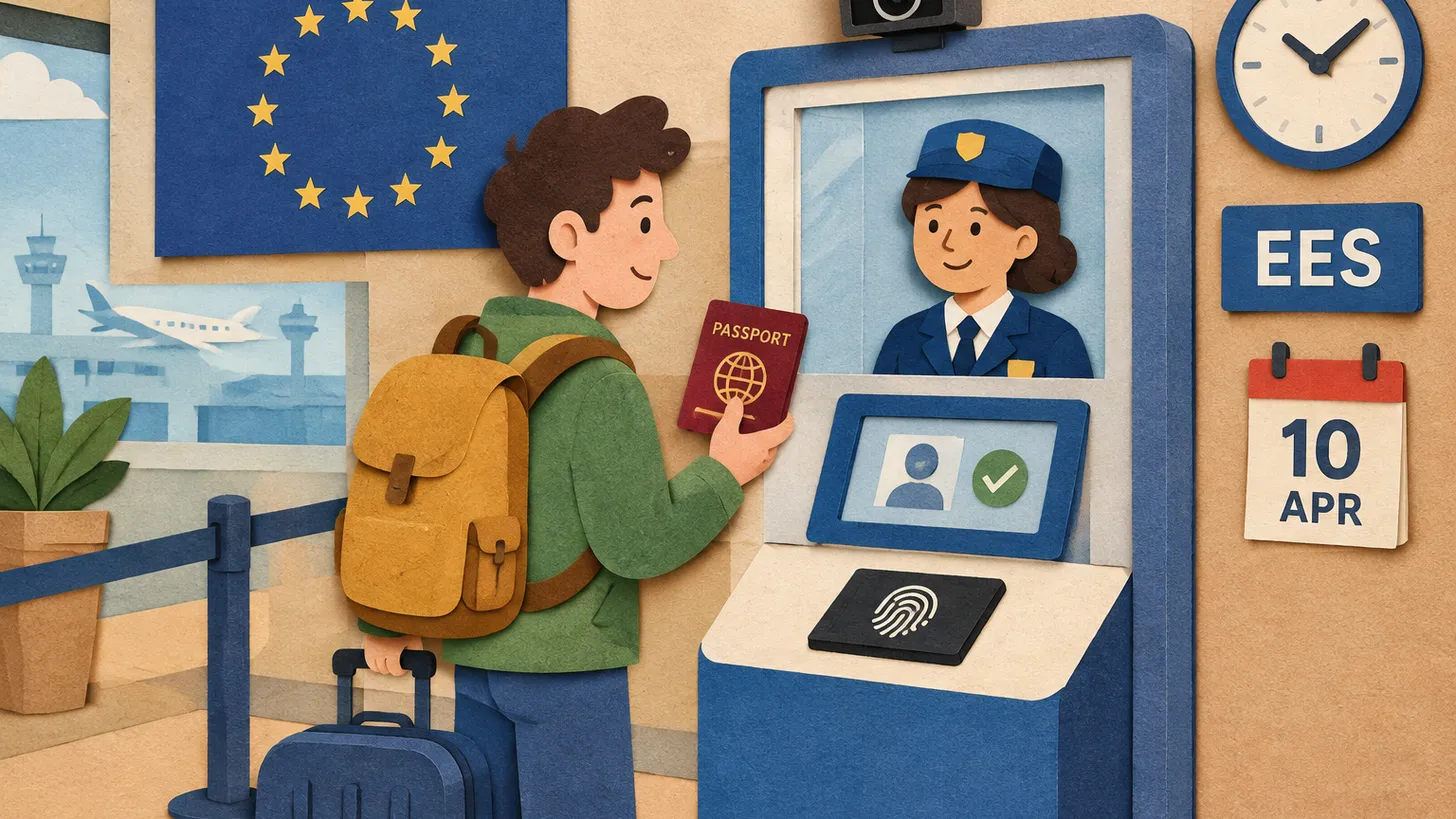
Since 10 April 2026 the EES records a face photo and fingerprints of non-EU short-stay visitors at all Schengen external borders — no advance registration.
Key points
5 points- The Entry/Exit System started on 12 October 2025 with a gradual roll-out and has been fully operational at all external border crossing points since 10 April 2026.
- It applies to non-EU nationals coming for short stays; travellers' facial image, fingerprints and travel-document data are recorded.
- There is nothing to register in advance — the enrolment happens at the border, so allow extra time.
- Fingerprints are not taken from children under 12, and the data is kept for a limited time (three years, five if you overstay).
- EES is not ETIAS: the separate travel authorisation for visa-exempt travellers is a different system and not yet in operation.
If you enter the Schengen area on a short stay from outside the EU, the border process is different from what it was a year ago. The EU’s Entry/Exit System (EES) replaced passport stamping with a digital record of your face and fingerprints. It has been fully live since 10 April 2026 — and questions about the “EES photo” are now among the most common ones from travellers and visa applicants.
What the EES is, in one paragraph
The European Commission announced that “as of 10 April 2026, the EES will become fully operational”. It records non-EU nationals coming for short stays when they cross the external borders of the 29 participating European countries, at entry and at exit. The system started operating on 12 October 2025 and was introduced progressively; from 10 April 2026 it covers all external border crossing points of the countries using it. It replaces manual stamping of passports with an electronic record.
What is recorded
According to the Commission, the traveller’s facial image, fingerprints and personal data from the travel document are recorded. Per the underlying EU regulation (Regulation (EU) 2017/2226), the entry and exit data also includes the date, place and other details of the crossing.
- Facial image: taken at the border (or at a self-service kiosk where one is provided) at your first crossing.
- Fingerprints: collected from adults. The regulation exempts children under 12 from fingerprinting.
- Travel document data: read from your passport.
- Retention: the regulation sets three years for an entry/exit record, and five years for people who overstay.
Who is affected — and who is not
The EES is for third-country nationals visiting for a short stay. EU citizens are not enrolled. If you have a short-stay Schengen visa or you are visa-exempt for short stays, you are in scope. Holders of residence permits or long-stay visas are not short-stay visitors, so check your own case on the official EES pages before you travel.
Do I need to prepare a photo in advance?
No. The EES photo is not something you upload: it is taken live in front of the camera at the border. The Commission’s wording is simple — you do not need to register beforehand, the enrolment happens on arrival. What you can prepare is practical:
- Time. The first crossing takes longer because everything is captured from scratch. Passport control is slower while the system is being rolled out at busy crossings.
- Your appearance. Remove hats, sunglasses and anything that covers your face. A neutral expression works best for the camera, the same way it does for a passport photo.
- Your passport photo. The image taken at the border is the live one. Still, travel with a passport whose photo looks like you today; an outdated picture is an avoidable source of questions at any border.
- Your visa photo. If you need a Schengen visa first, the visa application still needs its own photo that meets the biometric standard — the EES does not replace it.
EES vs ETIAS: do not mix them up
The EES is already running. ETIAS — the online travel authorisation that visa-exempt travellers will have to apply for — is a separate project. The official EU travel site says the launch date will be announced several months in advance, so any website claiming that ETIAS applications are open today is not something to trust with your passport number.
Practical checklist
- Arrive earlier than you used to at your first Schengen entry after October 2025.
- Keep your passport, visa and return ticket at hand — the officer or kiosk may need to see them.
- Follow the signs to the EES kiosks if the airport has them; otherwise the border officer will take the photo and fingerprints at the booth.
- If you are applying for a Schengen visa, prepare the 35 x 45 mm biometric photo before your appointment.
If your next step is a visa application, you can make the required photo with our Schengen visa photo tool.
Europe SchengenSchengen Visa · requirements
07Questions
5 answers01When did the EES become fully operational?
On 10 April 2026. The system began operating on 12 October 2025 with a progressive roll-out and has covered all external border crossing points of the participating countries since that date.
02Do I have to register for the EES before I travel?
No. Enrolment happens at the border: the facial image, fingerprints and travel-document data are recorded when you arrive.
03Are children fingerprinted?
Children under 12 are exempt from fingerprinting under the EES regulation. A facial image is still recorded.
04How long is the EES data kept?
Under the regulation, three years for entry/exit records and five years for travellers who overstay.
05Is ETIAS the same as the EES?
No. The EES is a border registration system that is already running. ETIAS is a separate online travel authorisation for visa-exempt travellers whose launch date has not been fixed.
08Official sources
- European Commission, Home Affairs — The Entry/Exit System will become fully operational on 10 April 2026
home-affairs.ec.europa.eu - Travel to Europe (EU) — EES frequently asked questions
travel-europe.europa.eu - Regulation (EU) 2017/2226 establishing the Entry/Exit System
eur-lex.europa.eu
Author: Yevhen Kravchenko. Published . Checked against official sources on .
Schengen Area Germany
 Spain+6
EU ID card photo requirements: sizes and rules by country
The size for an ID card photo in EU countries is not uniform: Spain requires 32 × 26 mm, France needs 35 × 45 mm, and in Lithuania, the initial print must be 40 × 60 mm.
 Schengen Area
EU residence permit photo requirements: what the EU sets and what countries decide
EU regulations mandate the ID-1 format and a microchip, leaving the exact photo size to individual member states, while biometric data is stored for a maximum of 90 days.
 Schengen AreaSpain
 Finland+3
EU passport photo size: why there is no single EU standard
Council Regulation (EC) No 2252/2004 requires a highly secure storage medium containing a facial image, but pan-European rules regarding the exact dimensions of the printed photo are not published in accessible sources.
Make the photo for this document
Upload a selfie — we crop it to 35 × 45 mm, replace the background and check it against the document rules. Free.
Schengen Visa · Europe SchengenUpload