 Spain
 Netherlands
 Sweden
 Belgium
 Schengen Area
Reused Biometrics or a New Photo for a Residence Permit Renewal: Rules in Spain, the Netherlands and Sweden
Rules for renewing a residence permit vary: the Netherlands may not require new biometrics if they were taken less than 6 months ago, while Sweden requires a new capture for every new card and Italy asks for 4 photos when you are called to the Questura.

In this article · 7 sections
Key points
6 points- European Regulation 1030/2002 does not set a single maximum age for the photo, leaving the procedure to each state's national practice.
- The Dutch IND may reuse biometrics if they were taken at an IND desk or an embassy less than 6 months ago; for W/W2 documents the period is less than 5 years and 3 months.
- The Swedish Migration Agency requires a new photo and fingerprints for every new card.
- In Spain, the current Regulation 1155/2024 requires one photo for each renewal, and its specifications refer to the DNI standard of 32 × 26 mm.
- In Italy, 4 new photos must be provided when you are called to the Questura for a renewal; renewal must be requested at least 60 days before expiry.
- In Germany, the authority may require a recent photo or the applicant's participation in taking the picture on site; the fee schedule lists a separate charge of 6 euros for a photo taken by the authority.
Short answer
There is no single rule in the European Union on reusing a photo when renewing a residence permit. Under European Regulation 1030/2002, the procedure for collecting biometrics is determined by each state's national practice. In the Netherlands, for example, new biometrics may not be needed if they were taken at an IND desk or an embassy less than 6 months ago. The Swedish Migration Agency, by contrast, requires you to be photographed and to give fingerprints for every new card. In Italy, 4 photos must be provided when you are called to the Questura, while in Spain a single photo meeting DNI requirements, including a size of 32 × 26 mm, is submitted with a renewal.
The European standard and differing national practices
Residence permit cards in EU states share a uniform format, but the procedure for issuing them can differ. Council Regulation (EC) No 1030/2002 laying down a uniform format for residence permits (consolidated version of 21.11.2017) provides for a storage medium containing a facial image and two fingerprints of the holder in interoperable formats. The identification photo must also be integrated into the card body and protected by a diffractive optically variable device (DOVID).
The regulation allows either a photo supplied by the applicant or a picture taken when the application is filed. It states explicitly that the procedure is determined in accordance with the national practice of the member state concerned. Regulation 1030/2002 itself sets neither the photo's size in millimetres nor a maximum age for it. Rules on reuse, paper photos or photos taken by the authority therefore have to be checked for the specific country and procedure.
In our database of 241 document profiles, 229 profiles record an exact printed photo size. Among them there are 17 different formats. The most common is 35 × 45 mm (148 profiles). Next by frequency are 51 × 51 mm (16 profiles), 30 × 40 mm (14 profiles) and 40 × 60 mm (11 profiles). On background colour: 52 of 241 profiles require a white background, 23 name a specific non-white shade, and the rest only require a light plain background without specifying an exact colour. Only 32 of 241 profiles record a maximum photo age in the system: 3 months for two profiles and 6 months for thirty. The remaining profiles in the database simply do not record such a limit; this is a limitation of the data collected, not proof that no limit exists in those countries. Database figures as of 23 Sep 2026, the date of this article.
Comparing the parameters: reuse and sizes
The table below compares confirmed country rules on the procedure for updating a residence permit photo, photo sizes and whether old pictures can be reused.
| Country and authority | Photo size (mm) | Reuse rule / photo age | Who takes the photo | Application window |
|---|---|---|---|---|
| Netherlands (IND) | Not published by the authority in form 7602 | May be reused if biometrics were taken < 6 months ago; for W/W2, < 5 years and 3 months | At a Desk or Service Point the IND takes a digital photo; biometrics are free of charge | Not published by the authority |
| Sweden (Migrationsverket) | Not published by the authority | New photo and fingerprints required for every new card | The Migration Agency photographs and fingerprints the applicant; a separate procedure applies to captures at an embassy or consulate | No earlier than 3 months before the card expires |
| Spain (Policía Nacional) | 32 × 26 mm | 1 photo submitted with each renewal | The applicant supplies the photo to DNI requirements | 2 months before expiry / up to 3 months after |
| Italy (Questura) | At least 45 mm high × 35 mm wide | 4 new photos submitted at the appointment | The applicant supplies the photos | At least 60 days before expiry |
| Germany (Ausländerbehörde) | Not published by the authority | Not published by the authority | On request, the applicant submits a recent photo or takes part in having the picture taken on site | Not published by the authority |
Europe SchengenResidence Card · requirements · check a photo
SpainResidence Card · requirements · check a photo
NetherlandsResidence Card · requirements · check a photo
SwedenResidence Card · requirements · check a photo
Country by country: where the old photo is kept and where a new one is required
Netherlands: clear time limits for biometrics
The Netherlands sets out time limits for reusing biometrics in writing in form 7602 (Appendix Fingerprints, passport photo and signature). New biometrics are not required if the fingerprints and photo were taken at an IND desk or at an embassy abroad less than 6 months ago. A separate period applies to W and W2 documents (Foreign Nationals Identity Document): biometrics may be reused if they were taken less than 5 years and 3 months ago. In that case the IND reuses the old biometric data.
If the IND says biometrics are needed to produce the document, staff at the Desk or Service Point take a digital passport photo and fingerprints. The IND does not accept photos taken elsewhere by a photographer. Providing biometrics is free of charge.
For a child under 2, no biometrics appointment is needed. Instead, the child's photo is sent using the Appendix Passport photo form. The photo must be taken by a photographer and meet the requirements for Dutch passports. Form 7602 also warns that a photo that does not meet the requirements may cause unnecessary delay. The form itself does not give the dimensions in millimetres.
The IND photographs applicants against a light grey background and asks them not to come in all-white or light grey clothing, as the photo may not turn out correctly. Headwear may be kept on for religious or philosophical reasons as long as the face remains uncovered. The IND also recommends plain headwear that is not light grey and has no reflective materials or busy patterns.
Sweden: a new photo for every card
The Swedish Migration Agency explains the rule this way: the residence permit card has a computer chip containing fingerprints and a photo. So every time a new card is needed, the applicant must be photographed and fingerprinted again. This also applies when a new or extended permit has been granted. The agency does not publish the photo's dimensions in millimetres; the photographing at the appointment is done by the agency.
To renew a permanent residence card, the appointment is booked through “My page”. The Migration Agency sends information and a request to book an appointment ahead of the expiry of the current card. If the letter or booking confirmation has not arrived within 14 days, the agency advises contacting it by phone or through the portal. An appointment can be booked no earlier than three months before the card expires. You must bring a valid identity document and your current card to the appointment. The old card must be returned when the new one is collected. If the capture takes place at an embassy or consulate general, producing and delivering the card may take up to four weeks.
Spain: a new regulation and a mandatory DNI format
In Spain, the photo requirement is set out in current legislation. One photo is attached to the application for each renewal of the foreigner's identity card (tarjeta de identidad de extranjero). The old Real Decreto 557/2011 was formally repealed as of 20 May 2025 by a final provision of the new Real Decreto 1155/2024 of 19 November. Renewal requirements are now contained in articles 178, 185 and 209 of the new decree.
Article 209 (paragraph 10) states that changes, including renewals (renovaciones), determine the issue of a new card. Under the legislation on the national identity document (DNI), the photo must be in colour, measure 32 × 26 millimetres, have a uniform plain white background, be taken full face with the head fully uncovered and without dark glasses or any other garment that could hinder identification.
Reissuing a document under DNI rules requires the holder's personal attendance, payment of the relevant fee, a new photo meeting the stated specifications and fingerprinting. To renew the foreigner's card, the application is filed two months before expiry, and filing within three months afterwards is also allowed. Once the card has expired or the permit has been renewed, foreign nationals must hand the old document in at the relevant police station for their place of residence.
Germany and Italy: different national procedures
The German foreigners' authority (Ausländerbehörde) operates under § 60 Aufenthaltsverordnung (AufenthV). At the request of the competent authority, the foreign national submits a current photo or takes part in having the picture taken at the office. If the authority takes the picture, the schedule of fees has a separate line of 6 euros. Renewing the permit itself costs 96 euros for a further stay of up to three months and 93 euros if the stay exceeds three months. Stored fingerprints, the photo and the signature may, after the document is issued, be used only to produce the chip document again. § 60 AufenthV sets no maximum age for the photo and does not say how long before expiry a renewal application must be filed.
In Italy, when called to the Questura to renew the permit, the applicant must provide 4 passport-style photos. The background must be white, the minimum height of the photo is 45 mm and the width 35 mm. One of the photos will be placed on the residence permit. Renewal must be requested from the Questore of the province of residence at least 60 days before the expiry date shown on the current card.
As for Belgium, an FPS Foreign Affairs instruction confirms the use of Belgian ID card-style photos for consular routes and a 35 × 45 mm format. Requirements for the residence card photo and its reuse on renewal are not confirmed in this file; the authority does not publish them in the sources checked.
To make sure your picture meets all current technical standards of these countries, you can prepare a residence permit photo with our service, which takes the correct proportions into account.
Procedural mistakes during renewal
Official sources describe several situations to keep in mind when preparing documents. The IND states plainly that photos taken elsewhere by a photographer are not accepted. In the Netherlands, it is important to count the less-than-6-months period from the day the biometrics were taken at an IND desk or an embassy, not from any other date.
In Italy, 4 photos must be provided when called to the Questura. In Sweden, you must be photographed and fingerprinted again for every new card. In Germany, the authority may take the photo itself, for which a separate fee of 6 euros applies.
Application windows also differ: in Sweden you can book no earlier than three months before the card expires, in Italy renewal must be requested at least 60 days ahead, and in Spain the application is filed two months before expiry or within three months afterwards. The Spanish size of 32 × 26 mm does not match the 35 × 45 mm format used in some of the other profiles.
For Spain, it is also important to cite the current Real Decreto 1155/2024: Real Decreto 557/2011 was repealed as of 20 May 2025. The old Swedish card must be returned when the new one is collected, and in Spain the document is handed in at a police station after the card expires or the permit is renewed.
Step-by-step guide to preparing for reissue
Use the following order to check the requirements:
- Check the application window. In Italy, renewal must be requested at least 60 days before the current card expires. In Sweden, booking opens no earlier than three months ahead. In Spain, the application is filed 2 months before the expiry date or within 3 months after it.
- Find out how the photo is obtained in your jurisdiction. In Sweden, the Migration Agency takes the photo and fingerprints for every new card. At a Desk or Service Point in the Netherlands, the IND takes the digital photo. In Spain, one 32 × 26 mm photo is submitted, and in Italy, 4 photos 35 mm wide and at least 45 mm high are provided when called to the Questura.
- Check how old your previous biometrics are for the Netherlands. Take into account the date biometrics were last taken at an IND desk or an embassy. If less than 6 months have passed, new biometrics may not be needed. For a W/W2 document, the period is less than 5 years and 3 months.
- Prepare your documents and check the fees. For a Swedish appointment, bring a valid identity document and your current card. In Germany, the fee is 96 euros for a further stay of up to 3 months or 93 euros for more than 3 months, with a separate 6-euro fee if the authority takes the photo. For the Spanish procedure, the legal sources provide for payment of the relevant fee.
- Check how the old card is returned. In Sweden, the old card must be returned when the new one is collected. In Spain, the document is handed in at the relevant police station after the card expires or the permit is renewed.
06Questions
5 answers01Can I reuse an old photo when renewing a residence permit in the Netherlands?
Yes: if the IND or an embassy took your fingerprints and photo less than 6 months ago, they may not take them again. For W/W2 documents, biometrics taken less than 5 years and 3 months ago are sufficient.
02Does the Swedish Migration Agency accept photos from photo studios?
The Swedish Migration Agency does not publish information on this. For every new card, the agency requires the applicant to be photographed and fingerprinted.
03What photo size is needed to renew a Spanish card?
Spanish law (article 5.1.b of RD 1553/2005) requires one photo measuring 32 × 26 millimetres on a uniform plain white background.
04How many photos do I need to bring to the Questura in Italy?
When called to the Questura to renew a residence permit, you must provide 4 photos 35 mm wide and at least 45 mm high.
05Do I have to pay for a photo taken at the German foreigners' authority?
If the authority (Ausländerbehörde) takes the picture itself on its own equipment, the fee schedule provides for a separate charge of 6 euros.
07Official sources
- Council of the European Union, EUR-Lex
eur-lex.europa.euopened - Immigratie- en Naturalisatiedienst (IND), Netherlands
ind.nlopened - IND Netherlands — Biometrics
ind.nlopened - Migrationsverket, Sweden — Renew permit
migrationsverket.seopened - BOE, Spain — RD 1155/2024
boe.esopened - BOE, Spain — RD 1553/2005
boe.esopened - Bundesministerium der Justiz, Germany
gesetze-im-internet.deopened - Ministero dell'Interno, Italy
portaleimmigrazione.itopened - Migrationsverket, Sweden — “Residence permit cards” (checked 2026-09-22)
migrationsverket.seopened - Agencia Estatal Boletín Oficial del Estado (BOE), Spain — Repeal notice for Real Decreto 557/2011 (checked 2026-09-22)
boe.esopened
Author: Yevhen Kravchenko. Published . Checked against official sources on .
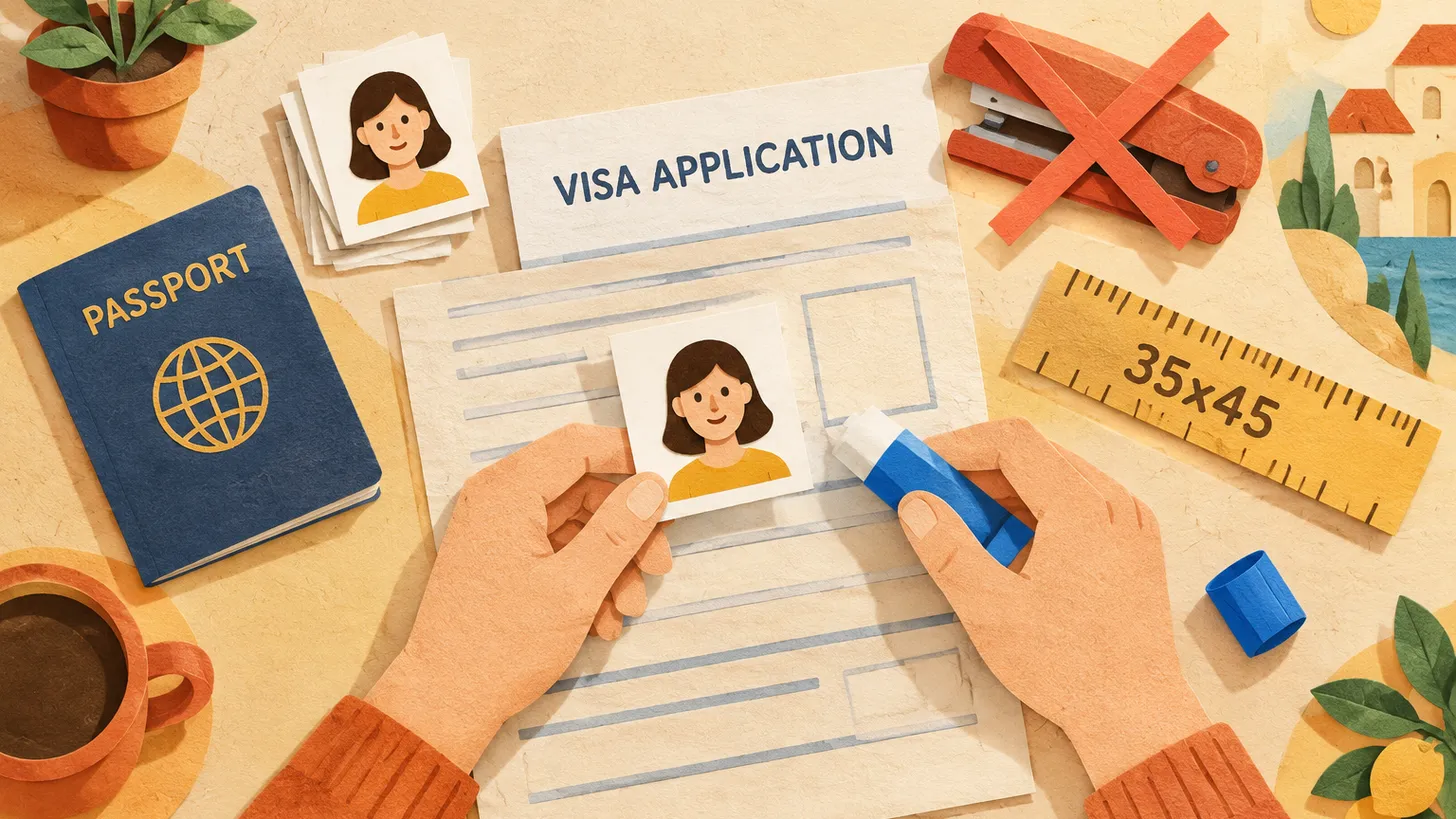
SpainSpain Schengen Visa Photo Requirements: 35 x 45 mm, White Background, Glued to the Form — What Consulates Ask
Spanish consulates ask for a recent colour passport-size photo (35 x 45 mm) on a white or light background, glued or clipped to the Schengen form.
 Schengen Area
 GermanySpain+6
EU ID card photo requirements: sizes and rules by country
The size for an ID card photo in EU countries is not uniform: Spain requires 32 × 26 mm, France needs 35 × 45 mm, and in Lithuania, the initial print must be 40 × 60 mm.
 Schengen AreaGermanyNetherlands+3
EU residence permit cards: why the Netherlands sets an ear-to-ear face width and Sweden takes the photo itself
There is no single EU standard for residence permit card photos: Regulation 1030/2002 governs the card itself, and national approaches differ.
Make the photo for this document
Upload a selfie — we crop it to 35 × 45 mm, replace the background and check it against the document rules. Free preview.
Residence Card · Europe SchengenUpload