 Latvia
 Lithuania
 Estonia
ID photos in the Baltics: megabytes in Estonia, stamps in Latvia and cropping in Lithuania
There is no single Baltic standard. Estonia's Police Department requires a 1300×1600 px digital file, Latvia takes photos on site or accepts a print stamped by a photo studio, and Lithuania crops a 35×45 image from a 40×60 mm sheet.
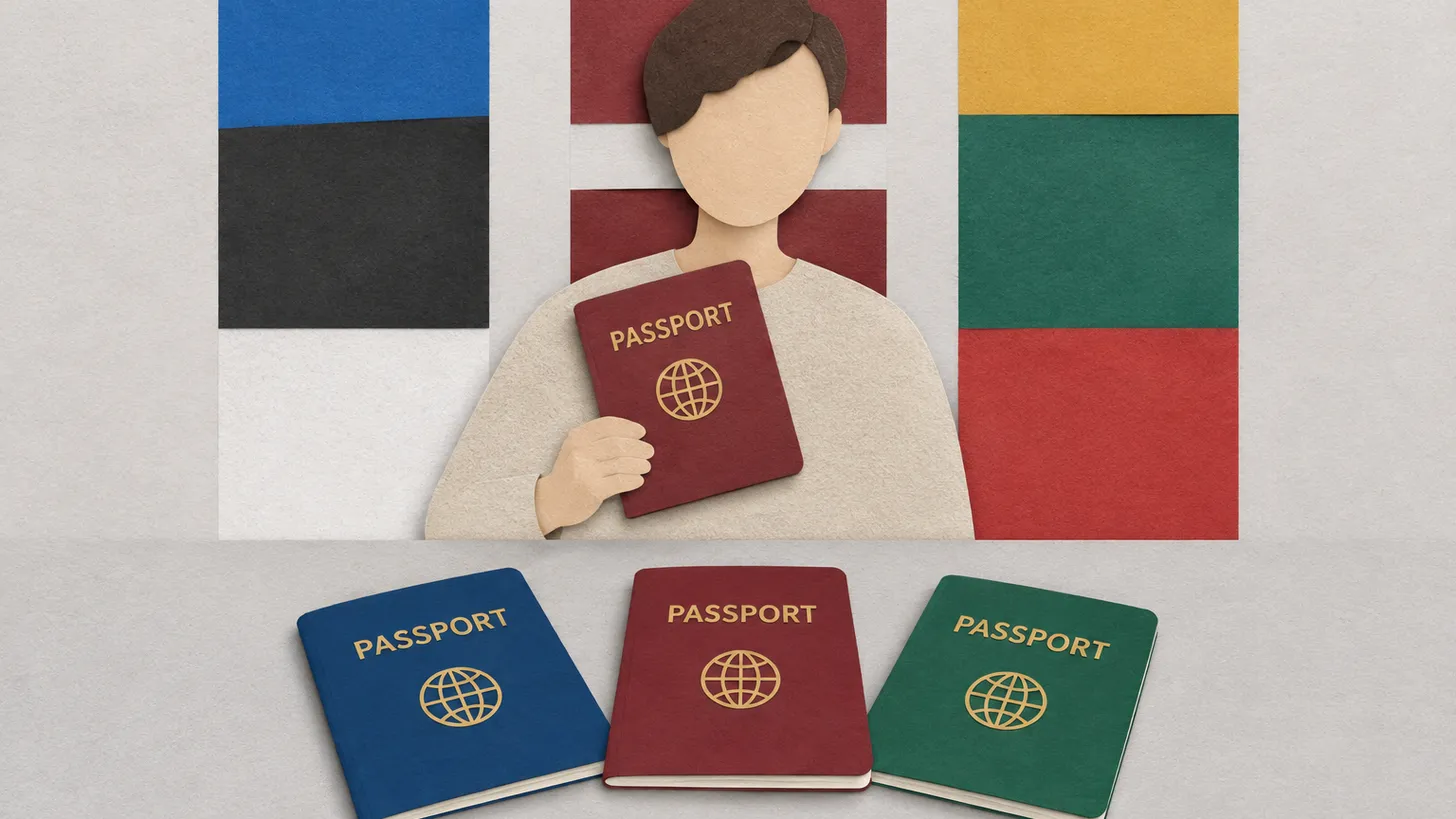
In this article · 10 sections
- 01Global practice and where the Baltic formats sit in our database
- 02Comparing the parameters: Estonia, Latvia, Lithuania
- 03Estonia: a digital standard, pixels and photo booths
- 04Latvia: scanning the print and the ban on photo booths
- 05Lithuania: the 40 × 60 mm format, cropping by the authority and half profile
- 06Why your photos may be rejected: common reasons
- 07Step-by-step: how to submit a photo you bring in
- 08Missing information
- 09Questions
- 10Official sources
Key points
6 points- Estonia's Police Department works with digital images of at least 1300 × 1600 pixels and between 1 and 5 MB in size.
- In Latvia, photos are taken on site, and photos brought in from photo booths are invalid. Passports require a studio print with a stamp and date on the back.
- Lithuania requires at least three photos in 40 × 60 mm format, from which the authority cuts out the image itself.
- A Latvian paper print must be no older than 3 months.
- In Lithuania, the face may be turned to the side by 10–30 degrees (half profile), and for very light hair the background must be darker.
- When sending a photo by email in Estonia, you must include your first name, surname and personal identification code or date of birth.
Short answer
Requirements for identity document photos differ across the Baltic states, and a photo prepared for one republic will not be accepted in its neighbours. Estonia's Police and Border Guard Board requires a file of 1 to 5 MB with a minimum resolution of 1300 × 1600 pixels. Latvia usually takes the photo on site; if you submit an external paper photo for a passport, the print must be 1–3 mm larger than 35 × 45 mm and carry the stamp of a professional photo studio with a date on the back. Lithuania has its own procedure: the applicant brings a sheet with at least three identical photos in a nominal 40 × 60 mm format, from which the authority itself cuts out a 35 × 45 mm rectangle using a special device. There is no single Baltic standard.
Global practice and where the Baltic formats sit in our database
To see how specific the requirements of Latvia, Lithuania and Estonia are, it helps to look at the statistics in our database of 241 profiles. Of these, 229 profiles specify a physical print size, spread across 17 different formats. In the verified database, the 35 × 45 mm size appears in 148 profiles. It is followed by the square US photo of 51 × 51 mm (16 profiles), the 30 × 40 mm format (14 profiles) and 40 × 60 mm (11 profiles). Database figures as of 22 Sep 2026, the date of this article.
The picture is similar for backgrounds: 52 of the 241 profiles require a white background, 23 profiles name a specific colour (for example, light grey), and the rest simply call for a light, plain background. The Baltic rules have their own nuances here too: Lithuania, for example, requires the background to be darker if the applicant has very light hair. Figures as of 22 Sep 2026.
The photo's validity period stands out in particular. In our database of 241 profiles, a maximum photo age is recorded in only 32 cases. Most of these (30 profiles) set a limit of 6 months. In the verified database, a 3-month limit is set in 2 profiles; the Latvian passport and ID profiles have this limit. Figures as of 22 Sep 2026.
Comparing the parameters: Estonia, Latvia, Lithuania
| Parameter | Estonia (Police and Border Guard) | Latvia (PMLP) | Lithuania (Ministry of the Interior) |
|---|---|---|---|
| Submission format | Digital file (1 to 5 MB) | Photo on site or paper print | Sheet with at least 3 identical photos |
| Size / Resolution | Min. 1300 × 1600 pixels | 1–3 mm larger than 35 × 45 mm (for photos brought in) | 40 × 60 mm (to be cropped to 35 × 45 mm) |
| Maximum photo age | 6 months (self-taken), 183 days (from a booth) | No older than 3 months | Not specified in the verified sources |
| Photo booth pictures | Permitted and recommended by the authority | Invalid | Not specified in the verified sources |
| Face size | Not specified in the verified sources | 70–80 % from chin to hairline | Face 31–36 mm, 70–80 % after cropping |
LatviaPassport · requirements · check a photo
LatviaVisa · requirements · check a photo
LithuaniaPassport · requirements · check a photo
EstoniaDocument Photo · requirements · check a photo
Estonia: a digital standard, pixels and photo booths
The key technical parameter is file size: it must be between 1 MB and 5 MB. The image resolution cannot be lower than 1300 × 1600 pixels. The photo must be in colour and unedited. The Board does not accept scanned photos or screenshots from a mobile phone or computer screen.
As for photo age, Estonia sets different limits depending on how the photo was made. If you took the photo yourself, it must be no older than six months. However, the Board recommends using the photo booths at its service offices. A photo taken in a photo booth can be used in the self-service portal for 183 days. A document photo can be taken free of charge in the photo booth of any service office, even if you do not plan to apply at that particular location.
For those taking the photo at home, the authority gives clear technical instructions: when shooting with a mobile phone, use the rear camera, because the front camera distorts the shape of the face. No headwear or headphones may be worn. People who wear glasses must make sure their eyes are visible above the frames and the lenses do not reflect light. The background behind the applicant must be light and plain, with no objects or patterns.
Sending a photo by email is also regulated. If the applicant sends a digital photo by email, they must include their first name and surname, as well as their personal identification code or date of birth, in the body of the message.
Latvia: scanning the print and the ban on photo booths
Unlike Estonia's digital approach, photos of adults and children are taken on site at PMLP offices at no extra charge; if you submit an external photo for a passport, a professional studio photo with a stamp and date is required. When applying for a child's passport, parents should consider whether the child can sit unaided or will cooperate when the photo needs to be taken. Otherwise, special photo cards must be submitted for the passport.
Photos brought in from outside must meet the requirements set out in Cabinet of Ministers Regulation No. 134. If you are not photographed at the office, you may submit a photo from a professional photo studio. Pictures taken in photo booths are invalid. If you need to prepare a photo, you can take a Latvia visa photo with our service in line with current regulations.
The physical parameters of a Latvian paper print are set out in Annex 11 to Regulation No. 134. Under point 4.5, the print must be 1–3 mm larger than 35 × 45 mm. The photo must be printed on high-quality smooth glossy or semi-matte photo paper (point 4.1). The photo must have no smudges and no white corner.
The anthropometric requirements state that the image of the person's face from the chin line to the hairline (including an imaginary line if the person is bald or hair covers the forehead) must take up 70 to 80 % of the vertical height of the image (point 2.4). The background must be light (point 2.1).
Under point 4.3, the photo must be no older than three months. Point 4.4 prohibits using a photo that was used to produce a previous identity document.
The back of the photo must carry the photo studio's stamp with the date it was made (point 4.6). At the same time, point 4.7 states that the stamp must not show through the photo. Retouching the image is prohibited (point 4.9).
Lithuania: the 40 × 60 mm format, cropping by the authority and half profile
Lithuanian requirements for document photos are governed by Ministry of the Interior Order No. 569 "Nuotraukų asmens dokumentams reikalavimai". The document covers the ID card, passport, service passport, alien's passport, driving licence, Lithuanian residence permit, alien's registration certificate, and travel documents for stateless persons and refugees (point 1).
Under point 22.1 of the Order, the nominal size of the photos submitted is 40 × 60 mm. One sheet must contain at least three identical photos from the same negative.
Under point 22.2, the authority issuing the document uses special devices to cut a 35 × 45 mm rectangle out of the photo.
Point 23 sets out the geometry of the cropped photo: the person's face from chin to crown must take up 70–80 % of the frame height. The distance from the top edge of the cropped photo to the crown must be between 1 and 3 mm. The face itself must be between 31 and 36 mm high. The distance from the bottom edge of the photo to the chin must be within 8–11 mm.
Point 11 of Order No. 569 allows a person to be photographed with the face turned to the side by 10–30 degrees (half profile).
If the applicant wears glasses at all times, they are photographed wearing them (point 5), but the lenses must not be dark or tinted. If religious headwear is worn, point 8 requires an official written request from the spiritual leadership of the religious community or centre to be submitted along with the photos, confirming that this particular person must wear headwear at all times.
The background must be very light, plain and even. But point 17 adds a clarification: if the person being photographed has very light hair, the background must be darker to create contrast. Point 25 recommends that the photo for the ID card, passport, service passport, alien's passport and driving licence be black and white, since it will appear in black and white in these documents.
The photo must be printed on thin paper with a smooth surface; textured paper is not allowed (point 19). Point 20 prohibits the use of chemically active, self-developing paper or paper that reacts to environmental factors (light, heat). Lithuania prohibits retouching or computer correction that alters facial features or hair colour (point 15).
Why your photos may be rejected: common reasons
The three republics demand three different things from the same person. Estonia expects a file of at least 1300 × 1600 pixels and 1–5 MB, Latvia a paper print 1–3 mm larger than 35 × 45 mm with a studio stamp on the back, and Lithuania a sheet of three identical 40 × 60 mm photos that the authority crops itself. None of the three formats works for the neighbours.
Estonia accepts neither scans nor screenshots. Submitting a non-compliant photo will delay receipt of the document.
Latvia explicitly declares photo booth pictures invalid: "Photographs made at snapshot cabins are invalid!" Estonia, by contrast, has free photo booths in every service office and recommends them itself.
A Latvian print will be rejected if the studio stamp shows through the photo (point 4.7 of Annex 11), if the photo has a white corner (point 4.5) or if it has already been used for a previous document (point 4.4). A photo may also be refused if a good-quality digital image cannot be obtained from it (point 25.1.3).
A Lithuanian photo laid out directly for 35 × 45 loses the required distances after the authority crops it: the 1–3 mm above the crown and 8–11 mm below the chin must be preserved after cutting from the 40 × 60 frame. Lithuania prohibits not only retouching but also computer correction that changes facial features or hair colour (point 15), and requires paper without texture and without a self-developing layer.
Step-by-step: how to submit a photo you bring in
- Choose the format for the country you are applying in. If you are applying in Estonia, find a photographer who will take the photo without retouching and send you a file of 1 to 5 MB with a resolution of at least 1300 × 1600 pixels. For Latvia, if you are not photographed on site, submit a print (passports require a photo from a professional photo studio with a stamp and date on the back). For Lithuania, provide a sheet with at least three identical 40 × 60 mm photos on thin, smooth paper.
- Submitting a digital photo in Estonia. If you send the photo by email, make sure you include your first name and surname, as well as your personal code or date of birth, in the body of the message.
- The scanning procedure in Latvia. At the PMLP office, hand over the studio photos. Under point 25.3, the submitted photo is scanned and the original is then returned to the person.
- Mechanical cropping in Lithuania. Hand the 40 × 60 mm sheet to the official. The issuing institution uses a special device to cut 35 × 45 mm rectangles from the photos; in the cropped photo, the face must be 31–36 mm high.
Missing information
In preparing this article, we relied solely on published regulations and official ministry statements. Some aspects of the procedures remain undisclosed. The text of Order No. 569 does not say to what extent live biometric capture is used today instead of a brought-in print, and the authority's page is unavailable, so it cannot be claimed that Lithuania already does without paper photos. Document fees in none of the three countries were examined in this review.
09Questions
6 answers01Can I submit a photo booth picture in Latvia?
No, pictures taken in photo booths are invalid. If you are not photographed on site, photos from a professional photo studio are accepted, and passports require a dated stamp on the back.
02What are the pixel requirements for a digital photo in Estonia?
Estonia's Police and Border Guard Board requires a file of 1 to 5 MB with a minimum resolution of 1300 × 1600 pixels.
03Do I need to cut a Lithuanian photo down to 35 × 45 mm at home?
No, the nominal format is 40 × 60 mm. The authority itself uses a special device to cut a 35 × 45 mm rectangle from it.
04How long is a photo for a Latvian passport valid?
The photo cannot be older than 3 months. The date it was made is confirmed by the photo studio's stamp on the back.
05Is a turned head allowed in a Lithuanian photo?
Yes, the face may be turned to the side by 10–30 degrees (half profile).
06Will a Latvian office return my paper photo?
Yes, under point 25.3, the submitted photo is scanned and the original is then returned to the person.
10Official sources
- Estonian Police and Border Guard Board
politsei.eeopened - Office of Citizenship and Migration Affairs of Latvia
pmlp.gov.lvopened - Cabinet of Ministers of Latvia Regulation No. 134
likumi.lvopened - Lithuanian Ministry of the Interior Order No. 569
e-seimas.lrs.ltopened - Ministry of Foreign Affairs of Estonia
vm.eeopened
Author: Yevhen Kravchenko. Published . Checked against official sources on .
LatviaLatvian passport photo: taken free at PMLP, or a stamped salon photo under 3 months — booth photos invalid
For a Latvian passport PMLP takes your photo on the spot for free.
 Latvia
 Schengen Visa Photo Requirements: One Colour Photo 35 x 45 mm, Face 70-80 %, Not Older Than 6 Months
Latvia visa photo: one colour photo 35 x 45 mm, taken in the last 6 months, face 70-80 % of the photo, uniform background, neutral look.
 Schengen Area
 Germany
 Spain+6
EU ID card photo requirements: sizes and rules by country
The size for an ID card photo in EU countries is not uniform: Spain requires 32 × 26 mm, France needs 35 × 45 mm, and in Lithuania, the initial print must be 40 × 60 mm.
Make the photo for this document
Upload a selfie — we crop it to 35 × 45 mm, replace the background and check it against the document rules. Free preview.
Passport · LatviaUpload