 USA
 India
 Egypt
 Israel
 Philippines
 Argentina+3
The 51x51 mm square photo: frame maths, signature rules and why a European-format print can't be cropped to fit
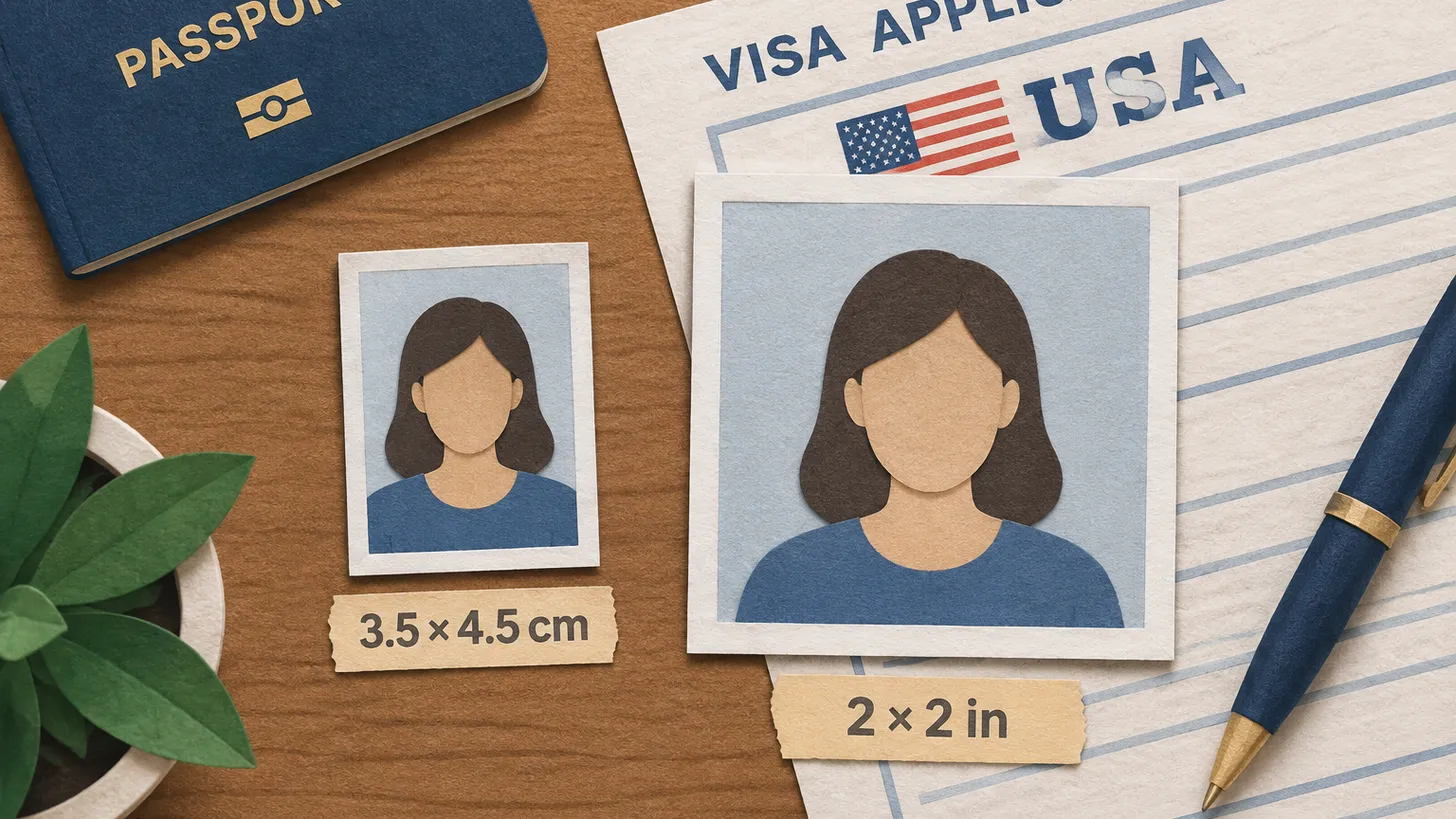
In the US 51x51 mm square, head height must be 50–69% of the frame height. By comparison, Estonia requires the face to take up 70–80%, so a face from such a photo may end up too large in the US square.
Key points
6 points- The 51x51 mm format is physically larger than a 35x45 mm frame in both dimensions, so a finished print cannot be cropped to fit.
- In the US square, head height is 25–35 mm, or roughly 50–69% of the frame height; Estonia requires the face to take up 70–80%.
- The US requires photos to be signed on the front with the full name, without covering the facial features.
- In the procedures covered, the number of photos required is not tied to the frame shape: Egypt requires one for a visa and three for a passport.
- A square photo may have to be no older than three months, as with the Philippine ACR I-Card.
- A square can be the requirement of a specific consulate (as with Brazil in Chicago) rather than a national standard.
The short answer
A 51x51 mm (or 2 × 2 inch) square photo cannot be made by physically cropping a finished 35x45 mm paper rectangle. The reason lies both in the absolute physical dimensions (the square is wider and taller) and in the internal proportions of the frame. Official US instructions limit head height to a range of 25 to 35 mm (1 to 1 3/8 inches), which is roughly 50–69% of the total photo height. By comparison, Estonia requires 70–80% of the vertical height of the photo, so a face from such a rectangular photo, placed into the US square, may end up too large. The rules depend on the specific procedure: the number of copies ranges from one to three, and signature requirements may include writing the full name directly on the front of the photo.
Being asked for a square photo can baffle applicants used to standard European prints. When the specification "2 x 2 inches" first appears on a form, the natural impulse is to take an existing stack of 35×45 mm photos and try to make them fit the new frame. Document photography, however, has to take the geometry of the frame into account. This article looks at how a square photo is built and why physically adapting one format to another changes the proportions.
Analysis of the document profile database
To understand where the 51x51 mm format fits in the global identification system, let us look at the statistics. Of the 241 document profiles in our database, 229 contain print size requirements. In total, authorities use 17 different size standards. The undisputed leader is the European 35x45 mm rectangle, required in 148 cases. The 51x51 mm square comes second, but by a huge margin: it appears in only 16 profiles. It is followed by the 30x40 mm (14 profiles) and 40x60 mm (11 profiles) formats. Database figures as of 22 Sep 2026, the date of this article.
The picture on background requirements is also interesting. Of the 241 profiles, 52 documents strictly require a pure white background. Another 23 profiles name a specific non-white shade (for example, light grey or off-white), while the rest only require a plain light background without specifying an exact colour. As for how recent the photo must be, this metric turned out to be even rarer: only 32 of the 241 profiles set a maximum photo age in their rules. Of these, 30 profiles require a photo no older than 6 months, and only 2 profiles set a strict limit of 3 months. For the remaining profiles, the maximum photo age is simply not recorded in our database; this is a data gap, not proof that no limit exists. Figures as of 22 Sep 2026.
Table of square format parameters
Requirements for a square frame are not universal. They vary by jurisdiction and by document type. Below is a comparison of confirmed procedures that use the 51x51 mm (2 × 2 inch) size.
| Jurisdiction and document | Size in inches / mm | Head height | Background | Maximum age | Number of copies |
|---|---|---|---|---|---|
| USA (Form I-131) | 2 × 2 inches (51x51 mm) | 25–35 mm (1–1 3/8 inches) | White to off-white | Taken recently | 2 |
| Philippines (ACR I-Card) | 2 × 2 inches (51x51 mm) | Not stated in the materials provided | White | No older than 3 months | 2 |
| Egypt (Visa) | 2 × 2 inches (51x51 mm) | Not stated in the materials provided | White | No older than 6 months | 1 |
| Egypt (Passport) | 2 × 2 inches (51x51 mm) | Not stated in the materials provided | White | Not stated in the materials provided | 3 |
| Brazil (in the USA) | 2 × 2 inches (51x51 mm) | Not stated in the materials provided | White | Preferably up to 6 months | Not stated in the materials provided |
USAUS Visa · requirements · check a photo
IndiaIndia Visa · requirements · check a photo
EgyptVisa · requirements · check a photo
IsraelVisa · requirements · check a photo
Why square photos can cause problems when applying
When preparing documents, applicants sometimes try to fit a rectangular photo into a square frame. Such attempts, however, run up against the strict geometry and maths of the frame, which change the proportion requirements.
A physical shortage of area
The most obvious reason a 51x51 mm square cannot be made from a 35x45 mm print is physics. A square is not "a European print trimmed at the side". The width of the square frame (51 mm) is considerably greater than the height of the European rectangle (45 mm). It is physically impossible to cut a 51x51 square out of a finished 35x45 mm print: the paper simply lacks the necessary 16 mm of width and 6 mm of height. The photo has to be printed again from the original file.
The face proportion and a mathematical paradox
The main thing that changes radically when moving to a square is the share of the frame taken up by the face. Consider the Estonian rule: Regulation No. 62 requires the distance from the chin to the top of the head to take up 70–80% of the vertical height of the photo. The US, in turn, requires the head to be 1–1 3/8 inches in a 2-inch-high frame, which equals 50–69%.
If you take a digital file composed under the Estonian rule (70–80% face) and print it at 51x51 mm, the head on paper will measure 35.7 to 40.8 mm. That exceeds the US maximum of 35 mm (1 3/8 inches). A photo composed to the Estonian standard may end up too large in the US square.
A shifted eye line
The second value that can change when reframing is the eye line. The Form I-131 instructions measure it from the bottom edge of the photo: the eyes must be between 1 1/8 and 1 3/8 inches high, which is roughly 29–35 mm (56–69% of the frame height). If you simply trim a finished rectangle at the top and bottom to fit the head into the new frame, the eye line may shift relative to the frame.
Photo age and false generalisations
Another source of problems is applying one country's rules to another country's documents. For example, it is widely believed that a square photo always means two copies, because the US requires that. Official sources, however, show otherwise: the number of copies is not tied to the square. Yes, USCIS and the Philippine Bureau of Immigration each require two photos. But the Egyptian visa requires exactly one photo, to be stapled to the application form, while the Egyptian passport requires three.
The same goes for photo age. An applicant may assume a photo is traditionally valid for six months. But for the ACR I-Card, the Philippine Bureau of Immigration states in its "Citizen's Charter": the photo must have been taken within the last three months before the date of application.
Paper and retouching
Paper requirements can also be strictly regulated. The US instructions for Form I-131 state plainly that the photo must be printed on thin glossy paper, unmounted and unretouched.
Legal basis and agency specifications
Paradoxically, US federal law does not contain the figure "2 × 2 inches" at all. The US Code of Federal Regulations, Title 8, Part 333 "Photographs", section 333.1, states plainly that photographs are to be provided "as specified by USCIS in the form instructions". The passport side is exactly the same: Title 22, Part 51, section 51.26 requires the submission of "photographs prescribed by the Department" without naming a single number. The dimensions are given in administrative specifications and in the instructions for specific forms. Saying that "under US federal law the photo is 2x2" is technically incorrect.
Signature rules: a uniquely American requirement
Square photos for the US hide another trap, set out in 8 CFR 333.1(b). The applicant must sign EACH copy of the photo on the front with their full true name. Moreover, the signature must be placed so that it does not cover the facial features. If a child is unable to sign, the rules require a parent or guardian to sign in the form: "(child's name) by (parent's or guardian's name)".
In addition, the Form I-131 instructions require the name and Alien Registration Number (A-Number) to be written lightly on the back of the photo in pencil or felt-tip pen.
A square as a requirement of the place, not the country
The 51x51 mm format may be not a national standard but a local requirement of a specific office. A striking example is Brazil. The national Brazilian standard for document photos is 5 × 7 cm. However, the Consulate General of Brazil in Chicago publishes a specification requiring passport applicants to bring a photo that is "passport size, 2 x 2 polegadas (inches)". The office also explicitly bans reuse: photos already used in previous passports are not accepted. Relying only on the requirements of the "passport country" can lead to a mistake if you do not check the rules of the specific place of application.
Step by step: how to prepare a square photo correctly
There is exactly one safe conversion rule: the frame must be rebuilt from the head outwards, not from the outer edges of the frame. Below is the basic procedure for preparing the photo.
- Read the instructions for the specific form. As shown above with the examples of the US and Brazil, the size and rules depend not on the country as a whole but on the specific office and type of application. Check how many copies are required and what maximum photo age is stated.
- Give up on old paper prints. Do not try to cut down 35x45 mm prints with scissors.
- Meet the technical camera requirements. If the procedure allows digital submission (or you are taking a base image for later printing), keep the minimum thresholds in mind. USCIS instructions require the photo to be taken with a camera of at least 3.5 megapixels. None of the official sources checked sets print resolution requirements in dpi for square photos. To prepare a file that strictly matches visa specifications, you can make a document photo online.
- Scale the head before building the frame. Open the original photo digitally. First bring the head size (from the top of the hair to the chin) to the reference value of 25 to 35 mm. Only then build the 51x51 mm square frame around the face.
- Check the eye line. Measure the distance from the bottom edge of the resulting square to eye level. It must fall within the 29–35 mm range. If the eyes end up too high or too low, move the frame vertically without changing the scale of the head itself.
- Choose the right paper and add the signatures. Print the result on thin glossy paper (if you are applying with US forms). Where required, add signatures on the front and back strictly in line with the instructions, using a pencil or felt-tip pen on the back so as not to press through the paper.
Sources
All figures and rules cited in this article are based on the following official documents (checked on 22 September 2026):
- U.S. Citizenship and Immigration Services (US Department of Homeland Security): Instructions for Form I-131 "Application for Travel Document" (01/20/25)
- Office of the Federal Register / USCIS (eCFR): US Code of Federal Regulations, Title 8, Part 333
- Office of the Federal Register / U.S. Department of State (eCFR): US Code of Federal Regulations, Title 22, Part 51
- Bureau of Immigration (Republic of the Philippines): Citizen's Charter: ACR I-Card issuance
- Embassy of the Arab Republic of Egypt: Visa application requirements (Washington)
- Passports, Immigration and Nationality Administration, Egyptian Ministry of Interior: Issuing an Egyptian passport (Washington)
- Ministério das Relações Exteriores (Brazilian Ministry of Foreign Affairs): Consulate General of Brazil in Chicago: photo specifications
- Immigration, Refugees and Citizenship Canada (IRCC): Temporary resident visa photo specifications
- Siseminister / Riigi Teataja: Regulation No. 62 of the Estonian Minister of the Interior of 01.12.2015
07Questions
5 answers01Can I trim the edges of a 35x45 mm photo to get 51x51 mm?
No, it is physically impossible. The 51x51 mm square is larger in both dimensions: you would be 16 mm short in width and 6 mm short in height on the paper.
02Is it true that the 2x2 inch format always requires two photos?
No. The number depends on the procedure: the US and the Philippines require two copies, an Egyptian visa needs one photo, and an Egyptian passport needs three.
03How recent do square photos need to be?
The limit is set by the authority. For the US it is a "recent" photo with no exact figure, for Egypt it is 6 months, and for the Philippine ACR I-Card it is no older than three months.
04Can I use old photos from previous passports?
It depends on the procedure. For example, the Brazilian consulate in Chicago, which uses the 2x2 inch format, explicitly prohibits reusing photos from old passports.
05Where do I sign the photo for US immigration forms?
Under 8 CFR 333, each copy is signed on the front with the full name, without covering the facial features. In addition, the I-131 instructions require the name and A-Number to be written on the back in pencil.
08Sources
- USCIS: Instructions for Form I-131
uscis.gov - Code of Federal Regulations (Title 8)
ecfr.gov - Code of Federal Regulations (Title 22)
ecfr.gov - Philippine Bureau of Immigration
immigration.gov.ph - Embassy of Egypt: Visa
egyptembassy.net - Embassy of Egypt: Passport
egyptembassy.net - Consulate General of Brazil
gov.br - IRCC Canada
canada.ca - Riigi Teataja (Estonia)
riigiteataja.ee
Author: Yevhen Kravchenko. Published . Checked against official sources on .
USAUS Visa Photo Requirements: 2 x 2 Inches, White Background, No Glasses, Taken Within 6 Months
US visa photo: colour, under 6 months old, white or off-white background, head 1 to 1 3/8 in (50-69 % of the image), no glasses.
 USA
Renew a U.S. Passport Online From Abroad: State Department Proposes Opening Online Renewal Overseas
A proposed rule would let Americans abroad renew a U.S.
 USA
First U.S. Passport Online: America.gov Will Let You Take the Passport Photo at Home
Rubio, 29 Sept 2026: first passports fully online on America.gov from next year, photo taken on your phone.

Make the photo for this document
Upload a selfie — we crop it to 51 × 51 mm, replace the background and check it against the document rules. Free preview.
US Visa · USAUpload