SourceNational Registry of Persons (RENAPER) and the Ministry of Foreign Affairs of Argentina
Verified
Quick answer: The recommended Argentina passport photo size is 40 × 40 mm. Plain white background. Neutral expression, clear lenses only, no glare. Last verified .
Argentina passport photo: size in mm, cm, inches and pixels
Millimetres
40 × 40 mm
Centimetres
4 × 4 cm
Inches
1.57 × 1.57″
Pixels at 300 dpi
472 × 472 px
Pixels at 600 dpi
945 × 945 px
Argentina-specific things to know
Argentina is a «no own photo» country for the passport: fingerprints and the photo are captured at the appointment, and a medical certificate is needed when they cannot be taken.
The photo standard written down is RENAPER's for the DNI — a uniform plain white background with a matte or semi-matte finish, 4 × 4 cm, half bust, head uncovered — not a figure published on the passport pages.
Express and «al instante» passports are processed only in Argentina, and from the start of the procedure the previous passport loses its validity.
How passport photos are verified
For an Argentine passport you bring no photograph: the Ministry of Foreign Affairs (Cancillería) says that the biometric data — «fingerprints and photo» — are taken at the procedure, which is personal and in person with an online appointment (the Consulate General in New York adds that the passport is the regular passport, valid 10 years for adults and 5 years for minors, and that it is processed only for residents of its jurisdiction — the residence is the address on the DNI). If there is a physical impediment to taking the fingerprints and the photo, a medical certificate or document is presented.
Read more
The photograph of the Argentine documents is regulated by RENAPER Resolution 169/2011, written for the DNI: «current, taken from the front, half bust, with the head fully uncovered, in colour, with a uniform plain white background, matte or semi-matte, 4 cm by 4 cm», with hair coverings for religious or health reasons accepted if the main features of the face are visible. The passport pages read give no size, because the photo is taken at the office; the 4 × 4 cm of the page is the RENAPER size. Express and «al instante» passports are processed only in Argentina, not at consulates.
Examples and mistakes
What makes Argentina passport photos accepted
One compliant example next to the six most common rejection causes for Argentina passport applications. These are the differences that most often determine whether a document photo is accepted.
Accepted
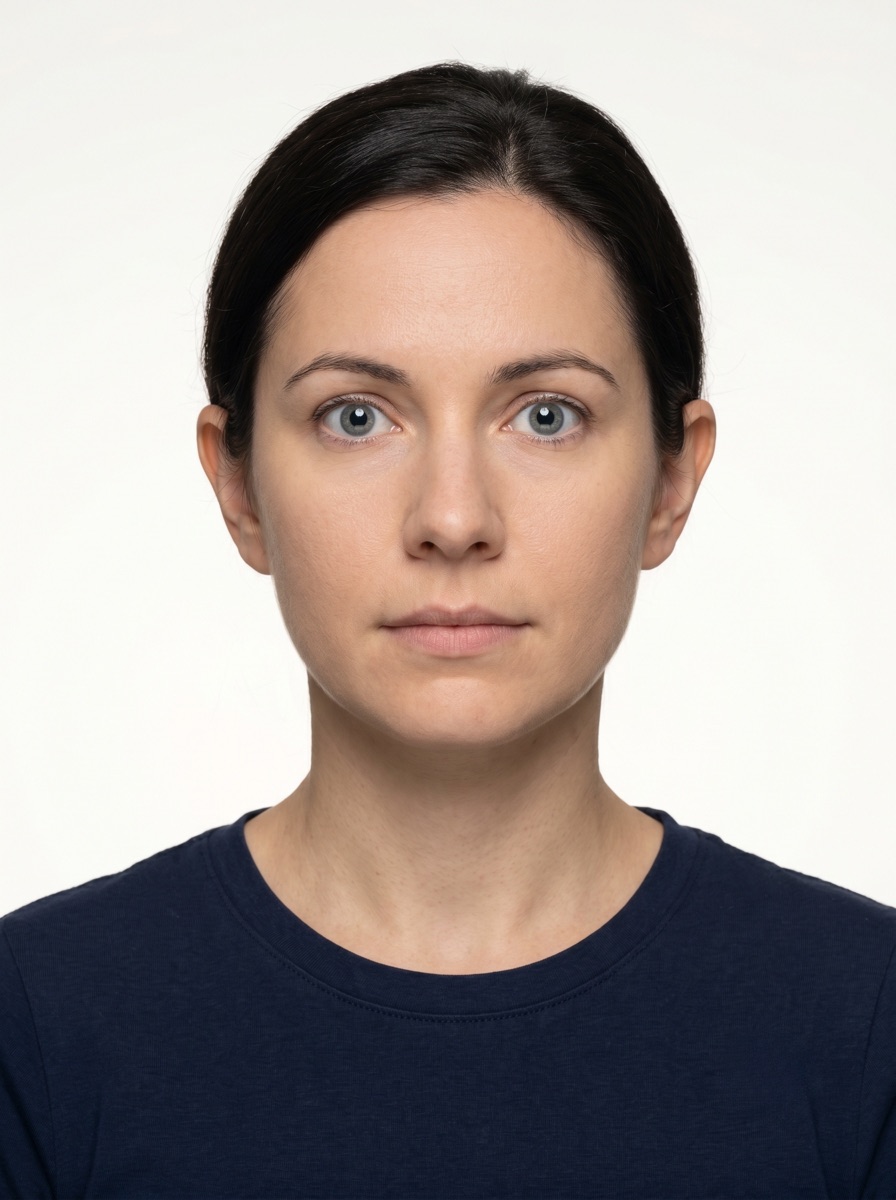
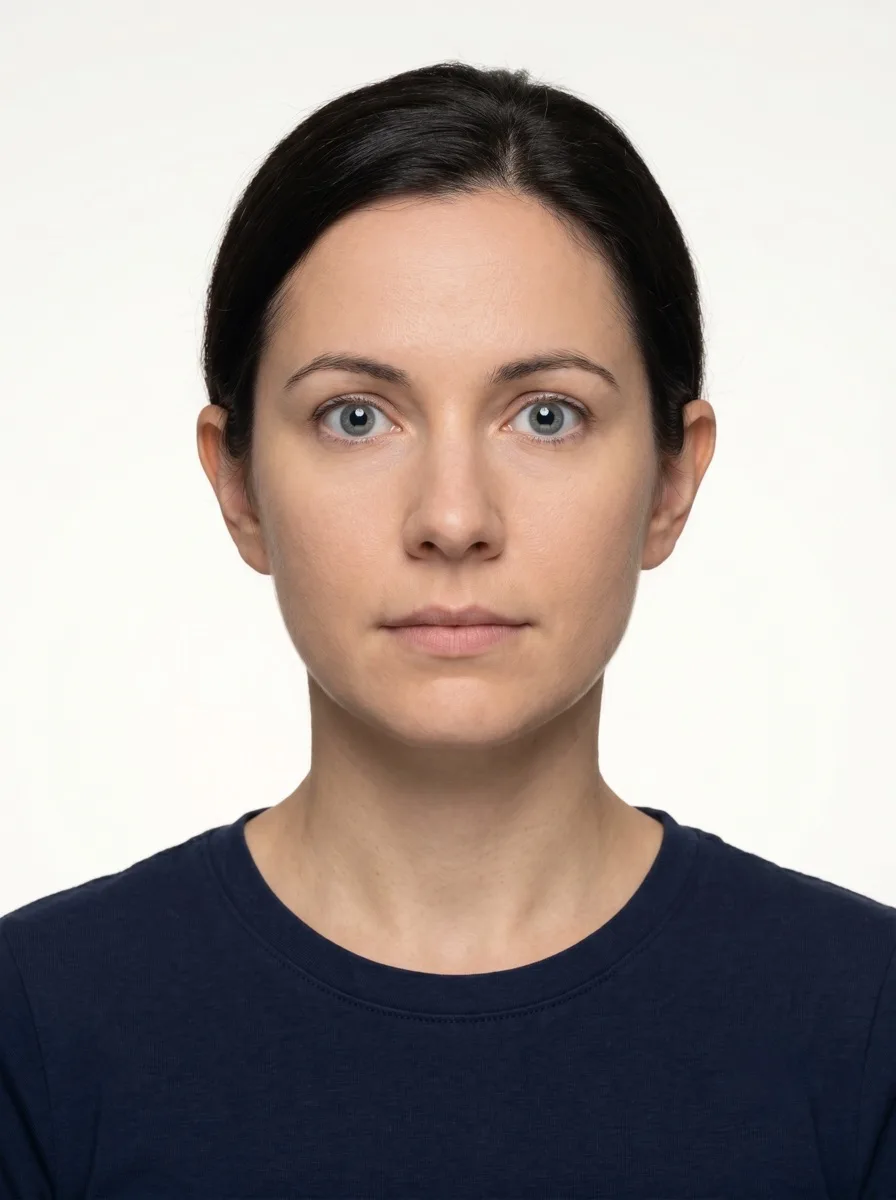
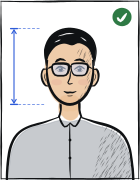
Compliant Argentina passport example (40 × 40 mm)
Face centred, looking directly into the lens
Plain background — no shadow, pattern or texture
Neutral expression, eyes open, mouth closed
No glasses, no hair across the face
Top 6 Argentina passport rejection causes
Background shadowShadow on the wall behind the head, or background with a visible pattern or gradient
Smile / open mouthVisible smile with teeth or open mouth instead of a neutral expression
Glasses with glareGlasses with a clearly visible light reflection covering part of the eye
Hair across the faceLoose hair strands covering the eyes, eyebrows or part of the face
Eyes off-cameraEyes looking to the side instead of directly into the camera lens
Head tiltedHead tilted so the eye line is no longer horizontal
How to take your Argentina passport photo correctly
Background and light
Background: plain white
The tool puts in the required background. Stand half a metre from a plain light wall, face a window and shoot without flash — then there are no shadows on your face or on the wall.
Framing
Size: 40 × 40 mm
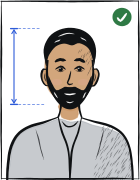
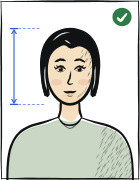
Camera at eye level, about a metre away; head and shoulders in the shot. The tool crops it to the required size.
Glasses
Clear lenses only, no glare
If you wear glasses, check the shot: no glare on the lenses, eyes clearly visible.
Expression and gaze
Neutral expression, mouth closed, eyes open
Look straight into the lens with your head level; keep hair away from your eyes and eyebrows.
Print at 100% scale, borderless, and turn off fit-to-page so each photo keeps its exact size.
Where to submit your passport application
An Argentine passport is applied for in person with an online appointment at a RENAPER office in Argentina or at the Argentine consulate that covers the address on your DNI; the photograph and the fingerprints are captured there.
RENAPER office in Argentina or the Argentine consulate of your jurisdictionin person with an appointment
cancilleria.gob.ar — regular passport; the consulate's website for the appointment
Processing
See the Cancillería or consulate page
Cost
See the consulate page (a fee applies)
No photo to bring; the photograph is captured at the procedure (RENAPER standard: 4 × 4 cm, white matte background).
Ministry of Foreign Affairs of Argentina, regular passport (translated from the Spanish): in the event of any physical impediment to taking the biometric data (fingerprints and photo), a medical certificate or document proving the circumstance must be presented; express and «al instante» passports cannot be processed at consulates, only in Argentina; consular offices do not process passports for foreigners; the appointments are free of charge and, from the start of the procedure, the previous passport loses its validity.
Consulate General of Argentina in New York, biometric passport: it is the regular passport, valid 10 years for adults and 5 years for minors; the Consulate does not process documents for people residing outside its jurisdiction — the residence is the address on the DNI; all documentation procedures are personal and in person, with an online appointment; for people over 18 the requirements are Argentine citizenship, the original and a copy of the last valid and updated DNI, and, where useful, the Argentine birth certificate.
RENAPER Resolution 169/2011, article 1 as amended by Resolution 356/2011 (the DNI, on which the passport procedure rests): the photographic image must be current, taken from the front, half bust, with the head fully uncovered, in colour, with a uniform plain white background, matte or semi-matte, 4 cm by 4 cm; hair coverings for religious reasons or health treatments are accepted if the main features of the face are visible; a religious covering of the face allows the procedure and the photograph in a reserved place by officials of the same sex.
Questions
Frequently asked questions
No: the biometric data — fingerprints and photo — are taken at the procedure, which is personal and in person with an online appointment; the consulate in New York says you do not need to bring a photograph.
The passport pages give no size because the photo is captured at the office; RENAPER's standard for Argentine documents is a current, frontal, half-bust colour photo of 4 × 4 cm on a uniform plain white background with a matte or semi-matte finish and the head uncovered.
Present a medical certificate or document proving the physical impediment, says the Cancillería.
10 years for adults and 5 years for minors, according to the consulate in New York.
The recommended size for the Argentina passport photo is 40 × 40 mm.
Plain white background. No gradients, textures, shadows or objects behind the subject are permitted. The tool removes background shadows automatically, but starting with a flat, evenly lit wall gives the best result.
Yes. Stand in front of a flat white wall in good natural light, face the light source and use the rear camera of your phone with a 3-second timer. The tool handles the crop, background normalisation and compliance check against the Argentina biometric standard.
Most passport authorities require the photo to be taken within the last six months. Do not reuse an older portrait even if your appearance has not changed.
Anfas.Pro provides a 14-day full refund if the photo is rejected by the Argentina authority and you supply the official rejection notice. See the refund policy page for the exact process.
Eyes must be fully visible; no tinted lenses or strong reflections. In practice, the biometric scanner at submission points flags even minor lens glare that looks fine to the naked eye. Removing glasses before shooting is the only option that eliminates the risk entirely.
40 × 40 mm = 4 × 4 cm = 1.57 × 1.57 inches. At 300 dpi that is 472 × 472 pixels; at 600 dpi, 945 × 945 pixels.
Yes. The same 40 × 40 mm format and head size apply to: visa.