SourceBelgian municipalities (civil registry offices) under the federal and regional rules — Wallonie.be, communes of Jette, Vaux-sur-Sûre and Éghezée; FPS Foreign Affairs and FPS Interior
Verified
Quick answer: The recommended Belgium driver's license photo size is 35 × 45 mm. White or very light plain background without shadows or gradients. Head occupies 69–80% of photo height (31–36 mm chin to crown). Neutral expression, clear lenses only, no glare. Last verified .
Belgium driver's license photo: size in mm, cm, inches and pixels
Millimetres
35 × 45 mm
Centimetres
3.5 × 4.5 cm
Inches
1.38 × 1.77″
Pixels at 300 dpi
413 × 531 px
Pixels at 600 dpi
827 × 1063 px
Belgium-specific things to know
Belgium leaves the licence photograph to the communes: Jette and Vaux-sur-Sûre ask for a white background and Éghezée says «the use of white is forbidden» — a light plain colour — so the same licence has two opposite background rules.
The photograph on the ID card can be reused for the licence («by default, the photograph on your ID card is used»), so a new photograph is often not needed.
The federal norm allows a black-and-white photograph for everything but passports, while the communes ask for colour.
How driver's license photos are verified
A Belgian driving licence is applied for at the commune (the civil registry office), and the Walloon portal lists «a recent ID photograph» with the ID card, the test certificate and any provisional licence to replace, adding that «by default, the photograph on your ID card is used». The communes write the photograph rule themselves: Jette asks for «1 recent ID photo (less than 6 months) in colour on a white background», Vaux-sur-Sûre for «a recent photo, of good quality, in colour, ID card format, on a uniformly white background» — and says that if the photo on the ID card is recent it can be used for the licence — and Éghezée for a photo «recent and a true likeness (not older than 6 months)» of «35 mm wide and 45 mm high», the face «between 32 mm and 36 mm» from the chin to the crown, 70–80 % of the photo, with «no accessories — for example a hat, a scarf, a jewel, a piercing, even heavy makeup», glasses only with thin frames and untinted lenses, a front view with a straight head, a neutral expression, the mouth closed and the eyes wide open. Éghezée lists the usual reasons for refusal — a blurred photo or one with marks or folds, wrong dimensions, strong contrasts with shadows, over- or underexposure, «failing to respect the plain background of a light colour, the use of white being forbidden», a face not clear (hat or hair) and glasses with reflections or a thick frame. The federal norm for passports, ID cards and residence documents, which the communes refer to, gives «35 mm x 45 mm», the face «between 31 and 36 mm (= 70 to 80 % of the height)», a photo of six months at most, in colour (black and white accepted except for passports), at least 400 dpi, a «light-coloured, regular, plain» background.
Examples and mistakes
What makes Belgium driver's license photos accepted
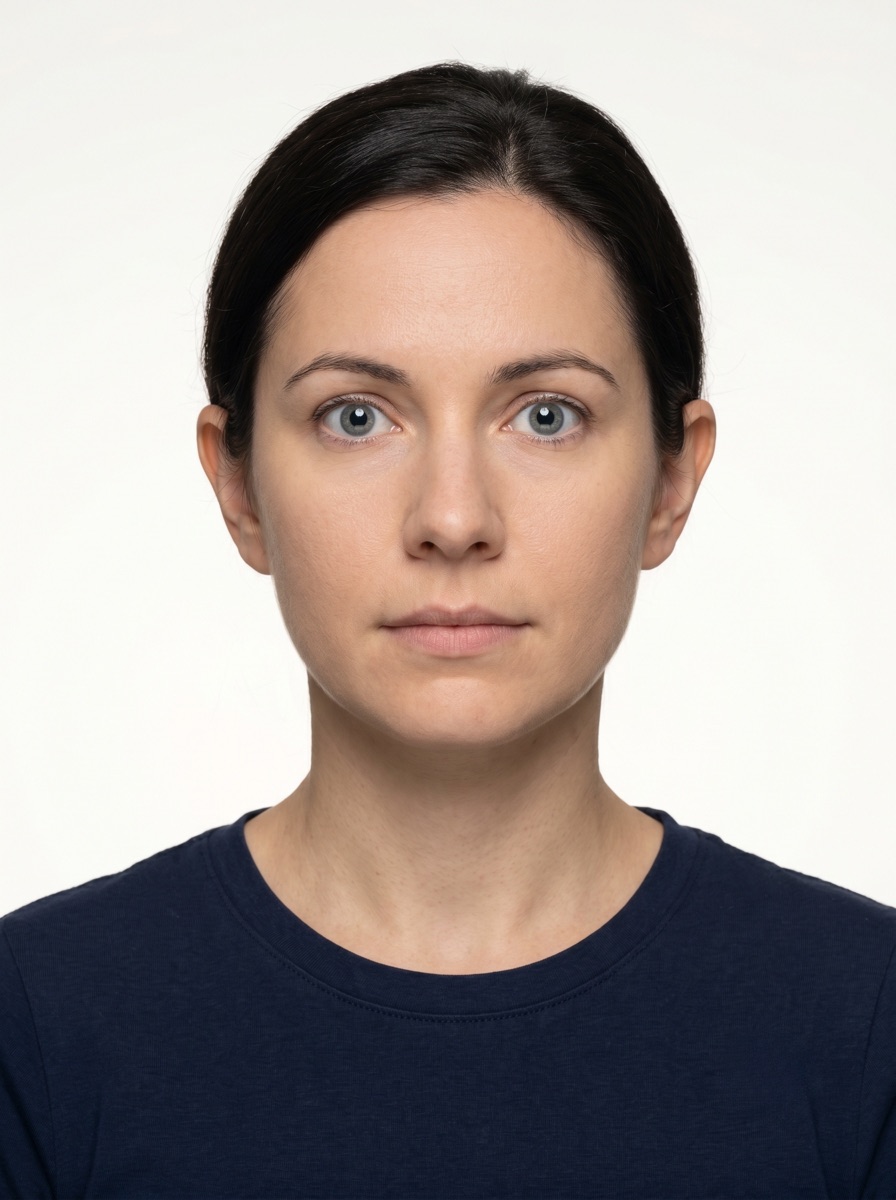
One compliant example next to the six most common rejection causes for Belgium driver's license applications. These are the differences that most often determine whether a document photo is accepted.
Accepted
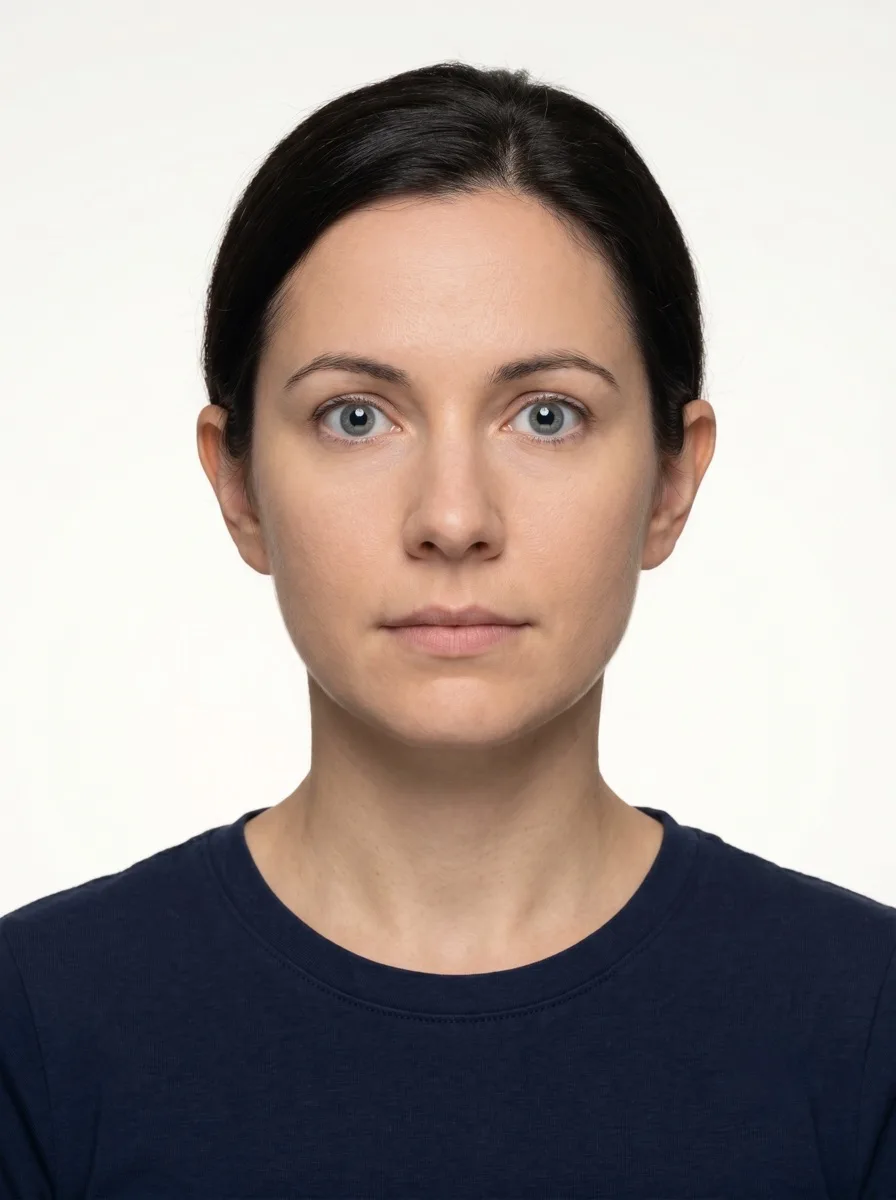
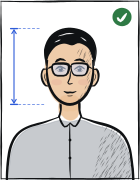
Compliant Belgium driver's license example (35 × 45 mm)
Face centred, looking directly into the lens
Plain background — no shadow, pattern or texture
Neutral expression, eyes open, mouth closed
No glasses, no hair across the face
Top 6 Belgium driver's license rejection causes
Background shadowShadow on the wall behind the head, or background with a visible pattern or gradient
Smile / open mouthVisible smile with teeth or open mouth instead of a neutral expression
Glasses with glareGlasses with a clearly visible light reflection covering part of the eye
Hair across the faceLoose hair strands covering the eyes, eyebrows or part of the face
Eyes off-cameraEyes looking to the side instead of directly into the camera lens
Head tiltedHead tilted so the eye line is no longer horizontal
Typical rejection reasons and how to fix them
Typical reasons a photo is rejected under the rules Belgian municipalities (civil registry offices) under the federal and regional rules — Wallonie.be, communes of Jette, Vaux-sur-Sûre and Éghezée; FPS Foreign Affairs and FPS Interior publishes: what is wrong and what to change.
Reason
Fix
A photo that is not recent (older than six months) or not a true likeness
A recent photo of the last six months that is a true likeness.
A print that is not 35 × 45 mm, or a face outside 32–36 mm (31–36 mm federal norm) from chin to crown
A 35 × 45 mm print with the face 32–36 mm high (70–80 % of the photo).
A background that is not plain or light, shadowed or with a gradient (and, at Éghezée, a white one)
A plain light background with sufficient contrast to the face — white or not, as the commune says.
A hat, a scarf, jewellery, a piercing, heavy makeup, hair over the face, or glasses with reflections, tinted lenses or a thick frame
A clear face; glasses only with a thin frame and untinted lenses.
A blurred photo, one with marks or folds, over- or underexposed, or with shadows on the face
How to take your Belgium driver's license photo correctly
Background and light
Background: white or light
The tool puts in the required background. Stand half a metre from a plain light wall, face a window and shoot without flash — then there are no shadows on your face or on the wall.
Framing
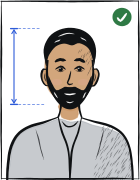
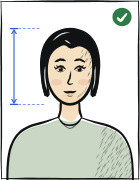
Head: 69–80 % of the photo height (31–36 mm)
Camera at eye level, about a metre away; head and shoulders in the shot. The tool crops it to 35 × 45 mm.
Glasses
Clear lenses only, no glare
If you wear glasses, check the shot: no glare on the lenses, eyes clearly visible.
Expression and gaze
Neutral expression, mouth closed, teeth not visible
Look straight into the lens with your head level; keep hair away from your eyes and eyebrows.
Print at 100% scale, borderless, and turn off fit-to-page so each photo keeps its exact size.
Where to submit your driver's license application
A Belgian driving licence is applied for in person at the Population service of the commune, with the ID card, the documents of the case and a recent ID photograph — by default the photograph on the ID card is used — or online through BelDrive for some cases.
Commune — Population service (civil registry office)in person; online through BelDrive in some cases
The commune of residence; wallonie.be — Obtain your driving licence at your municipality
Processing
About 2 to 5 working days, according to the communes
Cost
€25 (Vaux-sur-Sûre) to €30.70 (Jette) for a licence, according to the communes
A recent colour ID photo (35 × 45 mm); the ID card photo may be reused.
Wallonie.be, «Obtain your driving licence at your municipality»: for a licence the applicant goes to the local authority with the ID card or foreign residence permit, the driving test pass certificate, any provisional driving licence to be replaced and «a recent ID photograph»; for a renewal the licence to be renewed (or the police declaration of loss or theft), the Belgian ID card or residence permit and «a recent ID photograph»; for a provisional licence «a recent photograph if you have a residence permit in paper form. By default, the photograph on your ID card is used».
Commune of Jette, «Permis de conduire» (French, translated): for the licence («Demande délivrée par le centre d'examen»), the provisional licence (36, 18 and 12 months), the international licence, the exchange of a paper licence for the bank-card model, a lost or stolen licence and a foreign licence the applicant provides the ID card, the documents of the case and «1 recent ID photo (less than 6 months) in colour on a white background»; the fee for a provisional licence is €30.70 (5 working days) and for an international licence €31.80 (7 working days).
Commune of Vaux-sur-Sûre, «Permis de conduire» (French, translated): for the licence (category B) the applicant appears at the Population service with the ID card, the certificate of success in the practical driving test, the provisional licence if any and «a recent photo, of good quality, in colour, ID card format, on a uniformly white background»; «if the photo on your ID card is recent, it can be used for your driving licence» and the request can also be made online through BelDrive; the price is 25 euros and the licence is issued within 2 days; for a renewal «a recent ID photo (if the photo on your ID card is recent, it will be taken over onto the licence)».
Commune of Éghezée, «Photos : les exigences», «Permis de conduire» (French, translated): the photo must be recent and a true likeness (not older than 6 months), 35 mm wide and 45 mm high; the face between 32 mm and 36 mm high from the bottom of the chin to the top of the skull without the hair, covering 70 to 80 % of the photo; no accessory such as a hat, a scarf, a jewel, a piercing or even heavy makeup; the face clear, glasses with thin frames and untinted lenses; a front view with a straight head, a neutral expression, the mouth closed and the eyes wide open.
Same page, the refusals: a driving-licence photo is refused for a blurred photo or one with marks or folds; dimensions that are not to the norm; contrasts too strong with shadows on the face or in the background; a bad balance between over- and underexposure; «failing to respect the plain background of a light colour, the use of white being forbidden»; a face not clear (covered by a hat or hair); glasses with reflections on the lenses or a frame that is too thick.
FPS Foreign Affairs and FPS Interior, «Requirements for photos of passports, Kids-ID, electronic identity cards for Belgians and residence documents for foreigners» (12/2016; French, translated): the photograph must be a close likeness and meet the ICAO criteria; «Dimensions of the photo: 35 mm x 45 mm (w x h). Length of the face (from the chin to the top of the skull): between 31 and 36 mm (= between 70 and 80 % of the height of the photo)»; the quality good if the photo is at most 6 months old, in colour (black-and-white accepted except for passports), with a natural rendering, sharp, with sufficient contrast, in good condition, not a copy, not retouched, on smooth high-quality paper and at a minimum of 400 dpi; the lighting even, without shadows or reflections or red eyes; the background of a light colour, regular, plain, with no gradient and sufficient contrast with the head; the head entire and centred, the face and shoulders from the front, the eyes on a horizontal line; a neutral expression, looking straight at the camera, the mouth closed, no teeth visible; the face and eyes not hidden; glasses only with the eyes entirely visible, fully transparent lenses and no reflections or shadows; head coverings only for religious reasons with the face clear; children under 6 are exempt from the position and expression criteria.
Questions
Frequently asked questions
35 mm wide and 45 mm high, according to the commune of Éghezée and the federal photo norm, with the face 32–36 mm (31–36 mm federal) high from chin to crown.
Not always: by default the photograph on your ID card is used, and Vaux-sur-Sûre says a recent ID card photo can be used for the licence.
It depends on the commune: Jette and Vaux-sur-Sûre ask for white, Éghezée says white is forbidden and asks for a plain light colour, and the federal norm says light-coloured.
Less than six months old, according to Jette, Éghezée and the federal norm.
The recommended size for the Belgium driver's license photo is 35 × 45 mm. The head occupies 69–80% of the photo height. The photo is printed on the licence card and must remain recognisable for the full validity period.
White or very light plain background without shadows or gradients. Even, frontal light without shadow gradients. Driving licence printers tend to compress contrast — starting with even lighting prevents underexposed areas from disappearing in the final print.
No tinted lenses or reflections; frame must not cover the eyes. Many authorities specifically allow eyewear when it is required for driving, but the eyes must remain fully visible and there must be no lens glare. Tinted lenses or transition lenses that have darkened are not accepted.
Most authorities require the photo to be taken within the last six months. The licence is typically valid for 5–10 years, so use a recent photo that reflects your everyday appearance — not a one-off styled portrait.
No. Driving licence photos use the same neutral expression standard as biometric passports — closed mouth, eyes open and looking directly at the camera, no raised eyebrows. Smiles distort facial geometry used in modern biometric checks.
Anfas.Pro provides a 14-day full refund if the Belgium licence authority rejects the photo and you supply the rejection notice.
35 × 45 mm = 3.5 × 4.5 cm = 1.38 × 1.77 inches. At 300 dpi that is 413 × 531 pixels; at 600 dpi, 827 × 1063 pixels.
Yes. The same 35 × 45 mm format and head size apply to: passport, visa.