SourceFederal law on driving licences (FeV) and the Passport Ordinance (Anlage 8), Federal Ministry of Transport
Verified
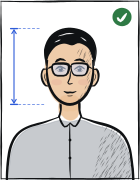
Quick answer: A Germany driver's license photo must be 35 × 45 mm. Plain neutral background with clear contrast to the face. Head occupies 70–80% of photo height. Neutral expression, clear lenses only, no glare. Last verified .
Germany driver's license photo: size in mm, cm, inches and pixels
Millimetres
35 × 45 mm
Centimetres
3.5 × 4.5 cm
Inches
1.38 × 1.77″
Pixels at 300 dpi
413 × 531 px
Pixels at 600 dpi
827 × 1063 px
Germany-specific things to know
The licence rule gives no size — it points to the Passport Ordinance — so the 35 mm × 45 mm comes from the driver-card rule and the federal portal, and the exchange rules ask for a «current biometric photo».
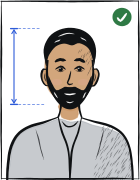
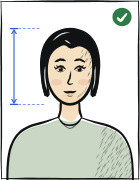
Annex 8 states the head only as a percentage — 70–80 % of the height, from the chin to the top of the head — and no millimetres.
The licensing authority may allow exceptions to the design of the photo, and several offices still insist on a paper photo for the licence even though passports and ID cards now take digital photos.
How driver's license photos are verified
In Germany the driving licence application needs «a photo that meets the provisions of the Passport Ordinance» (FeV § 21 para. 3 no. 2) — so the biometric rules of Annex 8 apply: the face from the chin to the top of the head takes 70–80 % of the height of the photo, both halves of the face are clearly visible, the face is evenly lit without reflections or red eyes, the head is centred and straight, the face is sharp and rich in contrast, the shadow-free background is of one colour and contrasts clearly with the face and the hair, colours — above all the skin tone — are true to life and digital photos are in colour, the expression is neutral with the gaze straight into the camera and the mouth closed, the eyes are clear and not covered, and a head covering is allowed only for religious reasons, with the face visible from the lower edge of the chin to the forehead and no shadows on it. Retouching, filters, soft focus, low resolution, a smile, hair over the eyes, frames over the eyes and dark or reflecting lenses are among the examples that fail.
Read more
For children the face takes 50–80 %, with smaller deviations allowed up to the age of 10 and further exceptions for babies up to the age of 6. The ordinance gives no size in millimetres for the licence; 35 mm × 45 mm on a light background, without headgear, is the size of the driver card (FPersV § 5) and of the federal portal's licence service, and «the licensing authority may allow exceptions to the design of the photo».
For exchanging an old licence the Federal Ministry of Transport lists «1 photo (a current biometric photo)» next to the ID and the old licence. Several licensing authorities, according to an earlier check of their pages, still ask for a paper photo — digital photos via cloud or QR code are not accepted for the licence there.
Examples and mistakes
What makes Germany driver's license photos accepted
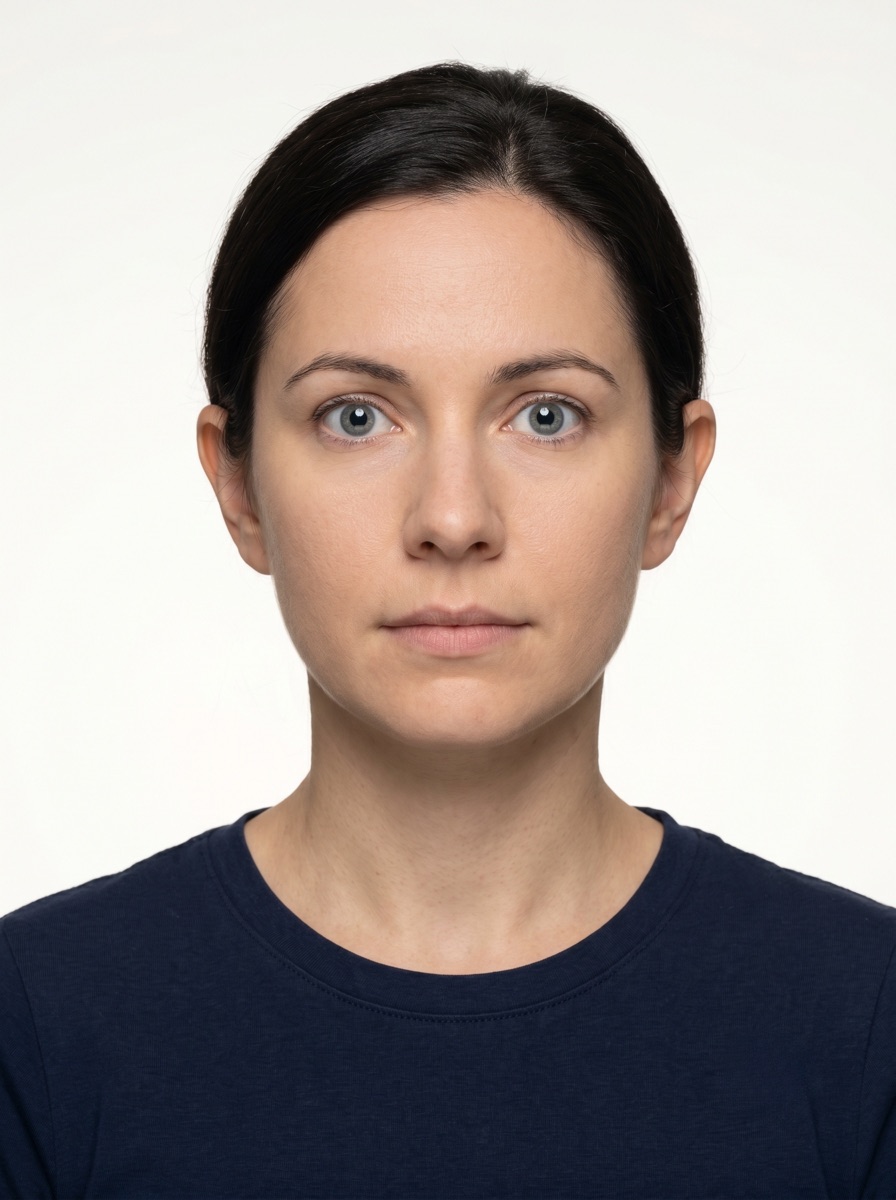
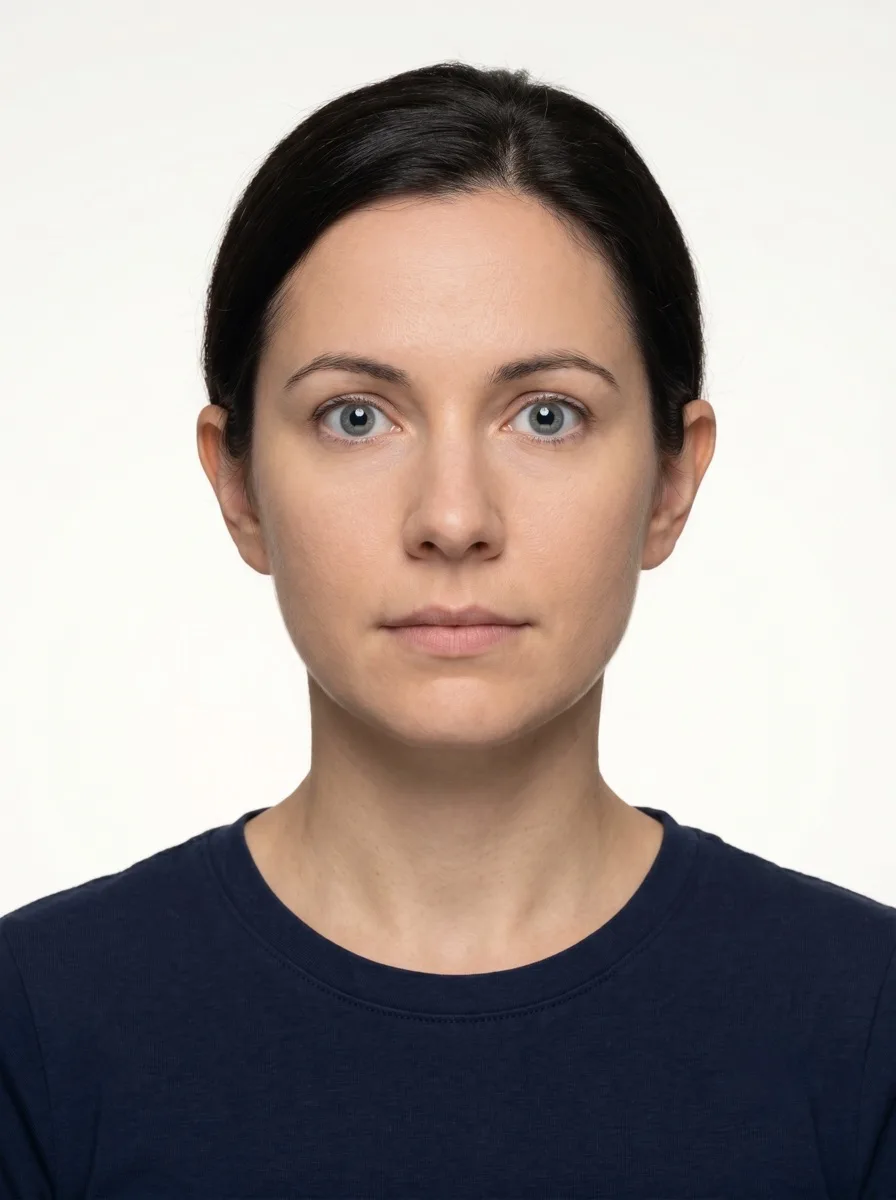
A photo that will be accepted, next to the six most common reasons Germany driver's license photos get rejected.
Accepted
Compliant Germany driver's license example (35 × 45 mm)
Face centred, looking directly into the lens
Plain background — no shadow, pattern or texture
Neutral expression, eyes open, mouth closed
No glasses, no hair across the face
Top 6 Germany driver's license rejection causes
Background shadowShadow on the wall behind the head, or background with a visible pattern or gradient
Smile / open mouthVisible smile with teeth or open mouth instead of a neutral expression
Glasses with glareGlasses with a clearly visible light reflection covering part of the eye
Hair across the faceLoose hair strands covering the eyes, eyebrows or part of the face
Eyes off-cameraEyes looking to the side instead of directly into the camera lens
Head tiltedHead tilted so the eye line is no longer horizontal
Typical rejection reasons and how to fix them
Typical reasons a photo is rejected under the rules Federal law on driving licences (FeV) and the Passport Ordinance (Anlage 8), Federal Ministry of Transport publishes: what is wrong and what to change.
Reason
Fix
A face that is not 70–80 % of the height, a head tilted, off-centre or not straight, or a photo that is blurred or too dark
Crop so that the face from the chin to the top of the head takes 70–80 % of the height, centred and straight, sharp and well lit.
A background with a pattern, a shadow or no contrast to the face and the hair
A single-colour, shadow-free background that contrasts with the face and the hair (a light colour, ideally neutral grey).
Retouching, a filter or soft focus, too low a resolution, unnatural colours or skin tone
An unretouched, sharp photo in true colours at high resolution.
A smile, open mouth, closed or squinting eyes, hair or frames over the eyes, dark or reflecting lenses, a cap
A neutral expression, gaze straight into the camera, mouth closed, eyes clear, no cap (a head covering only for religious reasons, face visible from chin to forehead).
How to take your Germany driver's license photo correctly
Background and light
Background: plain neutral
The tool puts in the required background. Stand half a metre from a plain light wall, face a window and shoot without flash — then there are no shadows on your face or on the wall.
Framing
Head: 70–80 % of the photo height
Camera at eye level, about a metre away; head and shoulders in the shot. The tool crops it to 35 × 45 mm.
Glasses
Clear lenses only, no glare
If you wear glasses, check the shot: no glare on the lenses, eyes clearly visible.
Expression and gaze
Neutral expression, mouth closed, eyes open
Look straight into the lens with your head level; keep hair away from your eyes and eyebrows.
Print at 100% scale, borderless, and turn off fit-to-page so each photo keeps its exact size.
Where to submit your driver's license application
A German driving licence is applied for, or exchanged, at the licensing authority (Fahrerlaubnisbehörde) of your place of residence, in some places at a citizens' office, with a biometric photo and an identity document.
Licensing authority (Fahrerlaubnisbehörde) or citizens' officein person; whether a digital application is possible is answered by the licensing authority
bmv.de — exchange of the driving licence; the licensing authority of your district or city
Processing
See your licensing authority
Cost
Exchange: 25.50 euros plus 1.00 euro, and 6.50 euros for direct delivery if wanted (BMV)
One current biometric photo; several offices still take a paper photo only.
FeV § 21 para. 3: the documents to enclose with the application for a driving licence include an official proof of the place and day of birth, a photo that meets the provisions of the Passport Ordinance, a vision test certificate or medical report depending on the class, and proof of first-aid training; the licensing authority may allow exceptions to the design of the photo prescribed in sentence 1 no. 2.
Passport Ordinance, Annex 8 (BGBl. 2025 I Nr. 260), the photo: it shows the face from the tip of the chin to the top of the head with both halves clearly visible, and the face takes 70–80 % of the height of the photo; the face is evenly lit and does not reflect, red eyes are avoided; the head is centred and straight; the face is sharp and rich in contrast; the background is shadow-free, of one colour and contrasts clearly with the face and the hair; colours and the skin tone are true to life, digital photos are in colour; the expression is neutral, the gaze straight into the camera, the mouth closed; the eyes are clear and not covered.
Annex 8, head covering and children: head coverings are only permitted for religious reasons, and then the face is visible from the lower edge of the chin to the forehead and no shadows on the face are visible; for children the face takes 50–80 % of the height, smaller deviations are allowed up to the age of 10; for (small) children and babies it is a frontal shot, and up to the age of 6 further exceptions are allowed in the head position, the expression and the visibility of the eyes. The table of examples marks as unsuitable: shadows, too dark, reflection on the face, a head tilted sideways, down or up, off-centre, a pattern or shadow in the background, retouching or filters, soft focus, too low a resolution, laughing or an open mouth, closed or squinting eyes, a grimace, frames covering the eyes, hair covering the eyes, red eyes, too dark or reflecting lenses, a cap, a burka.
Federal Ministry of Transport, exchange of the driving licence (state of 19 January 2025): the documents to present are proof of identity (identity card, passport or another identity document), 1 photo (a current biometric photo) and the old licence in the original; the new licence is limited to 15 years, a rule that serves above all to update the photo and, where applicable, the name. The fee is 25.50 euros plus 1.00 euro and, if wanted, 6.50 euros for direct delivery by the Bundesdruckerei.
FPersV § 5 (driver card, a different document): a photo against a light background, 35 mm × 45 mm, showing the applicant without headgear in a frontal shot; Annex 8 of the Passport Ordinance applies accordingly. KBA FAQ (English): a current colour passport photo (35 to 45 mm), the face looking straight into the camera and centred, the background a light colour, ideally neutral grey, to contrast with the face, hair and clothing. An earlier check of the pages of three licensing authorities recorded (not re-read today): a paper photo is still required for the licence (Uckermark), the applicant supplies the photo and none is printed on site (Berlin), and digital photos from external providers via cloud or QR code may not be used for the licence (Kreis Euskirchen).
Questions
Frequently asked questions
A photo that meets the Passport Ordinance (FeV § 21): the face from the chin to the top of the head 70–80 % of the height, evenly lit, centred and straight, sharp, a single-colour shadow-free background that contrasts with the face and hair, natural colours, a neutral expression with the mouth closed, eyes visible, no head covering except for religious reasons, no retouching.
The licence rule names no size; the federal portal and the driver-card rule use 35 mm × 45 mm, and the exchange rules ask for one current biometric photo.
Several licensing authorities, according to an earlier check of their pages, still ask for a paper photo and do not accept a digital photo via cloud or QR code for the licence.
70–80 % of the height of the photo, measured from the chin to the top of the head; for children 50–80 %.
The Germany driver's license photo must be 35 × 45 mm. The head must occupy 70–80% of the photo height. The photo is printed on the card and stays there for years, so use one that looks like you every day.
Plain neutral background with clear contrast to the face. Light should fall evenly on your face from the front, without shadows: face a window and turn off the flash.
Eyes must be fully visible; no tinting or reflections. Many offices allow the glasses you need for driving, as long as your eyes are clearly visible and there are no reflections on the lenses. Tinted or darkened lenses are not accepted.
Most offices ask for a photo taken within the last six months. Use an everyday photo rather than a styled portrait — the licence stays valid for years.
No. The rules are the same as for a passport: neutral expression, mouth closed, eyes open, looking straight into the camera.
We refund the payment in full. Email us within 14 days of purchase with your order number and the rejection notice from the Germany licensing office.
35 × 45 mm = 3.5 × 4.5 cm = 1.38 × 1.77 inches. At 300 dpi that is 413 × 531 pixels; at 600 dpi, 827 × 1063 pixels.
Religious reasons only; must not cover the facial oval. The face must stay fully visible from chin to forehead and on both sides, with no shadow across it.