SourceFrance-Visas (Ministry for Europe and Foreign Affairs and Ministry of the Interior) and the TLScontact centres
Verified
Quick answer: The recommended France Schengen visa photo size is 35 × 45 mm. Plain light background per ISO/IEC and ICAO standards. Head occupies 70–80% of photo height. Neutral expression, clear lenses only, no glare. Last verified .
France Schengen visa photo: size in mm, cm, inches and pixels
Millimetres
35 × 45 mm
Centimetres
3.5 × 4.5 cm
Inches
1.38 × 1.77″
Pixels at 300 dpi
413 × 531 px
Pixels at 600 dpi
827 × 1063 px
France-specific things to know
The France-Visas leaflet writes «35–40 mm in width» and no height — not 35 × 45 mm. A 35 × 45 mm photo with the face at 70–80 % of the height satisfies it, and is what visa centres usually print.
The age limit differs by page: six months in the ISO leaflet, three months on the Morocco page. Take the photo within three months to be safe.
The background is «light-coloured», not «white», on both pages — white is not forbidden, but a plain light background is what is asked.
In the TLScontact centres in Morocco the adult's photograph is taken in the biometric booth and a paid photo service exists; the printed photos are for the form.
How Schengen visa photos are verified
The French visa photograph is described by France-Visas, the portal of the French foreign and interior ministries, in an ISO/IEC leaflet that is the same text the visa centres of several countries use. It asks for a photograph no more than six months old, 35–40 mm in width (the leaflet gives no height), a close-up of the head and the top of the shoulders so that the face takes up 70–80 % of the picture, sharp, without ink marks or creases, printed on high-quality paper, on a plain light-coloured background, with even light and no shadows, flash reflections or red-eye, looking directly at the camera with a neutral expression and the mouth closed, eyes open with no hair across them, and no head covering except for religious reasons with the face from chin to forehead visible.
Read more
Other France-Visas pages are stricter on age: the Morocco page lists «two recent photos (less than 3 months old), unretouched, on a light background to the standard». And in the TLScontact centres the photograph and the fingerprints are taken in the biometric booths.
Examples and mistakes
What makes France Schengen visa photos accepted
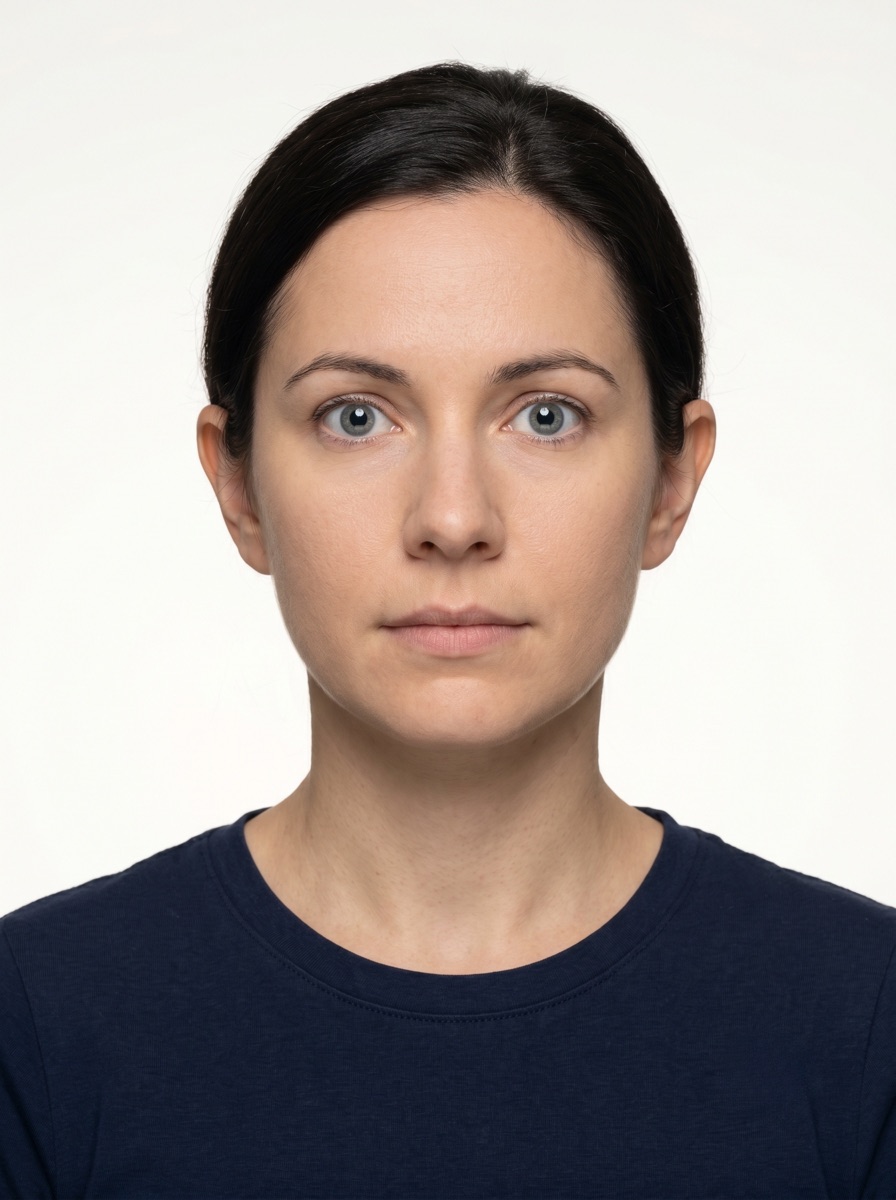
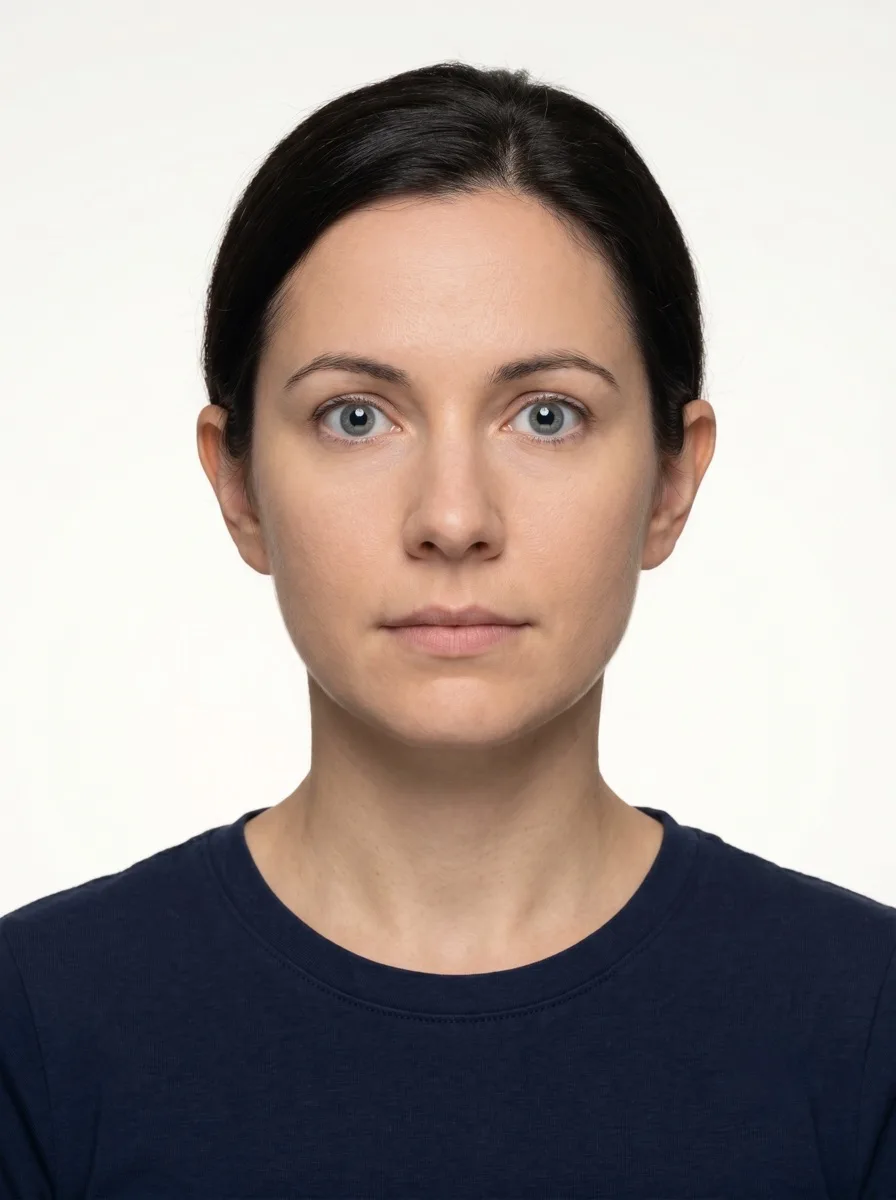
A photo that will be accepted, next to the six most common reasons France Schengen visa photos get rejected.
Accepted
Compliant France Schengen visa example (35 × 45 mm)
Face centred, looking directly into the lens
Plain background — no shadow, pattern or texture
Neutral expression, eyes open, mouth closed
No glasses, no hair across the face
Top 6 France Schengen visa rejection causes
Background shadowShadow on the wall behind the head, or background with a visible pattern or gradient
Smile / open mouthVisible smile with teeth or open mouth instead of a neutral expression
Glasses with glareGlasses with a clearly visible light reflection covering part of the eye
Hair across the faceLoose hair strands covering the eyes, eyebrows or part of the face
Eyes off-cameraEyes looking to the side instead of directly into the camera lens
Head tiltedHead tilted so the eye line is no longer horizontal
Typical rejection reasons and how to fix them
Typical reasons a photo is rejected under the rules France-Visas (Ministry for Europe and Foreign Affairs and Ministry of the Interior) and the TLScontact centres publishes: what is wrong and what to change.
Reason
Fix
Width outside 35–40 mm, or a face outside 70–80 % of the photograph
Print 35 × 45 mm and frame the head and top of the shoulders so that the face fills 70–80 %.
A busy or dark background, shadows or flash reflections on the face, red-eye
Use a plain light-coloured background with even light and no flash on the face.
A photo older than three months (Morocco list) or six months (ISO leaflet), or retouched
Take a new, unretouched photo within three months of applying.
Tinted lenses, reflections on the glasses, frames over the eyes, or hair across the eyes
Keep the eyes fully visible: clear lenses, no reflection, hair away.
A non-religious head covering, head tilted or turned, mouth open, or another person in the picture
Face the camera squarely, alone, with a neutral expression and the mouth closed.
How to take your France Schengen visa photo correctly
Background and light
Background: plain light
The tool puts in the required background. Stand half a metre from a plain light wall, face a window and shoot without flash — then there are no shadows on your face or on the wall.
Framing
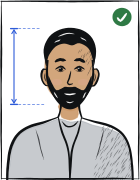
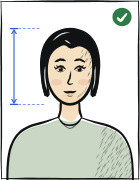
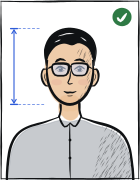
Head: 70–80 % of the photo height
Camera at eye level, about a metre away; head and shoulders in the shot. The tool crops it to 35 × 45 mm.
Glasses
Clear lenses only, no glare
If you wear glasses, check the shot: no glare on the lenses, eyes clearly visible.
Expression and gaze
Neutral expression, mouth closed, eyes open
Look straight into the lens with your head level; keep hair away from your eyes and eyebrows.
Print at 100% scale, borderless, and turn off fit-to-page so each photo keeps its exact size.
Where to submit your Schengen visa application
A French short-stay visa is applied for on the France-Visas portal, then at the visa centre of the country you apply from (TLScontact in Morocco, VFS Global or another provider elsewhere); the biometric photograph and the fingerprints are taken at the centre and the printed photos go with the form.
TLScontact visa centres in Morocco (Agadir, Casablanca, Fès, Marrakech, Oujda, Rabat, Tangier)appointment, in person
Fill in the form on France-Visas first, then book at the centre; the photo and fingerprints are taken in the biometric booths
Processing
Decided by the French consulate
Cost
Visa fee plus a TLScontact service fee of about 258 MAD; paid photo service optional
Standard list: two recent photos under 3 months, unretouched, on a light background to the standard.
France-Visas, ISO/IEC visa photograph requirements — quality: no more than 6 months old; 35–40 mm in width; a close-up of the head and top of the shoulders so that the face takes up 70–80 % of the photograph; in sharp focus; high quality with no ink marks or creases; looking directly at the camera; natural skin tones; appropriate brightness and contrast; printed on high-quality paper at high resolution (a digital-camera photo in high-quality colour on photo-quality paper).
Same leaflet — style and lighting: colour neutral; eyes open and clearly visible with no hair across; facing square on to the camera, not tilted, both edges of the face clearly shown; a plain light-coloured background; uniform lighting without shadows or flash reflections on the face and no red-eye.
Same leaflet — glasses and head coverings: if you wear glasses the eyes must be clearly shown with no flash reflection and no tinted lenses (avoid heavy frames if possible) and the frames must not cover any part of the eyes; head coverings are not permitted except for religious reasons, but the facial features from the bottom of the chin to the top of the forehead and both edges of the face must be clearly shown.
Same leaflet — expression and frame: the applicant alone (no chair backs, toys or other people visible), looking at the camera with a neutral expression and the mouth closed.
France-Visas, Morocco page: the standard list asks for «Deux photos récentes (datant de moins de 3 mois) non retouchées, sur fond clair aux normes»; «in the biometric booths your photograph will be taken and your fingerprints collected»; children under 12 are exempt from biometrics and an ICAO-standard photograph of the child is scanned; the TLScontact basic service fee is about 258 MAD per file, and optional paid services include identity photographs.
Questions
Frequently asked questions
From the France-Visas leaflet: no more than six months old, 35–40 mm wide, a close-up with the face at 70–80 % of the photograph, sharp and of high quality, on a plain light-coloured background with even light, looking at the camera with a neutral expression and the mouth closed, eyes open and clearly visible, no tinted lenses, and no head covering except for religious reasons with the face visible.
The France-Visas leaflet writes «35–40 mm in width» and no height; a 35 × 45 mm photo with the face at 70–80 % of the height meets it and is what centres normally expect. The Morocco list asks for two photos.
A plain light-coloured background: the leaflet and the Morocco list both write «light», not «white». White is not forbidden; keep it plain, evenly lit and free of shadows.
The ISO leaflet says no more than six months, while the Morocco page says less than three months. Take the photo within three months of your appointment.
In the TLScontact centres in Morocco, yes: «in the biometric booths your photograph will be taken and your fingerprints collected»; children under 12 are exempt and an ICAO photograph of the child is scanned. You still bring the printed photos the list asks for.
The recommended size for the France Schengen visa photo is 35 × 45 mm. The head occupies 70–80% of the photo height.
Often yes, but not always: tourist, student, work and transit visas can have different size or background rules. Compare the requirements of each France visa — if they match, one photo will do.
We refund the payment in full. Email us within 14 days of purchase with your order number and the consulate’s rejection notice.
No dark glasses or reflections; eyes must be fully visible. If you keep them on, tilt them slightly downwards by lifting the arms a little above your ears: this usually moves reflections of a window or lamp off the lenses.
35 × 45 mm = 3.5 × 4.5 cm = 1.38 × 1.77 inches. At 300 dpi that is 413 × 531 pixels; at 600 dpi, 827 × 1063 pixels.
Religious reasons only; must not cover the facial oval. The face must stay fully visible from chin to forehead and on both sides, with no shadow across it.
Yes. The same 35 × 45 mm format and head size apply to: national visa (Type D).