 Canada
 Brazil
50x70 Document Photos: How to Fit a 31–36 mm Face for Canada and Brazil
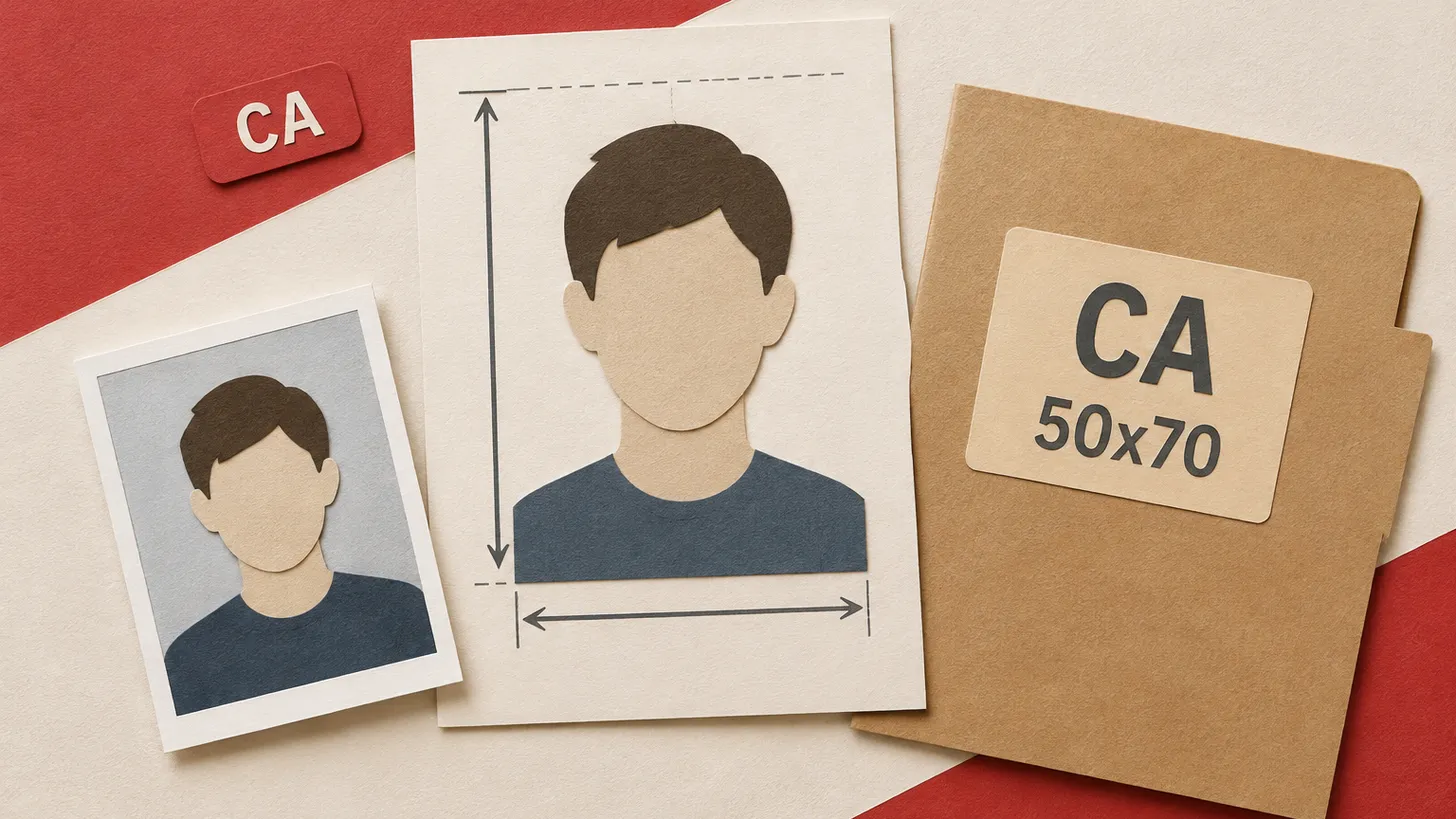
Canadian and Brazilian authorities require a 50x70 mm format with a head height of 31–36 mm, which cannot simply be cropped from a standard European photo.
In this article · 9 sections
- 01Where the 50x70 mm format fits in global practice
- 02Canada: the main user of the 50x70 mm format
- 03Brazil: the consular standard and exceptions for children
- 04Summary table of format parameters
- 05Why authorities reject 50x70 mm photos
- 06How to get a 50x70 mm print: step-by-step
- 07Frequently asked questions (FAQ)
- 08Questions
- 09Official sources
Key points
6 points- The 50x70 mm (5x7 cm) format requires a face height, from chin to crown, of strictly 31–36 mm.
- In Canada, this size is mandatory for passports, PR cards and citizenship certificates.
- Digital requirements differ within Canada: the PR card needs a file of up to 4 MB, while the passport needs a 3:2 aspect ratio.
- Within Brazil, only children under 5 submit a paper 5x7 cm photo; adults have their biometrics captured on site.
- Brazilian consulates' requirements depend on the country of application: standards range from 5x7 cm to 2x2 inches.
- The back of Canadian printed photos must show the date the photo was taken and the full address of the photo studio.
Short answer
The 50x70 mm document photo format (2 × 2¾ in inches, 5×7 in centimetres) is a rare standard, used mainly by Immigration, Refugees and Citizenship Canada (IRCC) and Brazilian authorities. The key parameter of this format is the face height from the chin to the natural crown of the head, which must be strictly between 31 and 36 mm. Because the frame is so tall, the head takes up only 44–51 % of the photo. Canadian procedures always require two identical prints, with the date the photo was taken and the full address of the photo studio on the back. Digital requirements for files of the same format vary: the Canadian permanent resident card (PR card) accepts files from 715 × 1000 pixels, while a Canadian passport requires a photo of at least 1800 × 1200 pixels in a strict 3:2 aspect ratio.
Where the 50x70 mm format fits in global practice
To see why this format is tricky to prepare, it is enough to look at the overall numbers. In our database of 241 document profiles, 229 have a recorded physical print size, and they use 17 different sizes. The most common standard is 35x45 mm, used in 148 profiles. Next come 51x51 mm (16 profiles), 30x40 mm (14 profiles) and 40x60 mm (11 profiles). Database figures as of 22 Sep 2026, the date of this article.
The 50x70 mm size is an exception. European photo booths do not offer it in their menus, and their cropping presets are designed for a larger face. Background rules also differ: of the 241 profiles in our database, 52 documents strictly require a white background, 23 specify a particular shade (for example, light grey), and the rest simply require a light background without naming a colour. In both jurisdictions (Canada and Brazil), the 50x70 mm format leans towards a white or strictly light plain background. Figures as of 22 Sep 2026.
The maximum age of the photo also varies. In our database, only 32 of the 241 profiles have a documented photo age limit (2 profiles require a photo no older than 3 months, 30 profiles no older than 6 months). The remaining authorities simply do not publish this parameter. For the 50x70 mm format, however, the time limits are spelled out very strictly and differ even within the same country. Figures as of 22 Sep 2026.
Canada: the main user of the 50x70 mm format
In Canada, 50x70 mm is the baseline standard for most domestic identity and status documents, not an exception for a single procedure. Immigration, Refugees and Citizenship Canada (IRCC) publishes detailed requirements for each document type.
Permanent resident card (PR card)
Under IRCC rules, PR card applications require two identical paper photos measuring 50 mm wide and 70 mm high (2 inches wide by 2¾ inches long). One digital file is also required. The digital requirements are specific: the resolution must be between 715 × 1000 and 2000 × 2800 pixels, and the file must not exceed 4 MB.
The photo for a PR card may be up to 12 months old. The renewal cycle of this document is governed by section 54 of the Immigration and Refugee Protection Regulations (SOR/2002-227), under which a PR card is valid for five years from the date of issue and remains the property of the Crown (Canada). The back of the paper print must show the name, the date the photo was taken, and the name and full address of the photo studio.
Canadian passport
Canada's Passport Program uses the same physical print size: 50 mm by 70 mm. The face height from chin to crown is likewise fixed within the 31–36 mm range (1¼ – 1⁷⁄₁₆ inches). However, the photo's validity is half as long: it must have been taken no more than 6 months before the application date.
The digital specifications for the passport differ fundamentally from those for the PR card. The authority requires at least 1800 pixels in height and 1200 in width, a strict 3:2 aspect ratio in portrait orientation, and a file size of 200 KB to 5 MB. For the digital photo, the face proportion is set explicitly: the distance from chin to crown must take up 45 % to 50 % of the frame height.
The process of certifying the back of the photo also differs. In addition to the studio details, the applicant's guarantor must write the phrase: "I certify this to be a true likeness of (applicant's name)".
Citizenship certificate and grant of citizenship
Citizenship procedures also use the 50x70 mm format with a face height of 31–36 mm. Applicants submit 2 identical colour printed photos on an even, plain background without shadows, taken no more than 6 months before the application. IRCC also gives a direct definition of prohibited alterations: an altered photo is any photo that has been edited or modified in any way and by any means.
Comparison with the Canadian visa
Canada's temporary resident visa uses a different frame size: at least 35 × 45 mm. But the head height from chin to crown stays exactly the same: 31 to 36 mm. This clearly shows the arithmetic of the format: going from visa to passport, the face size does not change; only the margins around it grow. In a 45 mm frame, a 31–36 mm face takes up 69–80 % of the height, while in a 70 mm frame that share drops to 44–51 %.
Brazil: the consular standard and exceptions for children
The second jurisdiction that actively uses similar proportions is Brazil. Here the format is referred to as 5×7 cm. However, how it is applied depends heavily on where the application is filed and the applicant's age.
Applying within Brazil
The most important fact about the Brazilian passport: within the country, a 5×7 cm print is required only from applicants under 5. According to the Federal Police of Brazil, the child must provide a recent 5×7 photo on a white background. The child must still attend the appointment in person. A child's photo will be rejected if the eyes are closed (an exception is made only for newborns), if the face is partly covered by jewellery or accessories, or if the child is no longer recognisable in the photo because of the time elapsed since it was taken.
For all citizens over 5, the process is different: an officer checks the documents and captures biometrics on the spot, namely fingerprints and a facial photo. The document is usually issued within 6 to 10 working days. No paper photo is required from adult applicants within Brazil.
Applying through Brazilian consulates abroad
For Brazilian citizens applying for documents outside the country, requirements vary from embassy to embassy. This divergence within a single Ministry of Foreign Affairs (MFA) means there is no single standard for applications abroad:
- Embassy in San José. explicitly requires "standard ID/passport size 5x7cm". The photo must be on a white background, preferably no older than 6 months. Using photos from previous passports is strictly prohibited.
- Consulate General in Atlanta. requires a 2 × 2 inch size (51x51 mm) rather than 5x7 cm, preferring the American format.
- Consulate General in London. does not specify a physical print size at all. Only framing requirements are given: full face on a white background, face and shoulders in the frame, no shadows, neutral expression, glasses without glare (dark and thick frames are prohibited), headwear only for religious reasons (without covering the face). Children may not be photographed with toys or someone else's hands in the frame.
Summary table of format parameters
| Parameter | Canada (Passport) | Canada (PR card) | Brazil (in-country, under 5) |
|---|---|---|---|
| Print size | 50 × 70 mm | 50 × 70 mm | 5 × 7 cm |
| Face height | 31–36 mm (45–50% of the frame) | 31–36 mm (44–51% of the frame) | Not published by the authority |
| Number of photos | 2 paper prints | 2 paper + 1 digital | 1 paper print |
| Maximum photo age | 6 months | 12 months | Recent photo (recognisability) |
| Background | White or light, uniform | Plain white | Strictly white |
| Digital file | Min. 1800 × 1200 px (3:2), up to 5 MB | 715 × 1000 ... 2000 × 2800 px, up to 4 MB | Not applicable |
CanadaPassport · requirements · check a photo
CanadaPermanent Residence Card · requirements · check a photo
CanadaCitizenship Certificate · requirements · check a photo
Note that print resolution in dpi, paper requirements (matte, glossy, weight) and service fees for these procedures are not published by the authorities in the official materials we reviewed. The exact maximum age for Brazilian consular photos is also not set as a firm rule (the wording "preferencialmente" means "preferably").
We can help you prepare a layout in the right size: create a digital photo and a print layout for a Canadian passport with the correct face proportions.
Why authorities reject 50x70 mm photos
Applications with photos in this format are rejected more often than standard ones. Based on the rules we analysed, we identify the following reasons for rejection:
- Trying to cut the frame out of a 35x45 mm photo. A 50x70 mm print is 15 mm wider and 25 mm taller than a standard visa photo. This cannot be fixed by cropping: you need either a complete reshoot or properly extended margins. The requirement is specifically about wide margins.
- European head proportions. In the Canadian format, the face does not scale with the frame. A 50x70 mm print in which the face takes up the usual European 70–80 % of the frame height will inevitably exceed the upper limit of the permitted share (which is 44–51 %). For the Canadian digital passport photo, this is strictly fixed: the face must take up 45–50 % of the frame.
- Using one file for everything. The two Canadian specifications are incompatible. If you prepared a file for the PR card (where different aspect ratios are allowed), it may not be accepted for the passport, which requires a strict 3:2 grid and at least 1800x1200 pixels.
- Errors on the back. For Canadian paper applications, the photo must bear the studio name, its FULL address and the date the photo was taken. A street photo booth or home printing without a stamp will not provide this.
- Missing in-country deadlines. A batch of 50x70 mm photos ordered for a PR card will become invalid for a Canadian passport after six months, since the maximum photo age is 6 months for the passport and 12 months for the PR card.
- Using old photos in Brazil. Brazilian consulates explicitly prohibit resubmitting photos already used in previous passports. Ordering photos "in reserve" for a decade does not work here.
- Digital retouching. The Canadian authority IRCC is categorical: any photo edited or modified in any way and by any means is considered "altered" and leads to rejection.
How to get a 50x70 mm print: step-by-step
Since the 50x70 mm format is practically unavailable in European photo booths, a sheet layout remains the most reliable option. Follow these steps:
- Check the consulate's rules (for Brazil). If you are applying abroad, go to the page of the specific consulate general. As we found, the size can range from 5x7 cm to 2x2 inches.
- Take the photo with extra background. Since the head must measure 31 to 36 mm in a frame 70 mm high, the camera must capture a large area above the head and the shoulders in full.
- Lay out the frames on a standard sheet. 50x70 mm photos fit two in a row on a standard 10x15 cm (100x150 mm) sheet of photo paper. This layout leaves room for the white margins needed for cutting with scissors and for the studio stamp.
- Follow the signature rules. For Canada, print the photo at a studio that can stamp it with its full address. For the passport, one photo must be given to the guarantor to write the required phrase and sign.
Frequently asked questions (FAQ)
- Can I cut a 50x70 photo out of a standard 35x45 photo? No. The 50x70 mm format is larger on both sides (15 mm wider and 25 mm taller). You will need an original file with plenty of background captured.
- Does an adult Brazilian citizen need to bring a paper 5x7 photo to a police office within the country? No. Within Brazil, only applicants under 5 submit a paper photo. For adults, an officer captures biometrics (fingerprints and a facial photo) when the documents are submitted.
- Will one digital file work for both the PR card and the Canadian passport? No, the digital requirements are incompatible. The PR card allows a range of 715x1000 to 2000x2800 pixels, while the passport requires a strict 3:2 aspect ratio and at least 1800x1200 pixels.
- Can I use a photo with slight background retouching in Canada? No. IRCC rules state that any photo altered or edited in any way is considered invalid and will be rejected.
08Questions
4 answers01Can I cut a 50x70 photo out of a standard 35x45 photo?
No. The 50x70 mm format is larger on both sides (15 mm wider and 25 mm taller). You will need an original file with plenty of background captured.
02Does an adult Brazilian citizen need to bring a paper 5x7 photo to a police office within the country?
No. Within Brazil, only applicants under 5 submit a paper photo. For adults, an officer captures biometrics (fingerprints and a facial photo) when the documents are submitted.
03Will one digital file work for both the PR card and the Canadian passport?
No, the digital requirements are incompatible. The PR card allows a range of 715x1000 to 2000x2800 pixels, while the passport requires a strict 3:2 aspect ratio and at least 1800x1200 pixels.
04Can I use a photo with slight background retouching in Canada?
No. IRCC rules state that any photo altered or edited in any way is considered invalid and will be rejected.
09Official sources
- Canadian passport photo requirements
web.archive.orgopened - Photos for the Canadian permanent resident card
web.archive.orgopened - Photos for proof of citizenship
canada.caopened - Embassy of Brazil in San José: photo specifications
gov.bropened - List of passport documents for Brazilian citizens
gov.bropened - Immigration and Refugee Protection Regulations (SOR/2002-227)
laws-lois.justice.gc.caopened
Author: Yevhen Kravchenko. Published . Checked against official sources on .
CanadaCanada Super Visa 2026: Income From Either of Two Tax Years, the 75% Option, $100,000 Insurance and the Photo
Since 31 March 2026 a super visa host can meet the income test in either of two tax years, or add the parent’s income once the host has 75%.
 Canada
 PRTD Photo: Not in the Travel Document Guide — $50 Fee, 730 Days; PR Card Later Needs 50 × 70 mm
IRCC’s guide for the permanent resident travel document (PRTD) asks for no photo.
 Canada
 PR Card Photo Requirements: 50 x 70 mm, Face 31–36 mm, Digital 715 x 1000 px up to 4 MB
PR card photo: 50 x 70 mm from a commercial photographer, face 31–36 mm, white background, within 12 months.
Make the photo for this document
Upload a selfie — we crop it to 50 × 70 mm, replace the background and check it against the document rules. Free preview.
Passport · CanadaUpload