 Spain
 Italy
Residence Permit Photos for Spain or Italy: 32×26 mm vs 35×45 mm
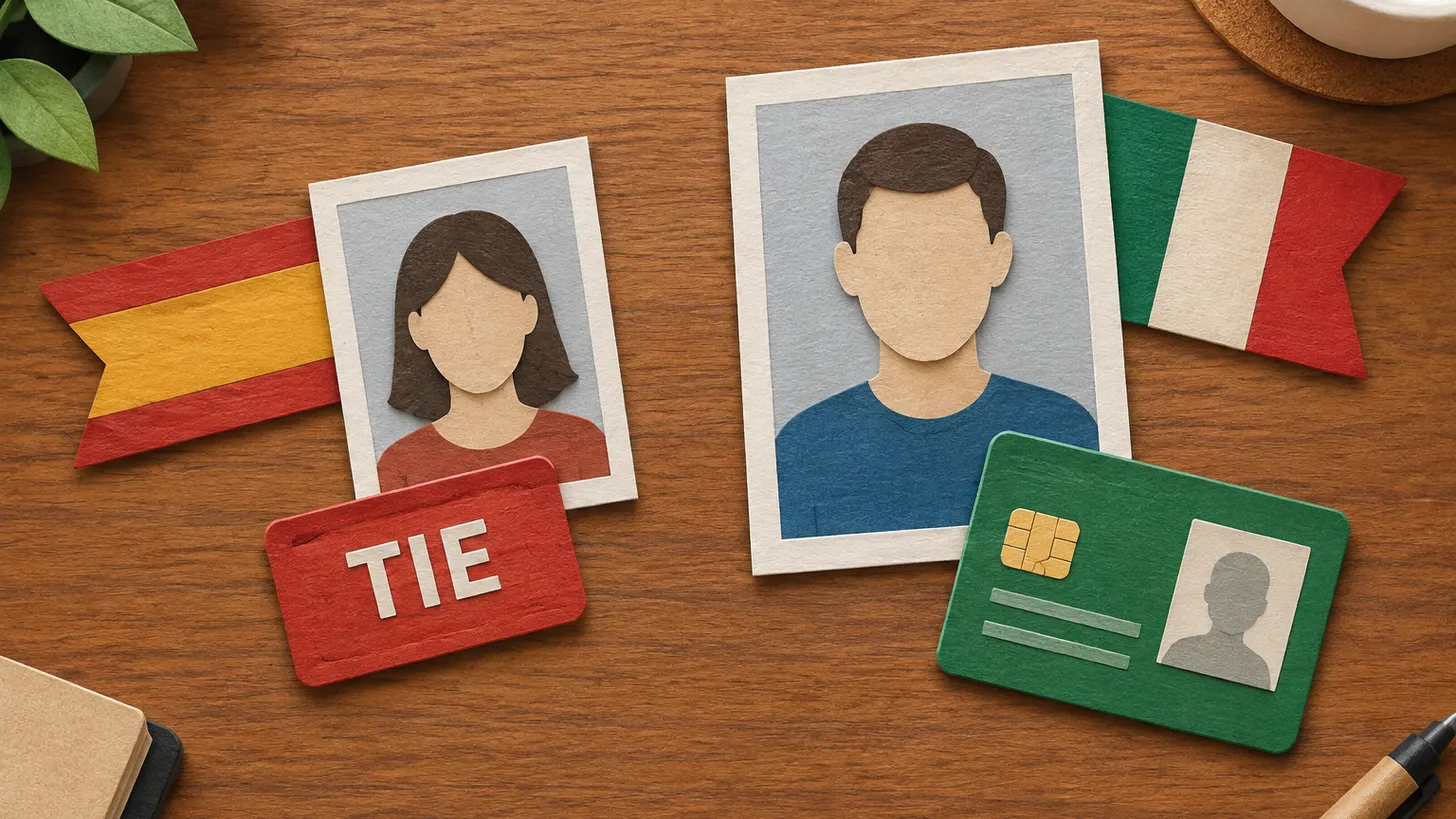
The Spanish TIE requires one 32×26 mm photo, while the Italian Permesso di Soggiorno requires four 35×45 mm photos. You cannot crop a single photo to suit both countries.
In this article · 8 sections
- 01Photo specifications compared: Spain (TIE) and Italy (Permesso di Soggiorno)
- 02The arithmetic of the gap: why the photos cannot be trimmed
- 03Why real applications get rejected
- 04Step-by-step procedure: the Spanish foreigner identity card (TIE)
- 05Step-by-step procedure: the Italian Permesso di Soggiorno
- 06What the Spanish and Italian authorities do not publish
- 07Questions
- 08Official sources
Key points
5 points- The Spanish TIE card requires 1 photo measuring 32 × 26 mm (the smallest print size in Europe).
- The Italian Permesso di Soggiorno requires 4 photos measuring 35 × 45 mm.
- The Spanish print is 9 mm narrower (26 vs 35) and 13 mm shorter (32 vs 45) than the Italian one. So you cannot make an Italian photo from a Spanish one, and the reverse only works by losing part of the frame.
- In Spain, the application is submitted in person at the police, where the index fingerprints are taken.
- In Italy, the four photos are brought to the in-person appointment at the questura; they are not put in the postal kit.
Short answer
If you are looking for information on residence permit photos for Spain or Italy: the two countries use different formats, and one cannot replace the other.
The Spanish foreigner identity card (TIE) requires one photograph measuring 32 × 26 millimetres, which the applicant brings in person to the National Police. The Italian Permesso di Soggiorno, by contrast, requires four identical photographs in the 35 × 45 millimetre format, handed in during the in-person appointment at the questura.
The Spanish print is 9 millimetres narrower: 26 mm versus 35 mm. It is also 13 millimetres shorter: 32 mm versus 45 mm. An Italian-format photo cannot be cut from a Spanish one; a Spanish one can be cut from an Italian photo only by losing part of the framing.
Photo specifications compared: Spain (TIE) and Italy (Permesso di Soggiorno)
In our dataset of 241 document profiles, 229 specify an exact print size. The analysis shows that these profiles use 17 different sizes. The most common is 35 × 45 millimetres, used in 148 profiles. Next come 51 × 51 millimetres (16 profiles), 30 × 40 millimetres (14 profiles) and 40 × 60 millimetres (11 profiles). Database figures as of 22 Sep 2026, the date of this article.
| Parameter | Spain (TIE) | Italy (Permesso di Soggiorno) |
|---|---|---|
| Print size | 32 × 26 mm (or 26 × 32 mm in portrait orientation) | Minimum height 45 mm, width 35 mm |
| Number of photos | 1 (one photograph) | 4 (four identical photographs) |
| Background requirements | Uniform, white and smooth (uniforme blanco y liso) | White background (fondo bianco) |
| Photo age | “Recent” (reciente) — the authority does not publish an exact time limit | The authority does not publish this |
| Where the photo is submitted | In person at the National Police, by appointment | In person at the appointment at the questura (Questura) |
SpainResidence Card · requirements · check a photo
ItalyElectronic Residence Permit · requirements · check a photo
ItalyPassport · requirements · check a photo
ItalyID Card · requirements · check a photo
As for the background, 52 of the 241 profiles in our database specify it as plain white, 23 name a specific non-white shade (for example, light grey), and the rest simply require a light background without specifying a colour. Figures as of 22 Sep 2026.
The arithmetic of the gap: why the photos cannot be trimmed
People moving from Spain to Italy or the other way round often hope to use the same printed photos for local immigration procedures. The maths of the formats makes this impossible.
Under Article 5.1.b) of the Spanish royal decree (Real Decreto 1553/2005), the print measures 32 × 26 millimetres. The Italian official portal sets a minimum height of 45 millimetres and a width of 35 millimetres. The Spanish photo is 13 millimetres shorter. So an Italian photo cannot be cut from a Spanish one at all.
A Spanish photo can be cut from an Italian one only by losing part of the head framing, because they have different proportions (width to height — 26:32 versus 35:45). This gap means that separate prints have to be made for each country from the start. If you are preparing documents for Spain, you can create a correct residence card photo in our system.
Why real applications get rejected
We have identified the reasons documents are turned down:
- Ordering “ID photos” in the familiar European 35 × 45 mm size for Spain. The DNI rule that the National Police applies to the TIE requires a size of 32 × 26 millimetres. This is the smallest print size in Europe.
- Relying on the main page of Spain's Ministry of the Interior. In all four application scenarios, this page only uses the vague “tamaño carné” (ID card size), without a single millimetre. The exact figure has to be taken from the royal decree on the DNI, which the police cite in a separate line.
- Submitting a photo with tinted glasses in Spain. The royal decree explicitly bans dark lenses and anything that hinders identification. The head must be completely uncovered.
- Putting the Italian photos in the postal kit. They do not go there. The applicant brings four photos to the appointment at the questura; one of them is glued onto the permit.
- Submitting one photo, or four different ones, for Italy. Exactly four identical photos on a white background are required. According to guidance from the Milan questura, this set of four photos is needed for each family member separately, even when a family application is filed for children.
- Missing application deadlines in Italy. The portal sets a deadline of eight working days after entry for applications, and renewals must be filed at least 60 days before expiry.
- Expecting to submit documents through a representative in Spain. The decree requires the physical presence of the person to whom the document is issued. A minor must be accompanied by a legal representative with the original of their own valid document.
- Trying to use the Spanish TIE as an identity document. Spain's Ministry of the Interior states plainly: the TIE certifies your administrative status and the legality of your stay. It does not certify your identity. A foreign national must prove their identity with a document issued by their own country, not with the TIE.
- Misunderstanding the Spanish background requirement. People often assume the background is the same because it is “white”. However, the Italian rule simply requires “fondo bianco”, while the Spanish DNI rule says “fondo uniforme blanco y liso” — that is, uniform, white, smooth. The Spanish wording adds a requirement about the surface itself.
Step-by-step procedure: the Spanish foreigner identity card (TIE)
Applying for the Tarjeta de identidad de extranjero (TIE) requires dealing with the Spanish National Police in person.
- Declaration of entry. If your passport has no entry stamp, a declaration of entry must be submitted in person at a police station or Oficina de Extranjeros within 72 hours of crossing the border.
- Preparing documents. According to the Commissariat for Foreigners, the document package includes a completed EX17 application form and proof of payment of the fee using form 790 (code 012). The application must be accompanied by the original and a full copy of a valid passport or travel document, and, for renewals, the old TIE card.
- Preparing the photograph. You need one recent colour photo of the face measuring 32 × 26 millimetres on a white, smooth background. Although 32 of the 241 profiles in our database specify a maximum photo age, the Spanish police do not publish an exact number of months, using only the word “reciente”. Figures as of 22 Sep 2026.
- Booking and visiting the police. The application is submitted in person at the National Police Unidad de Documentación in the province of residence, after booking an appointment through the electronic office of the public administrations.
- Fingerprinting. Under the DNI rule, the prints of both index fingers are taken from the applicant at the time of application. If those cannot be taken, prints of the middle, ring or thumb are taken, in that order.
The validity of the issued TIE card equals the validity of the permit or recognised right itself. The card is issued when the residence permit exceeds six months. If their address or nationality changes, the foreign national must notify the police station within one month.
Step-by-step procedure: the Italian Permesso di Soggiorno
In Italy, the permit application process is split into a postal part and a police part.
- Meeting the entry deadlines. Non-EU nationals (extracomunitari) must submit a request to the questore of the province where they are staying within eight working days of entering Italy. For renewals, the request must be filed at least sixty days before the current permit expires.
- Waiting for the appointment. After sending the application at the post office, the applicant receives a letter with the date and time of the appointment at the questura's Immigration Office. If the questura's schedule had no free slots at the time of application, the appointment will be sent later by registered letter.
- Preparing the set of photographs. You need four identical photographs in the 35 × 45 millimetre format on a white background. In Italian sources, the authority does not publish requirements on photo age or facial expression, limiting itself to the format.
- Visiting the questura. At the appointed time, the applicant goes to the Ufficio Immigrazione. There they hand over the four photographs and undergo photo-fingerprinting (fingerprints are taken).
- Receiving the smart card. The physical Permesso di Soggiorno is a credit-card-sized smart card containing a microchip and an optical strip. It stores the holder's personal details, photograph and fingerprints in digital form, and one of the paper photos brought along is glued onto it.
For European Union citizens, the Italian Ministry of the Interior portal sets out a separate procedure: they are called to the Immigration Office only for the Carta di soggiorno card. Even so, they are still required to provide four photographs in the specified format.
What the Spanish and Italian authorities do not publish
The Spanish and Italian authorities do not publish certain information:
- Digital file requirements. Neither Spanish nor Italian official sources give any technical requirements for a digital file (pixels, size in kilobytes, format). Both procedures are paper-based and offline.
- The cost of the Spanish TIE. The Ministry of the Interior and police pages do not state the exact fee in euros: only the form itself is named (form 790 code 012), but the authority does not publish the fee amount.
- Detailed Italian framing requirements. The Italian pages do not describe any requirements on pose, facial expression or glasses for the permit — they only say “formato tessera con fondo bianco” and give two sizes in millimetres.
A separate issue is the legal status of the Spanish requirements. Spanish decree 1553/2005 governs the issuance of the DNI (national identity card) for Spanish citizens. For the foreigner's TIE card, it applies through the police's cross-reference.
07Questions
5 answers01What photo size is required for the Spanish TIE?
Under the Spanish DNI rule that the police refer to, you need a 32 × 26 millimetre photo of the face on a uniform, white, smooth background.
02How many photos should I bring to the questura in Italy?
Four identical 35 × 45 mm photos on a white background; one of them will be glued onto the permit.
03Can I apply for the Spanish TIE through an authorised representative?
No, the decree requires the applicant to be present in person, and the prints of both index fingers are taken when the documents are submitted.
04Will a Spanish photo work for an Italian residence permit?
No, the Spanish print is 32 mm high, while the Italian one is at least 45 mm (a 13 mm gap). An Italian-format photo cannot be cut from a Spanish one.
05How recent must the photo be for the Spanish and Italian cards?
None of the authorities checked publishes a specific limit in months. The Spanish Ministry of the Interior only uses the word “recent” (reciente), and the Italian portal does not mention photo age at all.
08Official sources
- Agencia Estatal Boletín Oficial del Estado (Spain's official state gazette)
boe.esopened - Dirección General de la Policía, Comisaría General de Extranjería y Fronteras (Spanish Ministry of the Interior)
policia.esopened - Ministerio del Interior (Spanish Ministry of the Interior)
interior.gob.esopened - Ministero dell'Interno — Portale Immigrazione
portaleimmigrazione.itopened - Ministero dell'Interno — Portale Immigrazione
portaleimmigrazione.itopened - Polizia di Stato, Questura (Italian Ministry of the Interior)
questure.poliziadistato.itopened - Polizia di Stato, Questura di Milano (Italian Ministry of the Interior)
questure.poliziadistato.itopened
Author: Yevhen Kravchenko. Published . Checked against official sources on .
SpainSpain Schengen Visa Photo Requirements: 35 x 45 mm, White Background, Glued to the Form — What Consulates Ask
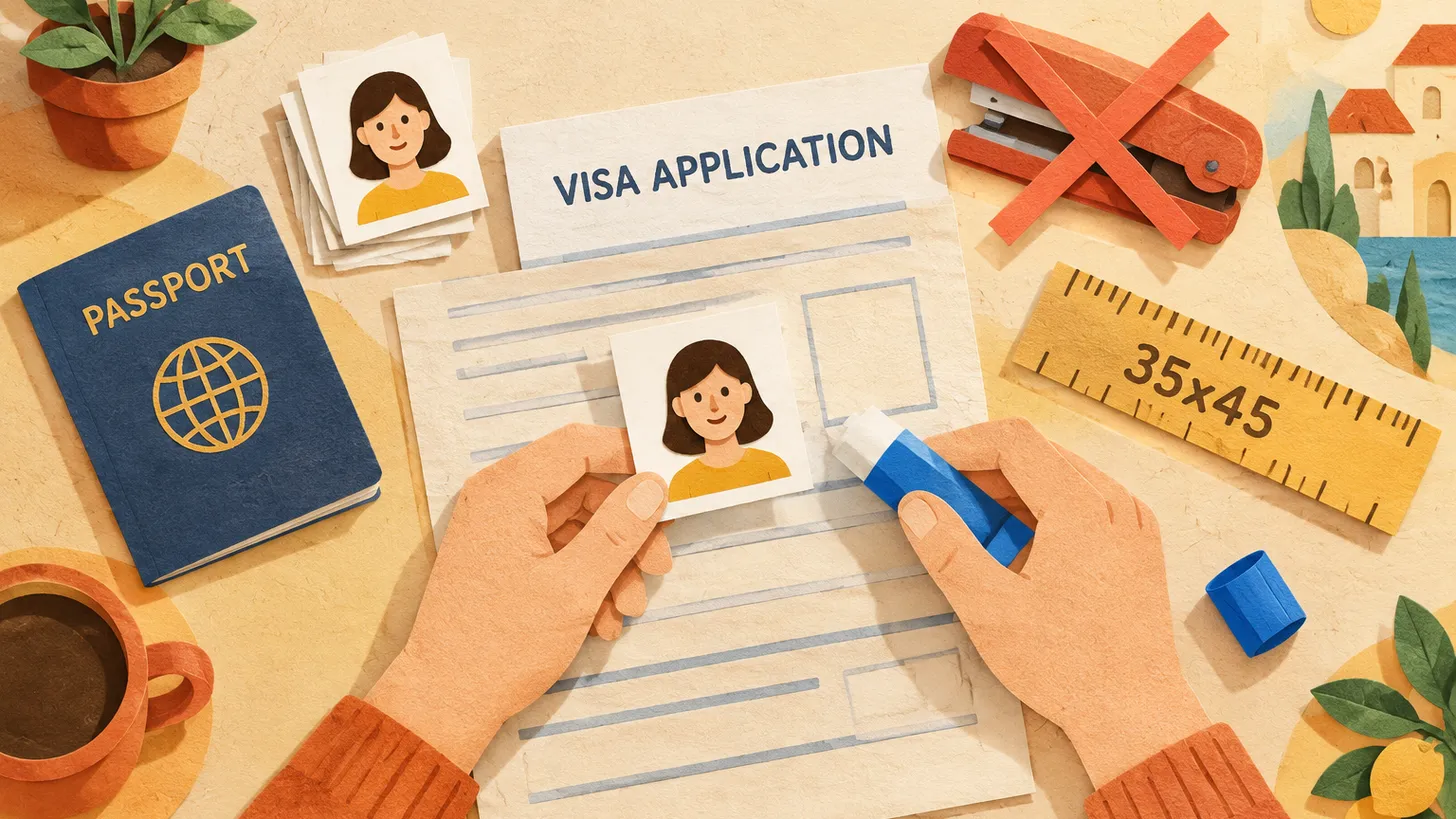
Spanish consulates ask for a recent colour passport-size photo (35 x 45 mm) on a white or light background, glued or clipped to the Schengen form.
 Spain
 Netherlands
 Sweden+2
Reused Biometrics or a New Photo for a Residence Permit Renewal: Rules in Spain, the Netherlands and Sweden
Rules for renewing a residence permit vary: the Netherlands may not require new biometrics if they were taken less than 6 months ago, while Sweden requires a new capture for every new card and Italy asks for 4 photos when you are called to the Questura.

 Schengen Area
 GermanySpain+6
EU ID card photo requirements: sizes and rules by country
The size for an ID card photo in EU countries is not uniform: Spain requires 32 × 26 mm, France needs 35 × 45 mm, and in Lithuania, the initial print must be 40 × 60 mm.
Make the photo for this document
Upload a selfie — we crop it to 26 × 32 mm, replace the background and check it against the document rules. Free preview.
Residence Card · SpainUpload