 Netherlands
Netherlands introduces new country policy on asylum for Ukrainians without TPD
From 1 July 2026 the IND assesses regular asylum claims from Ukrainians without TPD, citing "safe areas" in Ukraine; TPD status is unaffected.

In this article · 6 sections
Key points
5 points- From 1 July 2026 the Dutch government adopted the first-ever country policy for Ukraine since the war began.
- The policy applies only to regular asylum claims from Ukrainians who do NOT fall under the Temporary Protection Directive (TPD) — around 1,010 pending cases.
- The IND divides Ukraine into risk zones; regions with relatively lower violence can be treated as an "internal protection alternative" — grounds for refusal.
- If you already hold TPD status, nothing changes: it has been automatically extended until 4 March 2027, and this policy does not apply to you.
- The IND assesses every application individually; there is no ready-made list of "vulnerable groups" with automatic protection.
What changed
On 1 July 2026 the Dutch government adopted its first-ever country policy (landenbeleid) for assessing asylum applications from Ukrainian nationals since the start of the full-scale war. The announcement came from the Minister for Asylum and Migration, Bart van den Brink. The Immigration and Naturalisation Service (IND) had effectively paused decisions on these applications; it is now resuming them, using the new policy as its assessment framework.
The policy divides Ukraine into zones by intensity of violence: areas with exceptionally high violence, areas with relatively higher violence, and areas with relatively lower violence. The IND may treat regions with relatively lower risk as an "internal protection alternative" — meaning it can decide that a person could have found safety in another part of Ukraine rather than needing status in the Netherlands. The decision affects around 1,010 applications that are already pending and for which the statutory 21-month decision deadline has already passed.
Who this affects
The new policy applies only to regular asylum applications from Ukrainians whom the IND has refused temporary protection under the Temporary Protection Directive (TPD), or who already received temporary protection in another EU country. If you currently hold TPD status in the Netherlands, this policy does not affect you: the IND does not decide on an asylum application while your TPD status applies, and TPD itself has been automatically extended until 4 March 2027 (EU-level talks about a further extension are ongoing). The Netherlands currently hosts around 135,000 Ukrainians under TPD.
The IND stresses that it assesses every application individually, taking personal circumstances into account. There is no predefined list of "vulnerable groups" — for example, belonging to the LGBTIQ+ community or facing mobilisation-related difficulties does not by itself guarantee protection.
What to do now
- Check your status: if you already have a TPD decision in the Netherlands, the new policy does not affect you and no action is needed.
- If you do not have TPD and are considering a regular asylum application, weigh the consequences first: during the procedure you must hand in your travel document, which limits your ability to travel, and it can affect your rights in other EU countries.
- Get free advice from VluchtelingenWerk Nederland or an immigration lawyer before filing or changing an application.
- Follow the official IND and Government.nl pages for updates and for the long-term plan due after TPD ends on 4 March 2027.
Common mistakes
The most common mistake is confusing this country policy with the Temporary Protection Directive: they are two separate procedures, and the change only affects those filing a separate, regular asylum claim. A second mistake is filing an asylum application "just in case" without consulting a lawyer first — this can worsen your position, including limiting your freedom to travel while the case is pending. A third is assuming that belonging to a particular group (for example, evading mobilisation) automatically guarantees protection: the IND assesses each case individually.
Rules change frequently — before taking any action, always check the current requirements on the official government source linked above.
05Questions
5 answers01Does the new policy affect people who already have Temporary Protection (TPD) in the Netherlands?
No. If you already hold TPD status, this country policy does not apply to you: the IND does not decide on an asylum application while your TPD status applies, and TPD itself has been automatically extended until 4 March 2027.
02Who exactly will the IND's new country policy affect?
It applies only to Ukrainians who filed a regular asylum application and do not fall under TPD — for example, people refused temporary protection or who already received it in another EU country. Under the new policy the IND is assessing around 1,010 such pending applications.
03What does a "safe part of Ukraine" mean in an IND decision?
The IND has divided Ukraine into zones by level of violence. If your home region is classed as relatively lower-risk, the IND may decide you could have found safety there and refuse status in the Netherlands on that basis — but every decision is made individually.
04Does this mean TPD is being cancelled?
No. TPD and the country policy are two separate procedures. TPD, the EU-wide mechanism for Ukrainians, remains in force and has been extended until 4 March 2027; talks about a further extension are ongoing separately within the EU.
05What should I do if I receive a refusal under the new country policy?
Contact an immigration lawyer or VluchtelingenWerk Nederland as soon as possible — the IND's decision states the deadline and procedure for appeal. Do not decide on next steps without advice, since an asylum procedure carries its own consequences for your status.
06Official sources
- Rijksoverheid.nl — Cabinet adopts new country policy for Ukraine
rijksoverheid.nl - IND — IND resumes deciding on Ukrainian asylum applications
ind.nl - RefugeeHelp.nl — New country policy for Ukraine: what does this mean for you?
refugeehelp.nl
Author: Yevhen Kravchenko. Published . Checked against official sources on .
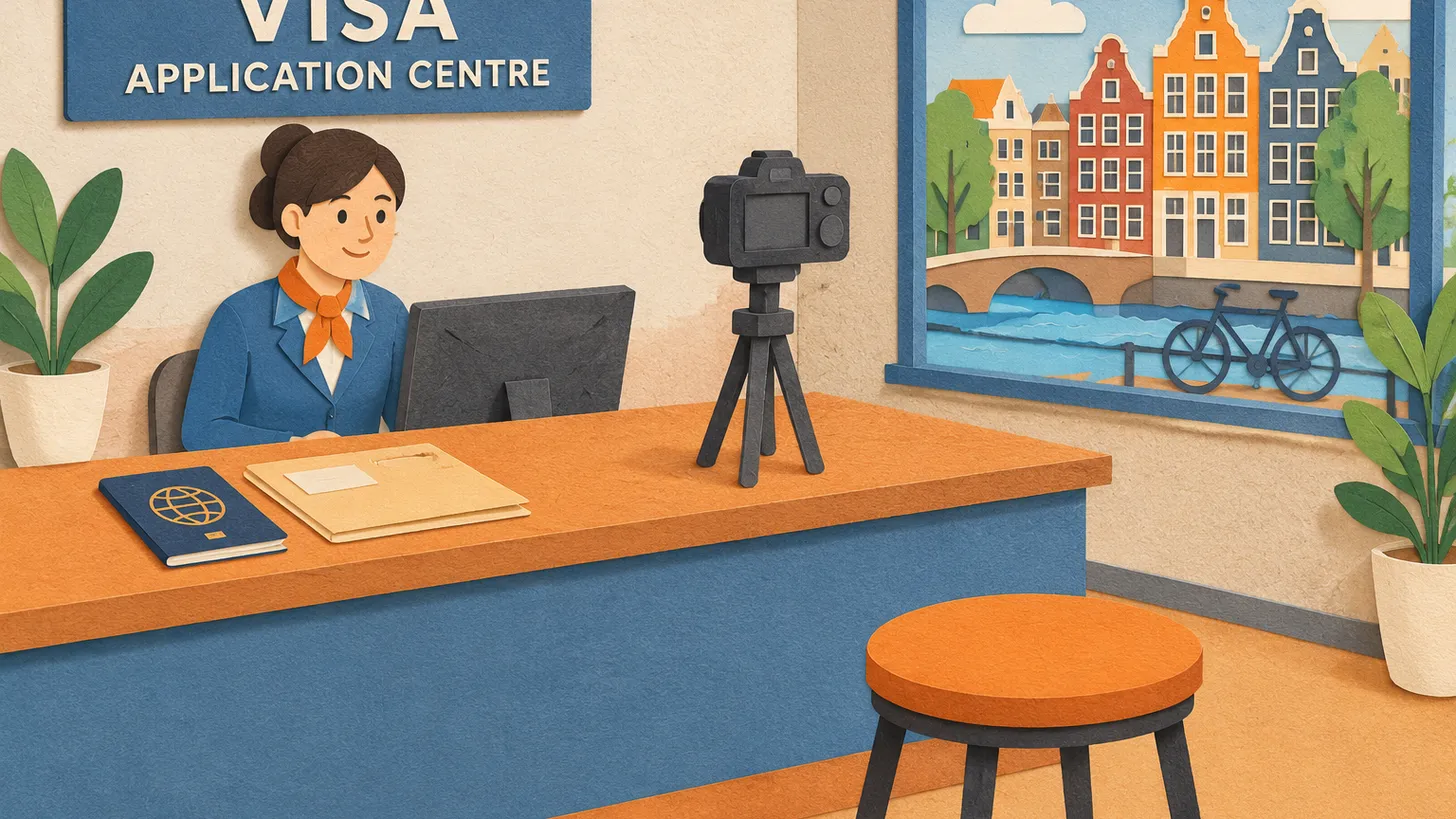
NetherlandsNetherlands Schengen Visa Photo: 35 x 45 mm, Face 26–30 mm, and When the Visa Centre Takes It for You
Dutch Schengen visa: a colour 3.5 x 4.5 cm photo under 6 months old on a white or light background — unless you apply via a visa centre, which takes it.
 Schengen Area
 Germany
 Spain+6
EU ID card photo requirements: sizes and rules by country
The size for an ID card photo in EU countries is not uniform: Spain requires 32 × 26 mm, France needs 35 × 45 mm, and in Lithuania, the initial print must be 40 × 60 mm.
 Netherlands
Photo for a Netherlands residence permit (verblijfsvergunning), MVV and passport in 2026: IND requirements for Ukrainians
A photo for a Netherlands residence permit, MVV visa and passport must be colour, 35×45 mm, with the head (from chin to crown) measuring 26–30 mm for people aged 11 and over, a light grey/light blue/white background, no glasses, a neutral expression, and no older than 6 months.

Make your photo to the current rules
Pick your document and upload a selfie — we crop it to size, replace the background and check it. Free. The sizes come from the same official sources as the news.