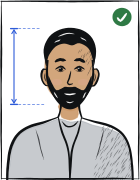
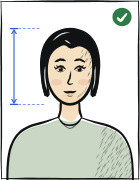
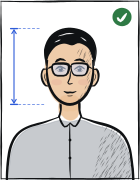
Quick answer: A Japan visa photo must be 35 × 45 mm. White or light uniform background. Head occupies 71–80% of photo height (32–36 mm chin to crown). Neutral expression, clear lenses only, no glare. Last verified .
Japan visa photo: size in mm, cm, inches and pixels
Millimetres
35 × 45 mm
Centimetres
3.5 × 4.5 cm
Inches
1.38 × 1.77″
Pixels at 300 dpi
413 × 531 px
Pixels at 600 dpi
827 × 1063 px
Japan-specific things to know
The size depends on the mission: 45 × 35 mm in Paris and 4.5 × 3.5 cm in Manila and Melbourne (all 35 × 45 mm as width × height), 2 × 2 inches in the US consulates, and a 45 × 45 mm square in India. Ask your embassy before printing.
Paris refuses the whole file if the form is submitted without the photo glued on. Melbourne and Detroit say glue only — no staples, no tape.
Nationals of Russia, CIS countries and Georgia must submit two photos and two forms (Melbourne); Paris adds Ukraine to that list.
Manila wants your full name and date of birth written on the back of the photo, and rejects photos that are out of the standard or digitally modified; Melbourne bans skin smoothing and face slimming.
Colour is the safe choice: India requires a colour photo, while Manila also takes monochrome. The background must be white in every mission — dark, busy or patterned backgrounds are refused.
How visa photos are verified
Japan visa photographs are set by the Ministry of Foreign Affairs of Japan (MOFA) and checked by the embassy or consulate (or the visa application centre working for it) that takes the application. MOFA's own application form has a photo box of 45 mm × 35 mm — height first in the Japanese wording, so 35 × 45 mm wide × high, the size used on this page.
Read more
Missions word the rule differently: Paris asks for 45 × 35 mm, Manila 4.5 × 3.5 cm, Melbourne and the US consulates also take 2 × 2 inches, and the embassy in India asks for a 45 × 45 mm square. All of them want a photo taken within the last 6 months on a plain white background, glued to the form; the Paris page adds that a form without the glued photo gets the whole file refused.
For the online JAPAN eVISA the photo is a file: plain, untextured background, face centred, JPG, PNG, GIF, BMP or HEIC, up to 2 MB recommended.
Examples and mistakes
What makes Japan visa photos accepted
One compliant example next to the six most common rejection causes for Japan visa applications. These are the differences that most often determine whether a document photo is accepted.
Accepted
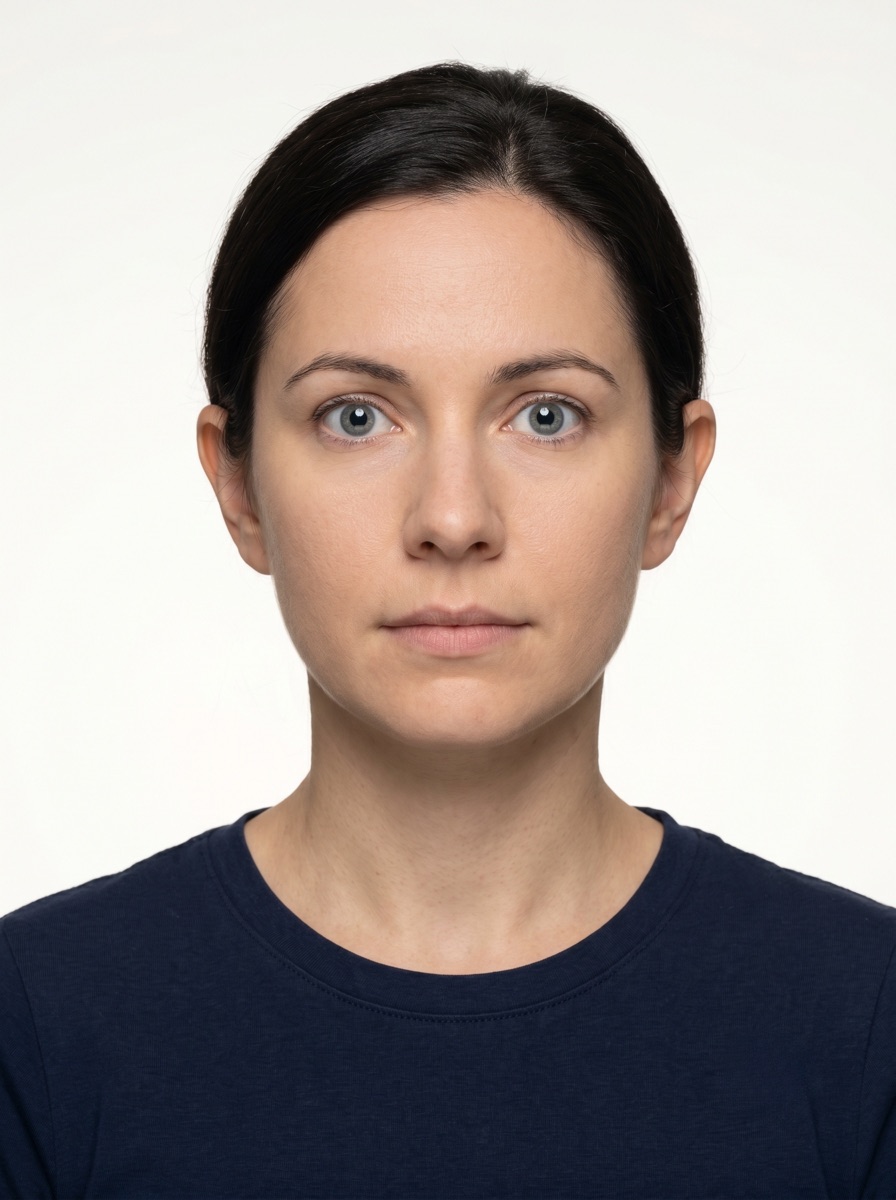
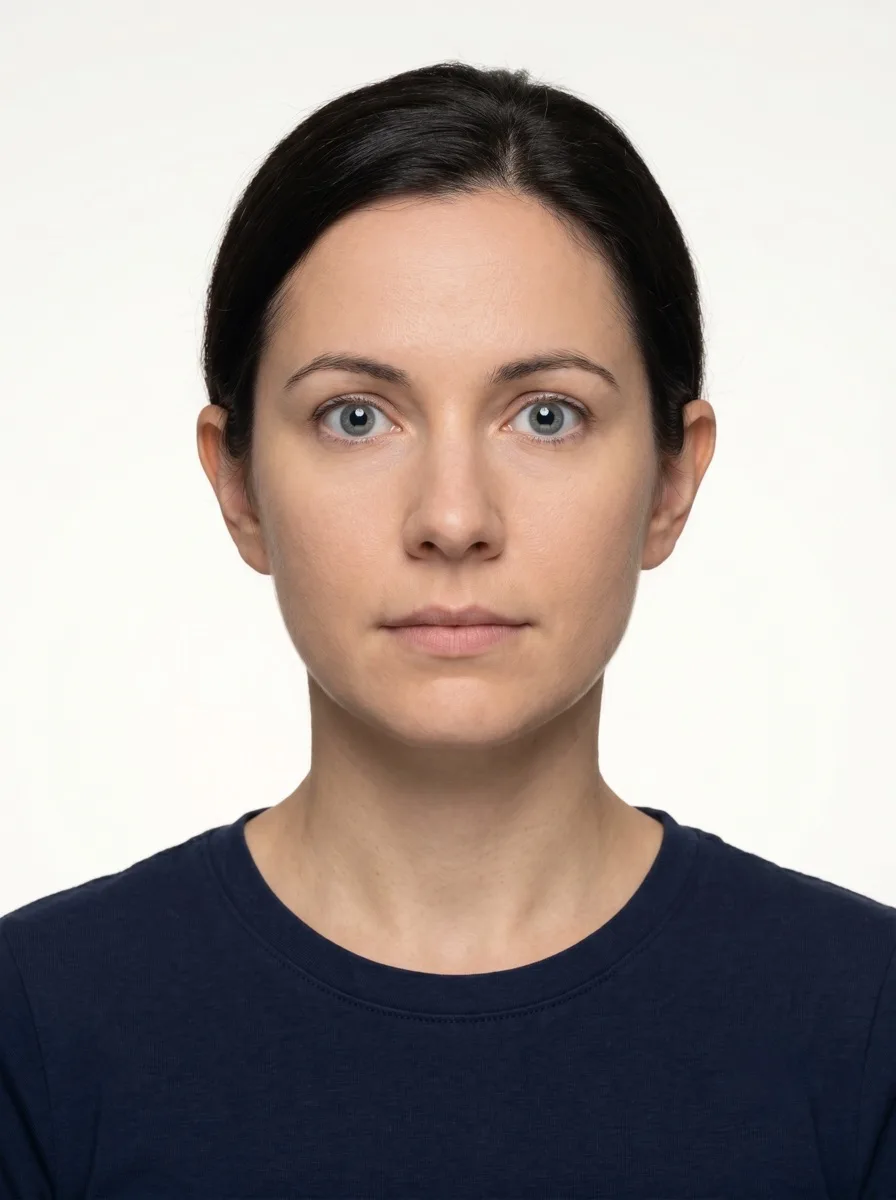
Compliant Japan visa example (35 × 45 mm)
Face centred, looking directly into the lens
Plain background — no shadow, pattern or texture
Neutral expression, eyes open, mouth closed
No glasses, no hair across the face
Top 6 Japan visa rejection causes
Background shadowShadow on the wall behind the head, or background with a visible pattern or gradient
Smile / open mouthVisible smile with teeth or open mouth instead of a neutral expression
Glasses with glareGlasses with a clearly visible light reflection covering part of the eye
Hair across the faceLoose hair strands covering the eyes, eyebrows or part of the face
Eyes off-cameraEyes looking to the side instead of directly into the camera lens
Head tiltedHead tilted so the eye line is no longer horizontal
Typical rejection reasons and how to fix them
Typical reasons a photo is rejected under the rules Ministry of Foreign Affairs of Japan publishes: what is wrong and what to change.
Reason
Fix
Size not the one your mission asks for (45 × 35 mm, 4.5 × 3.5 cm, 2 × 2 inches or a 45 × 45 mm square)
Read the photo line on your embassy's page and print that size; Paris says other sizes are not accepted. 35 × 45 mm (width × height) fits the MOFA form box.
Photo not glued to the form, or stapled or taped on
Glue the photo into the box on the form with glue only; in Paris a form without the glued photo means the whole file is refused.
Background not white, or dark, busy or patterned
Shoot in front of a plain white wall or use a white background in the tool; India, Melbourne and Manila all say white only, and JAPAN eVISA asks for a plain, untextured background.
Photo older than 6 months
Take a new photo within 6 months before you apply; every mission and the JAPAN eVISA FAQ use the same six-month limit.
Retouched or filtered photo, or a low-quality print with folds and scratches
Use an unedited photo: Melbourne bans skin smoothing and face slimming, Manila refuses digitally modified photos. Print on proper photo paper — Paris wants photo booth or photographer quality, Denver warns that poor-quality digital photos may not be accepted.
JAPAN eVISA upload fails: wrong format, file too heavy or photo outside the frame
Save the photo as JPG, PNG, GIF, BMP or HEIC, keep it near or under 2 MB and fit it inside the red rectangular frame shown on the upload screen.
The tool puts in the required background. Stand half a metre from a plain light wall, face a window and shoot without flash — then there are no shadows on your face or on the wall.
Framing
Head: 71–80 % of the photo height (32–36 mm)
Camera at eye level, about a metre away; head and shoulders in the shot. The tool crops it to 35 × 45 mm.
Glasses
Clear lenses only, no glare
If you wear glasses, check the shot: no glare on the lenses, eyes clearly visible.
Expression and gaze
Neutral expression, mouth closed, eyes open
Look straight into the lens with your head level; keep hair away from your eyes and eyebrows.
Print at 100% scale, borderless, and turn off fit-to-page so each photo keeps its exact size.
Where to submit your visa application
A Japanese visa is requested at the embassy or consulate of Japan, at a visa application centre working for it, or online through JAPAN eVISA where the mission offers it. MOFA tells applicants to read the page of the mission that covers their country; the photo rule on that page is the one that counts.
Embassy or consulate of Japanin-person
The mission that covers your country — list and visa pages on mofa.go.jp
Processing
Set by each mission
Cost
Visa fee per MOFA schedule; it differs by nationality and visa type and is shown by the mission
Bring the form with the photo glued on; the applicant must appear in person where the mission says so (Paris does). Paris asks for the passport original plus a copy of the photo page, with at least two blank pages.
evisa.mofa.go.jp — only for the applicants and missions the system lists
Processing
Shown in the system for your mission
Cost
Visa fee per MOFA schedule, paid online where the mission accepts it
The photo is uploaded as a file: JPG, PNG, GIF, BMP or HEIC, up to 2 MB recommended, six months old at most, plain untextured background, inside the red frame. Several supporting documents must be merged into one PDF.
fr.emb-japan.go.jp — tourist visa page lists the documents
Processing
Shown by the embassy page for your visa type
Cost
Visa fee paid in cash only, where one is due
One photo glued to the form (two for CIS, Ukraine and Georgia nationals), 45 × 35 mm, under 6 months, photo booth or photographer quality. The applicant must be present in person when filing.
Japan Visa Application Centre (JVAC), Philippinesin-person
Manila — through the JVAC, or directly at the embassy
Processing
Shown by the embassy page
Cost
Visa fee per MOFA schedule plus any centre service fee
4.5 × 3.5 cm photo glued to the form, name and date of birth written on the back, within 6 months; photos out of the standard or digitally modified are not accepted.
The official MOFA visa application form contains a 45 mm × 35 mm photo box; as width × height that is 35 × 45 mm.
Embassy of Japan in France: 45 × 35 mm, one photo (two for nationals of CIS countries, Ukraine and Georgia), face and eyes towards the lens, under 6 months old, photo booth or photographer quality without folds or scratches; the photo must be glued to the form.
Consulate-General of Japan in Melbourne: 4.5 × 3.5 cm or 2 × 2 inches, glued only (no staples or tape), white background only, taken within 6 months, no filters or editing such as skin smoothing or face slimming.
Embassy of Japan in India: 45 × 45 mm square (2 × 2 inches), colour, white background only; dark, busy or patterned backgrounds are not accepted; taken in person within six months.
Embassy of Japan in the Philippines (visa application centre JVAC): 4.5 × 3.5 cm, within 6 months, glued to the designated space, monochrome or colour but clear on a white background, full name and date of birth written on the back; a photo out of the standard or digitally modified is not acceptable.
US consulates: Denver accepts 35 × 45 mm (width × height) or 2 × 2 inches with 32–36 mm from chin to top of head, best taken in a photo studio; Detroit asks for 2 × 2 inches glued (not stapled or taped), accepts homemade digital photos if clear, and refuses green-card style photos with the face turned to the side.
JAPAN eVISA (online): photo taken within the last six months, plain untextured background, entire face centred horizontally; upload as JPG, PNG, GIF, BMP or HEIC, up to 2 MB recommended, fitted inside the red rectangular frame.
Questions
Frequently asked questions
A colour photo taken within the last 6 months, glued to the visa application form, on a plain white background, face and eyes towards the camera, no hat, no filters or retouching. The MOFA form box is 45 × 35 mm (35 × 45 mm wide × high); some missions take 4.5 × 3.5 cm or 2 × 2 inches, and India asks for a 45 × 45 mm square. Read your embassy's photo line before you print.
45 × 35 mm and 35 × 45 mm are the same photo: Japanese forms give the height first, so the portrait photo is 35 mm wide and 45 mm high. The embassy in Paris asks for exactly this, Manila and Melbourne write it as 4.5 × 3.5 cm, and the US consulates in Denver and Detroit also take 2 × 2 inches. Only the embassy in India asks for a 45 × 45 mm square. A mismatch with your embassy's size is the first thing to check.
Yes, if it is sharp and meets your embassy's size. The Paris page names «photomaton/photographe» as the expected quality, with no folds or scratches, 45 × 35 mm and under 6 months old. Check that the booth uses a plain white background and cuts the photo to your embassy's size, then glue it to the form.
The list depends on the purpose of travel and on the mission, so use the page of your embassy. What the Paris embassy lists for a tourist visa: the application form in English (do not sign it before submission), one ID photo glued to it, the passport with at least 2 blank pages plus a photocopy of the photo page, and any extra papers the embassy asks for at filing. Where the JAPAN eVISA is offered, the same documents are uploaded, merged into one PDF.
One photo glued to the application form. Nationals of Russia, CIS countries and Georgia (and Ukraine at the embassy in Paris) submit two photos and two forms. The online JAPAN eVISA takes a single uploaded facial photo.
A facial photo as JPG, PNG, GIF, BMP or HEIC, with up to 2 MB recommended, taken within the last six months against a plain, untextured background, with the whole face centred. The upload screen shows a red rectangular frame — the photo has to fit inside it. If several files will not upload together, the FAQ advises combining them into one PDF.
The Japan visa photo must be 35 × 45 mm. The head must occupy 71–80% of the photo height. Many consulates also require a specific digital file size — see the spec table above for full details.
White or light uniform background. The background must be evenly lit with no shadow gradients, especially around the head. Consular automated pre-screening rejects photos with any wall texture before the human reviewer ever sees the application.
Visa authorities typically require the photo to be taken within the last three to six months. Submitting an older photo, even one that looks similar to your current appearance, is a frequent cause of immediate consular rejection.
Not always. Tourist, work, student and transit visa categories sometimes specify different dimensions or background rules. Follow the requirements for your specific visa type rather than assuming one photo fits all Japan visa applications.
Anfas.Pro provides a 14-day full refund if the photo is the cause of rejection and you supply the consular rejection notice. We recommend keeping the consular receipt with rejection reason as proof.
Eyes must be fully visible; no tinted lenses or strong reflections. Consular automated checks flag glasses glare even when it is invisible to the human eye. Removing glasses entirely is the safest choice unless a medical exception is documented in your visa application.
35 × 45 mm = 3.5 × 4.5 cm = 1.38 × 1.77 inches. At 300 dpi that is 413 × 531 pixels; at 600 dpi, 827 × 1063 pixels.
Religious reasons only; must not cover the facial oval. The face must stay fully visible from chin to forehead and on both sides, with no shadow across it.