SourceSouth African Department of Home Affairs and DIRCO missions; VFS Global as the visa application centre
Verified
Quick answer: A South Africa visa photo must be 35 × 45 mm. Plain white, light grey, or cream background. Head occupies 70–80% of photo height. Neutral expression, clear lenses only, no glare. Last verified .
South Africa visa photo: size in mm, cm, inches and pixels
Millimetres
35 × 45 mm
Centimetres
3.5 × 4.5 cm
Inches
1.38 × 1.77″
Pixels at 300 dpi
413 × 531 px
Pixels at 600 dpi
827 × 1063 px
South Africa-specific things to know
The sources do not agree on background and head size: Home Affairs says plain without a «white lining» and a head of 22–25 mm, while VFS India and Cotonou say white, and VFS India a face of 70–80 % (about 31–36 mm of 45 mm). Where the figures conflict, follow the list of the centre that takes your file.
The number is two identical photographs on every list read. The age limit is one month at VFS India and «recently taken» at Cotonou; colour is required in India and Cotonou, colour or black-and-white at Stockholm.
Machine-type or instant photographs are not accepted for the long-term visa (Stockholm); print the photographs on proper photo paper without border, holes or marks.
How visa photos are verified
A South African visitor visa takes two identical photographs of 35 mm × 45 mm. The Embassy in Cotonou writes «two recently taken identical passport photographs with white background (35 mm width and 45 mm length)», and the Embassy in Stockholm «two identical photographs 35 × 45 mm, colour or black/white»; VFS Global South Africa in India asks for a photo in colour, without border, on a white background only, with the face taking up 70–80 % of the picture, sharp and clean, looking directly at the camera, taken within the last month and without headgear unless a case-by-case consideration allows it.
Read more
The Department of Home Affairs specification that VFS reproduces (headed «photographs submitted for identity documents and passports») differs in detail: length 45 mm and width 35 mm, a plain background free of shadows «and shall not have a white lining», only head and shoulders, the head from chin to top of hair 22–25 mm, spectacles allowed if the lenses do not make the eyes invisible, the full face from the front with the head not bent or turned, and no holes, pencil or ink marks. For a long-term visa the Stockholm embassy asks for two passport-type photographs and says machine-type or instant photographs are not acceptable.
Examples and mistakes
What makes South Africa visa photos accepted
One compliant example next to the six most common rejection causes for South Africa visa applications. These are the differences that most often determine whether a document photo is accepted.
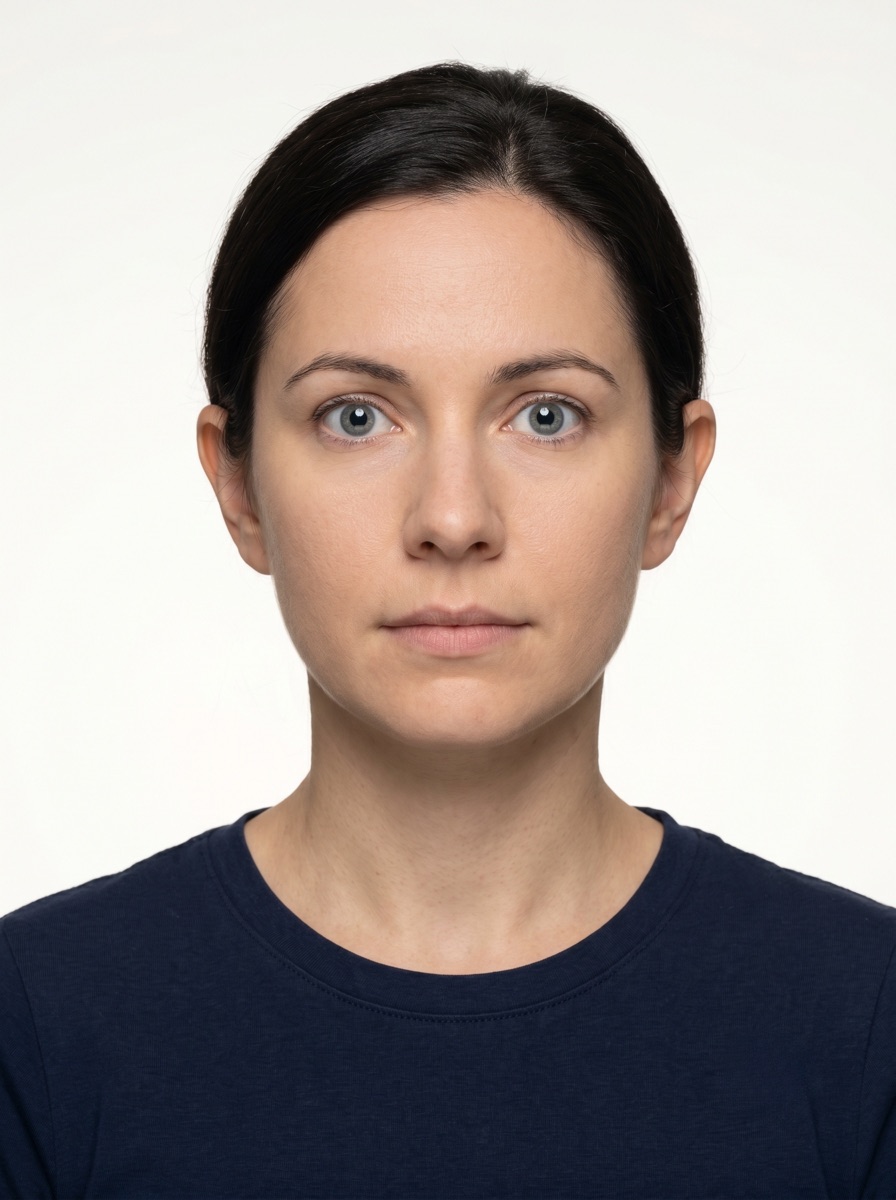
Accepted
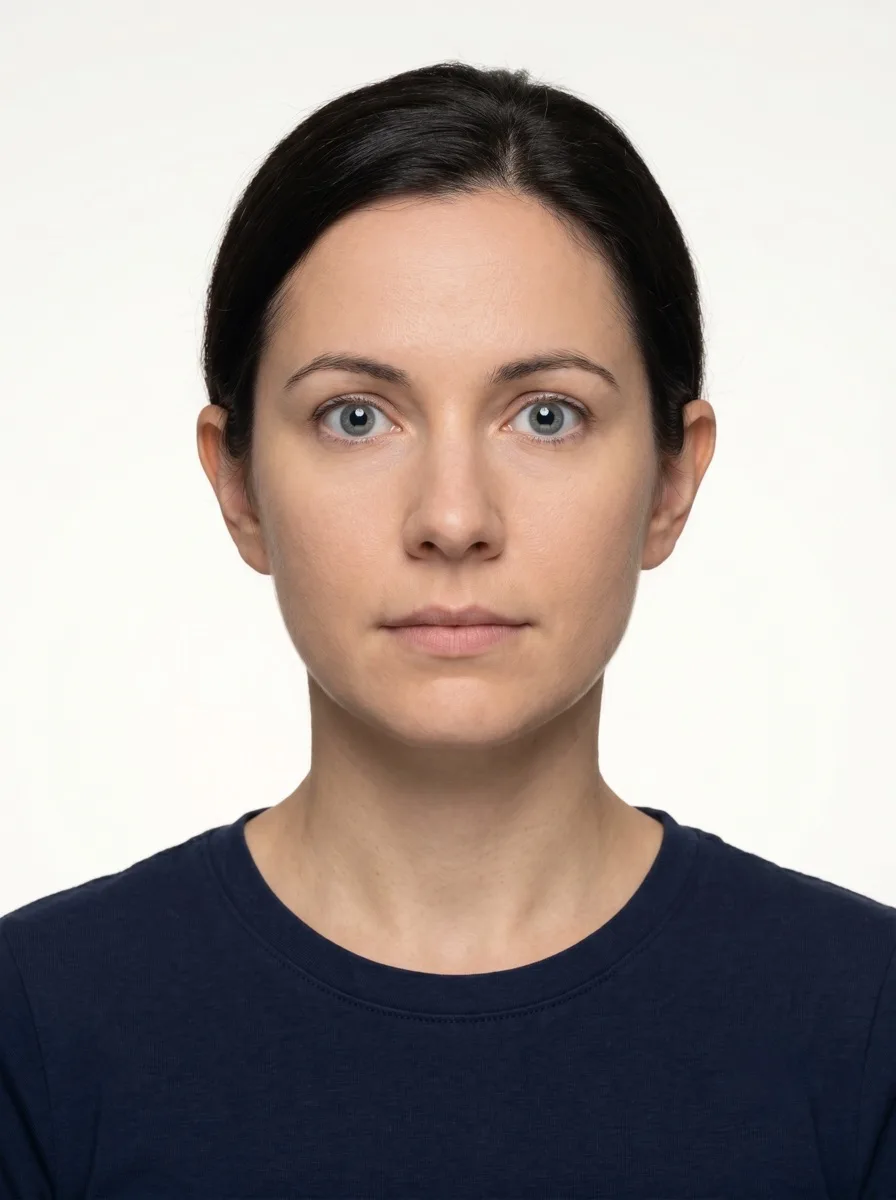
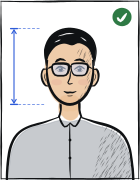
Compliant South Africa visa example (35 × 45 mm)
Face centred, looking directly into the lens
Plain background — no shadow, pattern or texture
Neutral expression, eyes open, mouth closed
No glasses, no hair across the face
Top 6 South Africa visa rejection causes
Background shadowShadow on the wall behind the head, or background with a visible pattern or gradient
Smile / open mouthVisible smile with teeth or open mouth instead of a neutral expression
Glasses with glareGlasses with a clearly visible light reflection covering part of the eye
Hair across the faceLoose hair strands covering the eyes, eyebrows or part of the face
Eyes off-cameraEyes looking to the side instead of directly into the camera lens
Head tiltedHead tilted so the eye line is no longer horizontal
Typical rejection reasons and how to fix them
Typical reasons a photo is rejected under the rules South African Department of Home Affairs and DIRCO missions; VFS Global as the visa application centre publishes: what is wrong and what to change.
Reason
Fix
A single photograph, or two photographs that are not identical
Hand in two identical 35 × 45 mm prints.
A background that is not plain white, with a border or shadows
Use a plain white background, no border, no shadows.
A photo older than one month at VFS India, or not recently taken
Take a new photograph within the last month.
Head bent or turned, head covering without approval, eyes hidden by the lenses
Face the camera squarely with the eyes visible and nothing on the head.
Holes, pencil or ink marks, creases, or a machine-type or instant print
Print clean copies on photo paper and do not mark them.
How to take your South Africa visa photo correctly
Background and light
Background: white, light grey or cream
The tool puts in the required background. Stand half a metre from a plain light wall, face a window and shoot without flash — then there are no shadows on your face or on the wall.
Framing
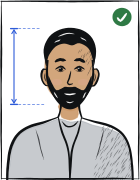
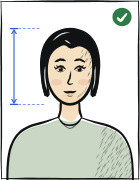
Head: 70–80 % of the photo height
Camera at eye level, about a metre away; head and shoulders in the shot. The tool crops it to 35 × 45 mm.
Glasses
Clear lenses only, no glare
If you wear glasses, check the shot: no glare on the lenses, eyes clearly visible.
Expression and gaze
Neutral expression, mouth closed, eyes open
Look straight into the lens with your head level; keep hair away from your eyes and eyebrows.
Print at 100% scale, borderless, and turn off fit-to-page so each photo keeps its exact size.
Where to submit your visa application
A South African visa is applied for at the South African embassy, high commission or consulate, or at the VFS Global visa application centre in many countries; the forms are DHA-84 for a visit of up to 90 days and DHA-1738 for a longer stay, and the printed photographs are handed in with them.
VFS Global South Africa visa application centreby appointment, in person
The VFS centre of your country, listed on visa.vfsglobal.com
Processing
Stockholm: up to 21 working days
Cost
Processing fee plus the VFS service fee
Two identical colour photographs, 35 × 45 mm, white background, no border, face 70–80 %.
VFS Global South Africa (DR Congo), Home Affairs specification: «Length - 45mm Width - 35mm»; «The background of the photograph shall be plain and free of shadows and shall not have a white lining»; only the head and shoulders, and «the head from the chin to the top of the hair shall not be smaller 22mm and not larger than 25mm».
Same specification: no head-gear or veil and no additions to the face that alter the natural likeness (the Director-General may exempt); «Spectacles may be worn provided that the lenses do not make the eyes invisible»; dark lenses only if the eyes look distorted without them or the person is blind; the full face directly from the front, the head not bent or turned sideways; head, hair, eyebrows, eyes, nose and moustache or beard sharply and clearly defined; no holes, pencil or ink marks.
VFS Global South Africa (India), photo specifications: «The photograph must be in color. It should be without border. It should have a white background only. It should have a close up of your head and top of your shoulders so that your face takes up 70-80% of the photograph… It should be 3.5 cm X 4.5 cm… not more than 1 month old… taken without headgear» (with headgear after case-by-case consideration); the visitor visa checklist asks for two recent passport-size photographs (35 mm × 45 mm of the picture).
DIRCO Embassy in Stockholm, visitor's visa (DHA-84): «Two (2) identical photographs 35x45mm, colour or black/white»; for the long-term visa application form DHA 1738: «two passport type photographs. Machine-type or instant photographs are not acceptable». DIRCO Embassy in Cotonou, visitor visa: «Two recently taken identical passport photographs with white background (35 mm width and 45 mm length)».
Questions
Frequently asked questions
Two identical photographs of 35 mm × 45 mm. At VFS India: in colour, without border, white background only, the face taking up 70–80 % of the photo, taken within the last month, no headgear unless approved case by case. Cotonou asks for a white background; Stockholm accepts colour or black-and-white.
35 mm wide by 45 mm long (3.5 × 4.5 cm). The Department of Home Affairs text gives length 45 mm and width 35 mm.
Two identical photographs on the lists read: the visitor visa at VFS India, Stockholm and Cotonou, and two passport-type photographs for the long-term visa form DHA 1738.
The Home Affairs specification allows spectacles provided the lenses do not make the eyes invisible; dark lenses only if the eyes would look distorted without them or the person is blind. A head covering is not allowed unless the visa centre approves it case by case.
The South Africa visa photo must be 35 × 45 mm. The head must occupy 70–80% of the photo height. Many consulates also require a specific digital file size — see the spec table above for full details.
Plain white, light grey, or cream background. The background must be evenly lit with no shadow gradients, especially around the head. Consular automated pre-screening rejects photos with any wall texture before the human reviewer ever sees the application.
Visa authorities typically require the photo to be taken within the last three to six months. Submitting an older photo, even one that looks similar to your current appearance, is a frequent cause of immediate consular rejection.
Not always. Tourist, work, student and transit visa categories sometimes specify different dimensions or background rules. Follow the requirements for your specific visa type rather than assuming one photo fits all South Africa visa applications.
Anfas.Pro provides a 14-day full refund if the photo is the cause of rejection and you supply the consular rejection notice. We recommend keeping the consular receipt with rejection reason as proof.
Glasses must not cover the eyes; tinted lenses permitted only for medical reasons. Consular automated checks flag glasses glare even when it is invisible to the human eye. Removing glasses entirely is the safest choice unless a medical exception is documented in your visa application.
35 × 45 mm = 3.5 × 4.5 cm = 1.38 × 1.77 inches. At 300 dpi that is 413 × 531 pixels; at 600 dpi, 827 × 1063 pixels.
Religious reasons only; must not cover the facial oval. The face must stay fully visible from chin to forehead and on both sides, with no shadow across it.