 Germany
Germany's digital passport photo code: which documents need it and where paper stays
For a German electronic residence permit, you need a digital photo (DataMatrix code) or a photo taken at the agency terminal for 6 euros, but a paper photo is still required for driving licenses and refugee residence permit stickers.
In this article · 10 sections
- 01Digital reform: why Germany split its photo requirements
- 02Which documents need a digital photo: ID card, passport and eAT
- 03Exceptions: when a 35x45 mm paper photo is still required
- 04Comparison table: digital vs. paper
- 05Why the authority rejects photos (and how to avoid paying twice)
- 06Step-by-step procedure: how to submit a photo under the new rules
- 07Frame requirements for paper photos (Anlage 8 PassV)
- 08Photo size and age statistics in global practice
- 09Questions
- 10Official sources
Key points
5 points- From August 1, 2025, German authorities will no longer accept paper photos for ID cards, passports, and electronic residence permits with a chip.
- Photos for electronic documents are taken either at the agency (for a unified fee of 6 euros) or by a photographer or service provider who issues a DataMatrix code instead of a print.
- For a driving license (Führerschein), a digital photo is not suitable—you still need to bring a 35x45 mm paper photo.
- Ukrainian refugees receiving a residence permit sticker directly in their passport must continue to bring a paper biometric photo.
- Agencies recommend allowing an extra 5–10 minutes before your appointment to use the photo terminal, and digital files on USB flash drives are not accepted.
Short answer
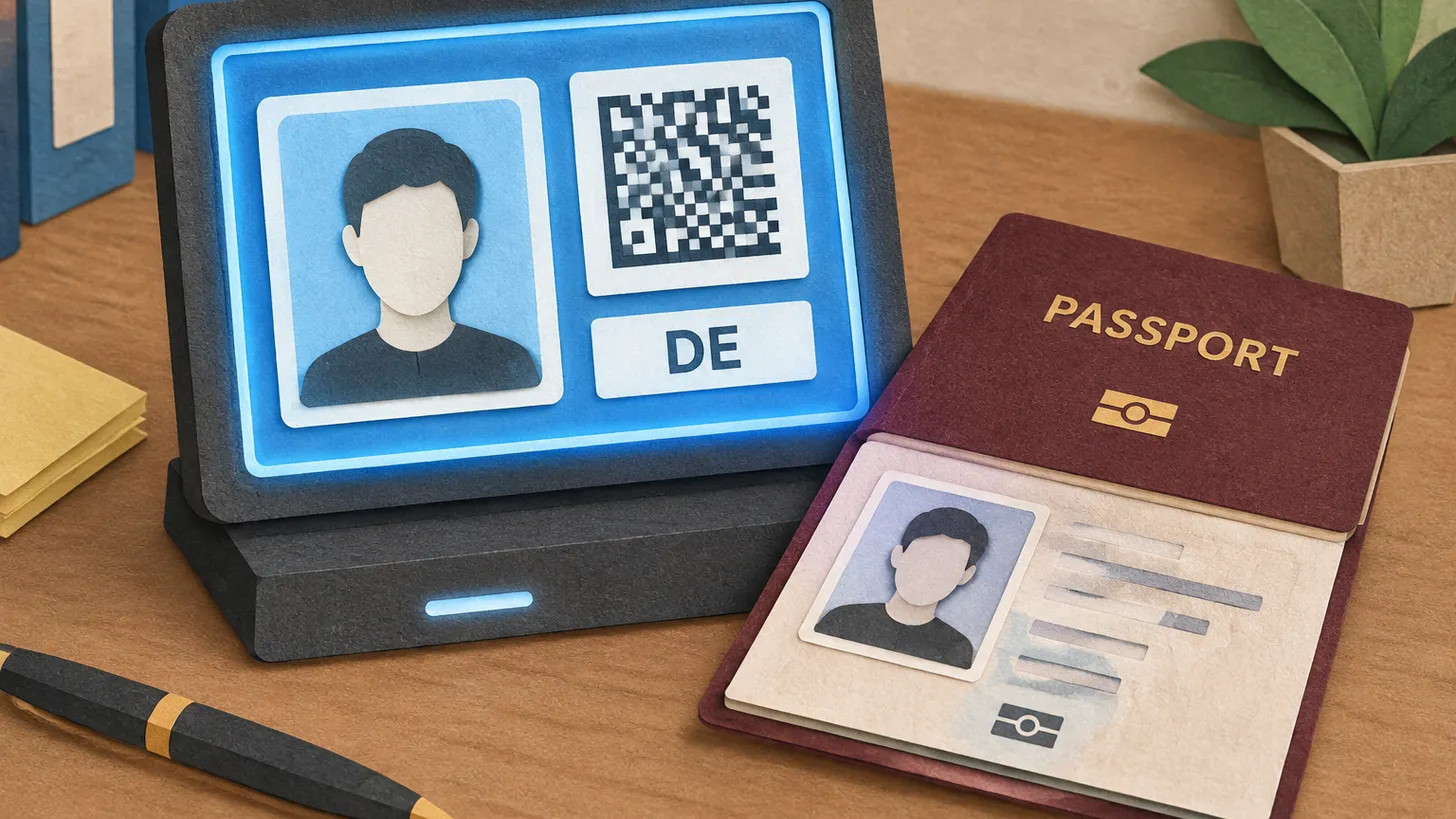
From August 1, 2025, bringing a paper photo on photo paper to apply for a German electronic residence permit (eAT), ID card, or passport is no longer allowed. The immigration offices (Ausländerbehörde) and citizen service centers (Bürgerbüro) exclusively require a digital photo. You can take it either directly at the agency terminal for 6 euros or at a photo studio or another provider who can transmit the photo to the agency via a secure electronic channel and issue a Germany digital passport photo code (DataMatrix code).
However, Germany operates two opposing systems simultaneously. If you are applying for a driving license (Führerschein) or receiving a specific residence permit for Ukrainian refugees, which is affixed as a sticker in your foreign passport, you must bring a printed paper photo. A digital DataMatrix code is not suitable for these services, and the applicant will be turned away.
For cases where the rules require a printed photo, you can prepare a photo for a residence permit in Germany in advance.
Digital reform: why Germany split its photo requirements
European background and the Passport Act
At the European level, there are security requirements for identity documents. According to Article 1a of Council Regulation (EC) No 2252/2004, biometric identifiers must be collected by qualified and duly authorized staff of the document-issuing authority itself. Passports and travel documents must contain a highly secure storage medium containing a facial image.
In Germany, the Gesetz zur Stärkung der Sicherheit im Pass- und Ausweiswesen (Act on Strengthening Security in the Passport and Identity Card System) was adopted. As the Berlin State Office for Immigration (Landesamt für Einwanderung) points out, the law came into force on May 1, 2025. Since then, biometric passport photos may only be created digitally directly at the authorities or at photo studios that can transmit them digitally via a secure electronic channel.
End of the transition period
Any large-scale reform requires time for technical adaptation. The Stuttgart authority officially confirms that the exception, which temporarily allowed paper photos, was only valid until July 31, 2025. Starting August 1, 2025, employees of citizen service centers (Bürgerbüro) and immigration offices (Ausländerbehörde) are not authorized to accept any paper photos for electronic documents.
Which documents need a digital photo: ID card, passport and eAT
According to § 5a of the Identity Card Ordinance (Personalausweisverordnung), the same rule of electronic transmission applies to the German ID card (Personalausweis). The Residence Ordinance (Aufenthaltsverordnung) establishes in its § 60 that the provision of § 6 paragraph 2 sentence 3 of the Passport Act also applies to an eAT residence permit digital photo, uniform format residence titles, and travel documents for foreigners, refugees, and stateless persons.
Two allowed submission methods
According to § 6 para. 2 of the German Passport Act (Passgesetz), there are two submission methods in Germany; for a passport issued abroad, a 45 × 35 mm paper photo is allowed under certain conditions:
- Option 1: Through a service provider (Dienstleister). A photographer takes the picture electronically and transmits it to the passport authority in a secure manner. § 4 of the Passport Ordinance (Passverordnung) specifies that a secure manner means using a cloud provider or transmitting from a certified device connected directly to the authority's network.
- Option 2: At the authority itself. The agency takes the photo electronically using its own certified capture devices (terminals).
Exceptions: when a 35x45 mm paper photo is still required
Residence permits for Ukrainians (passport stickers)
The most critical exception applies to refugees from Ukraine. The Berlin State Office for Immigration clearly distinguishes between plastic eAT cards and paper stickers. According to their clarification, the issuance of residence permits for refugees from Ukraine, which are affixed directly into the passport (Aufenthaltserlaubnissen für Geflüchtete aus der Ukraine in den Pass), as well as Duldung and Aufenthaltsgestattung certificates, are excluded from the digital reform.
The official requirement states: persons affected by these exceptions must continue to bring non-digital biometric passport photos on photo paper.
German driving licence photo: paper or digital?
The second large category is drivers. According to the Stuttgart authority, the driving license is excluded from the new rules. If you are wondering about the German driving licence photo—paper or digital—the law has not yet provided a digital photo mechanism for it. § 21 para. 3 point 2 of the Driving Licence Ordinance (Fahrerlaubnis-Verordnung, FeV) requires a photo that complies with the provisions of the passport ordinance, but it is submitted exclusively as a paper print.
Consular submission abroad
The third case is described in § 16 para. 3 PassV. If you order a German passport from a passport authority abroad (for example, at a consulate) and electronic capture with the authority's devices is not possible there, the law allows you to submit a current 45 by 35 millimeters paper photo in a vertical format without borders. In this case, the authority makes a "nicht verifizierbar" (not verifiable) note in the passport register.
Comparison table: digital vs. paper
| Document | Do they accept paper? | Allowed submission method | State fee for the photo |
|---|---|---|---|
| Electronic residence permit (eAT) with chip | No (prohibited from 01.08.2025) | Terminal or DataMatrix code | 6.00 euros at the terminal |
| ID card (Personalausweis) and Passport | No (prohibited within Germany) | Terminal or DataMatrix code | 6.00 euros at the terminal |
| Passport sticker (refugees from Ukraine) | Yes (exception) | non-digital biometric photo on photo paper | Authority does not publish |
| Driving license (Führerschein) | Yes (exception) | Only 35x45 mm paper photo | Authority does not publish |
| Duldung and Aufenthaltsgestattung certificates | Yes (exception) | non-digital biometric photo on photo paper | Authority does not publish |
GermanyDriver's License · requirements
GermanyResidence Permit · requirements
GermanyGerman Passport · requirements
GermanyID Card (Personalausweis) · requirements
Why the authority rejects photos (and how to avoid paying twice)
The transition to digital biometrics has created new grounds for document rejection. Based on clarifications from German city administrations, we can highlight the most common reasons why applicants lose time and money:
- An envelope with prints for a plastic document. The most expensive mistake is showing up for an electronic residence permit appointment with classic paper photos. As of August 1, 2025, the clerk has no discretionary power to accept them. As the Stuttgart city hall puts it: employees "dürfen ab diesem Zeitpunkt keine Papierfotos mehr akzeptieren" (from this point on, they are no longer allowed to accept paper photos).
- A digital file on a flash drive or phone. The "if you won't take paper, take the file" logic does not work in Germany. It is not just the digital format that matters, but exclusively the transmission channel. Stuttgart explicitly states that self-taken and printed photos, as well as digital photos on your own storage media, cannot be used. The file must arrive via a secure procedure—through a cloud provider or from a certified device connected directly to the authority's network.
- A photo from a photographer without a code. Not every photo studio complies with the new rules. You only need a service provider connected to the system that issues a DataMatrix code. If the studio gave you a picture without such a code, they are not integrated into the network, and their work is useless.
- Assuming one format fits two documents. This is exactly where people pay twice: paper is banned for the electronic permit, but paper is still mandatory for the driving license. A single trip to the photographer does not cover both needs. If you are applying for both documents on the same day, you will need both a DataMatrix code and an envelope with 35x45 mm paper prints.
- Reverse logic for Ukrainians. A person who read in the news that "paper is no longer accepted" goes to the authority without it for an Aufenthaltserlaubnis sticker, and comes back empty-handed. For a sticker, paper is mandatory.
- Expecting a printout "just in case". Photographers' clients often expect to receive a printout along with the digital code. However, the Munich Kreisverwaltungsreferat directly answers the question "will I also get a printed photo": No, the image is used exclusively digitally for your document.
Step-by-step procedure: how to submit a photo under the new rules
Depending on the type of document, the preparation procedure is divided into several steps.
- Determine the document type: Check exactly which document is being produced. If it is an electronic card (eAT) or passport—proceed to step 2. If it is a driving license, Duldung, or sticker—you need a regular paper photo.
- Choose the path for the digital photo: You can take a photo at the authority's terminal (PointID-Geräte). According to § 48 para. 1 point 16 AufenthV, the authority charges a nationwide uniform fee of 6.00 euros for producing the photo. Munich advises setting aside an extra 5–10 minutes before the appointment to work with the machine. Munich also recommends contacting a photo studio or service provider in advance for infants and small children.
- Get a DataMatrix code: If you choose a studio, ensure that it supports the TR-03121 technical standard of the Federal Office for Information Security (BSI). After taking the photo, the studio issues you a DataMatrix code.
- Procedure at the appointment: If you come with a code, you provide it to the clerk (a printout of the face itself is not needed). If you took your photo in the authority's terminal, the clerk pulls your image from the internal database. According to § 9 PassV, the photo is deleted from the authority's device immediately after retrieval, but is stored for a maximum of 96 hours.
- Payment of fees: The 6 euro fee for a photo in the terminal is added to the total bill. For example, reissuing a document with a chip costs 67 euros, and express production of a title will cost an additional 35 euros.
Frame requirements for paper photos (Anlage 8 PassV)
Although the photo delivery method for most documents has become digital, the biometric frame composition requirements themselves have not changed. They are fixed in Annex 8 to the Passport Ordinance (Anlage 8 PassV) and are critical for those submitting paper photos for driving licenses or stickers.
- Face percentage: The photo must show the face from the tip of the chin to the top of the head. Both halves of the face must be clearly recognizable. The face must take up 70–80% of the photo height. Note that the law specifies the percentage, without indicating specific millimeters for the head height of drivers.
- Background: The law requires the background to be plain, without shadows, and to form a clear contrast with the face and hair. In practice, this means a light, neutral color that does not blend in with your clothing or skin tone.
- Facial expression: The expression must be completely neutral. The gaze must be directed straight into the camera, and the mouth must be closed.
- Image quality: Colors, and especially skin tone, must be rendered realistically. The use of retouching and filters is prohibited.
- Headgear: These are permitted exclusively for religious reasons. The authority can make exceptions for medical reasons that are not merely temporary in nature.
Photo size and age statistics in global practice
The German 35x45 mm paper photo standard is classic for Europe, but not the only one possible globally. In our database of 241 document profiles, 229 have a fixed print size, using 17 different sizes. The German 35x45 mm format is the most common (148 profiles). For comparison, the next most popular are 51x51 mm (16 profiles), 30x40 mm (14), and 40x60 mm (11).
Regarding the background, 52 out of 241 profiles in our database strictly require a white background, 23 require a specific non-white shade (e.g., light gray), and the rest limit themselves to requiring a plain light background without specifying an exact color, which matches the German approach from Anlage 8. As for the photo's age, according to the database, 30 profiles set a limit of 6 months, and 2 profiles set 3 months. German legislation phrases this requirement with the word "aktuell" (current).
09Questions
6 answers01Can I bring a digital photo on a flash drive to a German authority?
No. The Stuttgart authority explicitly emphasizes that digital photos on your own media are not used. The image must arrive via a secure electronic channel from a photographer or service provider.
02How much does it cost to take a photo at the authority's terminal?
According to § 48 of the Residence Ordinance (AufenthV), the fee for producing a photo by the authority itself is 6 euros.
03Is the German driving licence photo paper or digital?
For a driving license (Führerschein), you still need to bring a classic paper photo. The legislator has not yet provided a digital photo mechanism for it.
04Do Ukrainian refugees need to bring a paper photo?
Yes, if it is about a residence permit affixed as a sticker in the passport (Aufenthaltserlaubnis), or Duldung and Aufenthaltsgestattung certificates. The Berlin authority has officially excluded these documents from the digital reform.
05How do I get a Bürgeramt biometric photo QR code from a photographer?
A photographer connected to the transmission system issues you a DataMatrix code (which serves the function of a Bürgeramt biometric photo QR code). You take this code to your appointment at the authority instead of a printout.
06How long is a photo stored on the authority's terminal?
According to § 9 of the Passport Ordinance (PassV), the photo is deleted immediately after the authority downloads it, but it is stored for a maximum of 96 hours.
10Official sources
- Passgesetz (PassG) § 6
gesetze-im-internet.deopened - Passverordnung (PassV) § 4
gesetze-im-internet.deopened - Passverordnung (PassV) § 9
gesetze-im-internet.de - Passverordnung (PassV) § 16
gesetze-im-internet.de - Passverordnung (PassV) Anlage 8
gesetze-im-internet.de - Personalausweisverordnung (PauswV) § 5a
gesetze-im-internet.deopened - Aufenthaltsverordnung (AufenthV)
gesetze-im-internet.deopened - Fahrerlaubnis-Verordnung (FeV) § 21
gesetze-im-internet.deopened - Landesamt für Einwanderung Berlin
berlin.deopened - Landeshauptstadt Stuttgart
stuttgart.deopened - Landeshauptstadt München
stadt.muenchen.deopened - Regulation (EC) 2252/2004
eur-lex.europa.euopened
Yevhen Kravchenko, founder of Anfas.Pro, runs this article. Published . Checked against official sources on .
 Schengen AreaGermany
 Spain+6
EU ID card photo requirements: sizes and rules by country
The size for an ID card photo in EU countries is not uniform: Spain requires 32 × 26 mm, France needs 35 × 45 mm, and in Lithuania, the initial print must be 40 × 60 mm.
 Schengen AreaGermany
 Austria+5
National D visa photo requirements: set by each country, not the EU
A type D visa photo is governed by the national laws of the specific country, not the EU Visa Code: the Czech Ministry of Foreign Affairs, for example, requires a 35x45 mm size with a 32–36 mm face height.
 Germany
Germany replaces Bürgergeld with Grundsicherung from July 1, 2026: what changes for Ukrainians
From 1 July 2026, Germany's basic welfare benefit Bürgergeld was renamed Grundsicherung, with stricter savings checks and sanctions — the change applies to Ukrainians under temporary protection too.
Make the photo for this document
Upload a selfie — we crop it to 35 × 45 mm, replace the background and check it against the document rules. Free.
Driver's License · GermanyUpload