 Schengen Area
EU residence permit photo requirements: what the EU sets and what countries decide
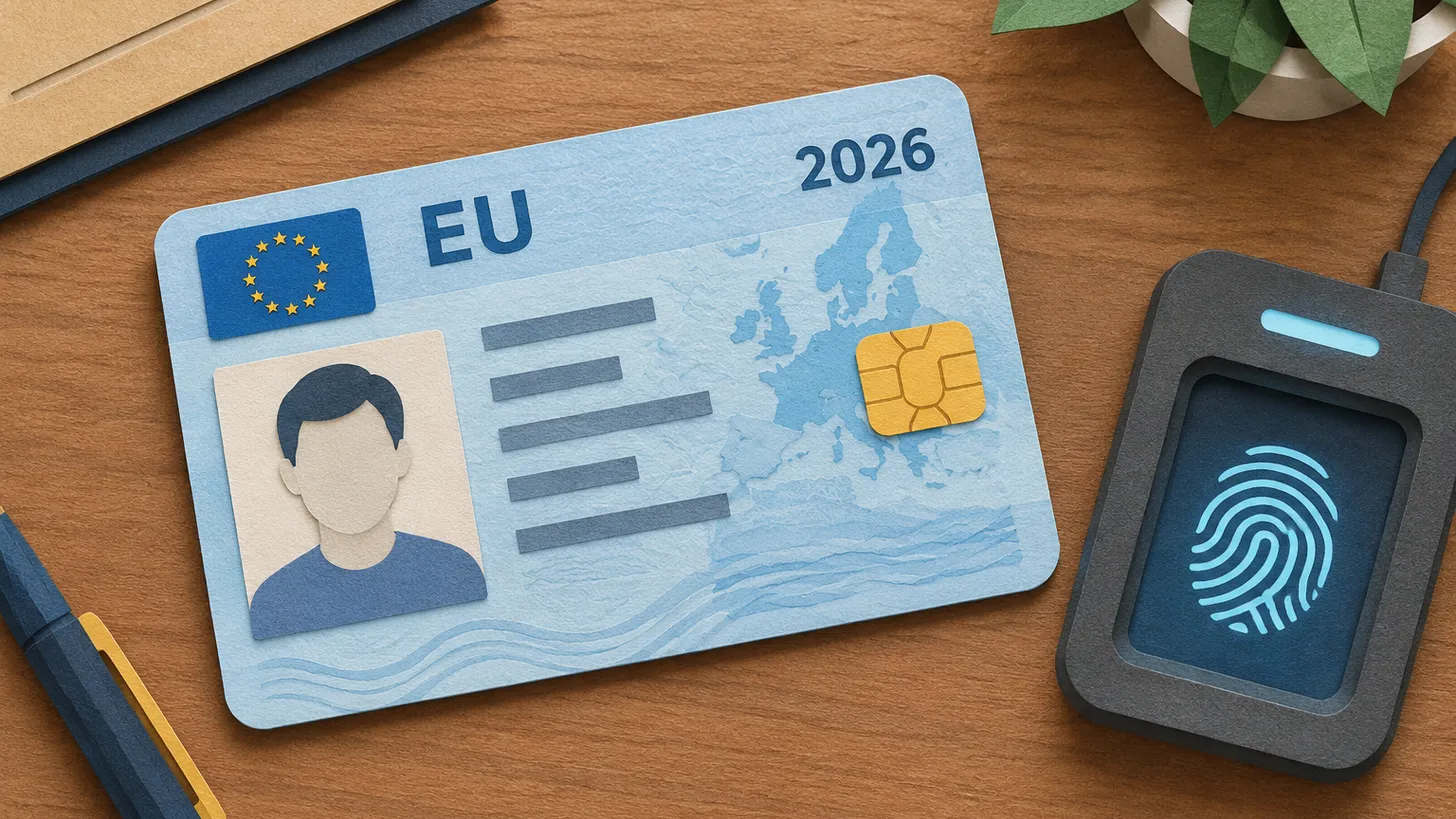
EU regulations mandate the ID-1 format and a microchip, leaving the exact photo size to individual member states, while biometric data is stored for a maximum of 90 days.
In this article · 8 sections
- 01What European law says about EU residence card photo size
- 02The end of the Regulation 2019/1157 era
- 03What national authorities check: parameters and statistics
- 04Why applications are rejected: common mistakes
- 05Submitting the photo and biometrics: step by step
- 06Card validity periods and EU family member residence card photo requirements
- 07Questions
- 08Official sources
Key points
5 points- In European law (Regulations 1030/2002 and 2025/1208), there is not a single millimeter specified for the photo size — requirements are exclusively national.
- Regulation 2019/1157 is no longer valid: it expired on July 9, 2025, and was replaced by a new act.
- Biometric data (facial image and two fingerprints) collected to personalize the card is stored for no longer than 90 days from the date of issue, after which it is destroyed.
- The applicant is required to appear in person at least once during the card issuance process for each application submitted.
- For third-country national cards, fingerprints are mandatory starting at age 6, while for EU citizen identity cards, children under 12 may be exempt.
Short answer
In European law, there is no single millimeter standard for EU residence permit photo requirements. Council Regulations (EC) 1030/2002 and the new 2025/1208 (which replaced the repealed 2019/1157) only establish the general format of the card itself (ID-1) and the mandatory presence of a chip containing a facial image and two fingerprints. The procedure for submitting a photograph by the applicant (in our database, the most common size is 35x45 mm) or taking a picture upon application is determined according to the national practice of the respective member state. Biometric data saved for document personalization is kept in the database for no longer than 90 days from the date of issue.
What European law says about EU residence card photo size
A person who already holds or is waiting for a plastic residence card in one of the EU countries often faces discrepancies in the requirements on the websites of various authorities and tries to find a single pan-European rule. However, searching for a "European standard" for the residence card photo size in the EU in millimeters within the texts of EU regulations is doomed to fail. None of the key documents — neither Regulation 1030/2002, 2017/1954, 2025/1208, nor the passport Regulation 2252/2004 — contain a size in millimeters, a background color, or a file weight.
Instead of physical parameters for the photograph, European legislation sets the format of the card itself. According to Regulation (EU) 2017/1954, a residence permit for third-country nationals is produced as a stand-alone document in ID-1 format according to ICAO Doc 9303 specifications (seventh edition, 2015). The photograph is not glued to the plastic: regulations require it to be securely integrated into the body of the card and protected by a diffractive optically variable image device (DOVID). The personalization itself is carried out using laser engraving technology or other equivalent secure technology.
So where do the requirements for facial image quality live? They are outlined in additional technical specifications adopted by the European Commission (specifically, Commission Implementing Decision C(2018) 7767 as amended by C(2021) 3726). However, Article 3 of Regulation 1030/2002 and Article 15(2) of Regulation 2025/1208 explicitly allow member states to keep these specifications secret and not publish them openly. This is exactly why specific European technical thresholds (pixels or lighting) may be classified — only printing facilities designated by the states and authorized persons have access to them.
The end of the Regulation 2019/1157 era
A significant portion of intermediary websites and old departmental instructions still cite Regulation (EU) 2019/1157 as the basis for biometric cards in Europe. This information is outdated. According to the document's official page on the EUR-Lex portal, Regulation 2019/1157 expired on July 9, 2025. It was fully replaced by the new Council Regulation (EU) 2025/1208 of June 12, 2025, on strengthening the security of identity cards of Union citizens and of residence documents, which was published in the Official Journal on 20.6.2025.
It is the new act that establishes that identity cards issued by member states must contain a machine-readable zone (MRZ) and have a minimum validity period of 5 years and a maximum of 10 years, and also defines the mandatory personal appearance. Identity cards that do not meet the minimum security standards of part 2 of ICAO Doc 9303 or do not have a functional MRZ cease to be valid at their expiration date or by August 3, 2026 — whichever comes first. Other non-compliant cards will become invalid by August 3, 2031.
What national authorities check: parameters and statistics
Since Brussels leaves the specific parameters of the picture to the discretion of the national practice of member states, requirements can vary significantly from country to country. Below is a comparison of what is strictly fixed in EU law and how it is implemented at the national level according to our database.
| Parameter | EU regulation requirement | National practice (from our database) |
|---|---|---|
| Document format | ID-1 format card (per ICAO Doc 9303) | Applied by member states |
| Physical photograph size | No number in millimeters is specified | In our database, out of 241 profiles, 229 have an exact size. The most frequent: 35x45 mm (148 profiles). Others: 51x51 mm (16), 30x40 mm (14), 40x60 mm (11). |
| Picture background | Not regulated in the texts of the regulations | 52 out of 241 profiles require a white background, 23 name a specific non-white shade (light gray or off-white), the rest allow simply a light solid color. |
| Photograph age limit | Not regulated | Only 32 out of 241 profiles fix a maximum (30 require a photo no older than 6 months, 2 — no older than 3 months). The remaining profiles simply do not fix this restriction. |
| Biometric data in the chip | Facial image and 2 fingerprints | Fingerprints are collected by authorized personnel, the photo may be provided by the applicant |
Europe SchengenResidence Card · requirements
Europe SchengenEU ID Card · requirements
Europe SchengenEU Passport · requirements
Europe SchengenNational Visa (Type D) · requirements
To prepare a digital or printed picture taking into account the national specifications of a specific member state, you can make an EU residence permit photo through our system.
Why applications are rejected: common mistakes
An analysis of rejections shows that applicants often make mistakes by misinterpreting multi-layered European legislation. Authorities in EU countries reject applications or do not accept photographs for the following reasons:
- Looking for a "European 35 × 45 mm photo standard" within EU law itself. It is not there in any of the four acts. Any number in millimeters is national, and you must ask the authority that issues the document in your country about it.
- Citing Regulation 2019/1157. Authorities reject appeals to this number because it officially expired on July 9, 2025, and was replaced by Regulation 2025/1208, as explicitly indicated by the document's page on EUR-Lex.
- Confusing two different documents. A third-country national card (issued under Regulation 1030/2002) and an EU family member residence card (under Regulation 2025/1208, Article 7) look the same and share the ID-1 format. But the title ("Residence card" or "Permanent residence card") and the standardized code in field [10] ("Family Member EU Art 10 DIR 2004/38/EC" or "Art 20") are different, and the procedures for obtaining them differ.
- Expecting the "bring your own photo" rule to be the same everywhere. European law (Regulation 1030/2002) explicitly names a biometric identifier as "a photograph provided by the applicant or taken at the time of application" and leaves the choice to national practice. This is exactly why the Netherlands might take your picture themselves, while Croatia will require a print from a photographer, and yet both countries are faithfully complying with the exact same regulation.
- Thinking the taken photo will wait for you for years. According to the rules, biometrics for card personalization are stored in a highly secure manner for no longer than 90 days from the date of the document's issuance. After this period, they are immediately erased or destroyed, so old data is not automatically reused for new applications.
- Planning to apply without a personal appearance. Even if all other documents are uploaded online, Regulation 2025/1208 strictly requires the applicant to appear in person at least once during the issuance process for each application.
- Bringing a child under 6 years old for fingerprinting. For residence permits of third-country nationals, capturing fingerprints is mandatory from the age of six. For identity cards of EU citizens, the situation is slightly different: children under 12 may be exempt from fingerprinting.
- Missing the two "expiration" dates for old cards. August 3, 2026, and August 3, 2031, are the two critical dates when old identity cards without a machine-readable zone or without minimum ICAO security standards cease to be valid.
- Searching for a published "EU photo requirements table." It does not exist publicly. Additional technical specifications (for example, C(2018) 7767) may be classified by a decision in the committee procedure.
Submitting the photo and biometrics: step by step
The process of obtaining a residence card and capturing biometric identifiers is governed by strict European regulations. The sequence of actions looks like this:
- Personal appearance of the applicant. In accordance with Regulation 2025/1208, to guarantee that the biometric identifiers actually belong to the applicant, the person must appear at the authority at least once for each application.
- Providing or capturing the facial image. Depending on the national practice of the respective member state (Regulation 1030/2002), the photograph is provided by the applicant or taken upon application. The preamble to Regulation 2025/1208 advises member states to consider collecting biometrics (especially the facial image) by capturing them on-site by national authorities.
- Taking fingerprints. Qualified and duly authorized personnel of the issuing authority take two fingerprints flat and capture them digitally. Fingerprints are taken exclusively by the staff of these authorities (or diplomatic missions).
- Recording on a highly secure medium. The facial image and fingerprints in interoperable formats are recorded on an RF chip (storage medium), which is a mandatory component of the ID-1 format card, both for third-country nationals and for family members of EU citizens.
- Deleting temporary data. All biometric identifiers stored by the authority for the purpose of personalizing the residence permit are destroyed no later than 90 days from the date of the card's issuance.
It is important to understand why the state needs this data at all. According to European law, biometric features in residence permits are allowed to be used exclusively to verify the authenticity of the document itself and to verify the identity of the holder via directly available comparable features when national law requires the residence permit to be presented.
Card validity periods and EU family member residence card photo requirements
According to the current Regulation 2025/1208, the standard minimum validity period of an identity card is 5 years, and the maximum is 10 years. However, if it is temporarily physically impossible to take the applicant's fingerprints, the member state is obliged to issue a document with a validity period of only 12 months or less.
Cards for family members of EU citizens who are not themselves citizens of any member state deserve special attention. For these cards, Article 7 explicitly requires the use of the same card format (ID-1), but with the application of the heading "Residence card" or "Permanent residence card" and the inclusion of a special code in data field [10]. It is worth remembering that cards for family members of EU citizens (who are not citizens of a member state) that do not meet the requirements of Article 7 will cease to be valid at their expiration date or by August 3, 2026 — whichever comes first.
As for the cost of producing the card and the speed of its printing, European regulations do not regulate this at all — this is a matter exclusively for the national law of each member state.
07Questions
6 answers01What is the exact photo size for an EU residence card?
European legislation does not fix a single millimeter. Regulation 1030/2002 only sets the format of the card itself (ID-1), and the physical size of the picture is determined by national practice (in our database of 241 profiles, the most frequently found size is 35x45 mm).
02Is Regulation 2019/1157 still valid?
No, it is no longer valid. According to EUR-Lex, this act expired on July 9, 2025, and was completely replaced by Council Regulation (EU) 2025/1208.
03Does a young child need to be present to submit fingerprints?
For residence permits of third-country nationals, taking fingerprints is mandatory starting at six years old. For EU citizen identity cards, children under 12 years of age may be exempt from this requirement.
04How long are the photo and fingerprints kept after the card is issued?
According to Regulation 2025/1208, biometric identifiers stored for personalization are kept for no longer than 90 days from the date the document is issued, after which they are immediately erased or destroyed.
05Can I apply entirely online without appearing in person?
No. Regulation 2025/1208 requires the applicant to appear in person at least once during the issuance process for each application submitted.
06Is there a public EU table of photo specifications, such as pixel sizes?
A comprehensive public table does not exist. Article 3 of Regulation 1030/2002 allows member states to make additional technical specifications secret and not publish them openly.
08Official sources
- Consolidated text of Council Regulation (EC) No 1030/2002 on a uniform format for residence permits (version of 21.11.2017)
eur-lex.europa.euopened - Council Regulation (EU) 2025/1208 of June 12, 2025, on strengthening the security of identity cards and residence documents
eur-lex.europa.euopened - Document information: Regulation (EU) 2019/1157 — status of the act
eur-lex.europa.euopened - Aufenthaltsverordnung (AufenthV) — Germany, § 60 "Lichtbild" and schedule of fees
gesetze-im-internet.de - European Parliament and Council of the EU, Official Journal: Regulation (EU) 2017/1954 of October 25, 2017, amending Regulation 1030/2002 (retrieved 2026-09-22)
eur-lex.europa.euopened - Council of the European Union, Official Journal: Council Regulation (EC) No 2252/2004 on standards for security features and biometrics in passports and travel documents (retrieved 2026-09-22)
eur-lex.europa.euopened
Yevhen Kravchenko, founder of Anfas.Pro, runs this article. Published . Checked against official sources on .
Schengen Area Germany
 Spain+6
EU ID card photo requirements: sizes and rules by country
The size for an ID card photo in EU countries is not uniform: Spain requires 32 × 26 mm, France needs 35 × 45 mm, and in Lithuania, the initial print must be 40 × 60 mm.
 Schengen AreaSpain
 Finland+3
EU passport photo size: why there is no single EU standard
Council Regulation (EC) No 2252/2004 requires a highly secure storage medium containing a facial image, but pan-European rules regarding the exact dimensions of the printed photo are not published in accessible sources.
 Schengen AreaGermany
 Austria+5
National D visa photo requirements: set by each country, not the EU
A type D visa photo is governed by the national laws of the specific country, not the EU Visa Code: the Czech Ministry of Foreign Affairs, for example, requires a 35x45 mm size with a 32–36 mm face height.

Make the photo for this document
Upload a selfie — we crop it to 35 × 45 mm, replace the background and check it against the document rules. Free.
Residence Card · Europe SchengenUpload