 Luxembourg
 Switzerland
Bringing Your Own Photo in Luxembourg and Switzerland: Rules for ID Cards, Passports and Residence Permits
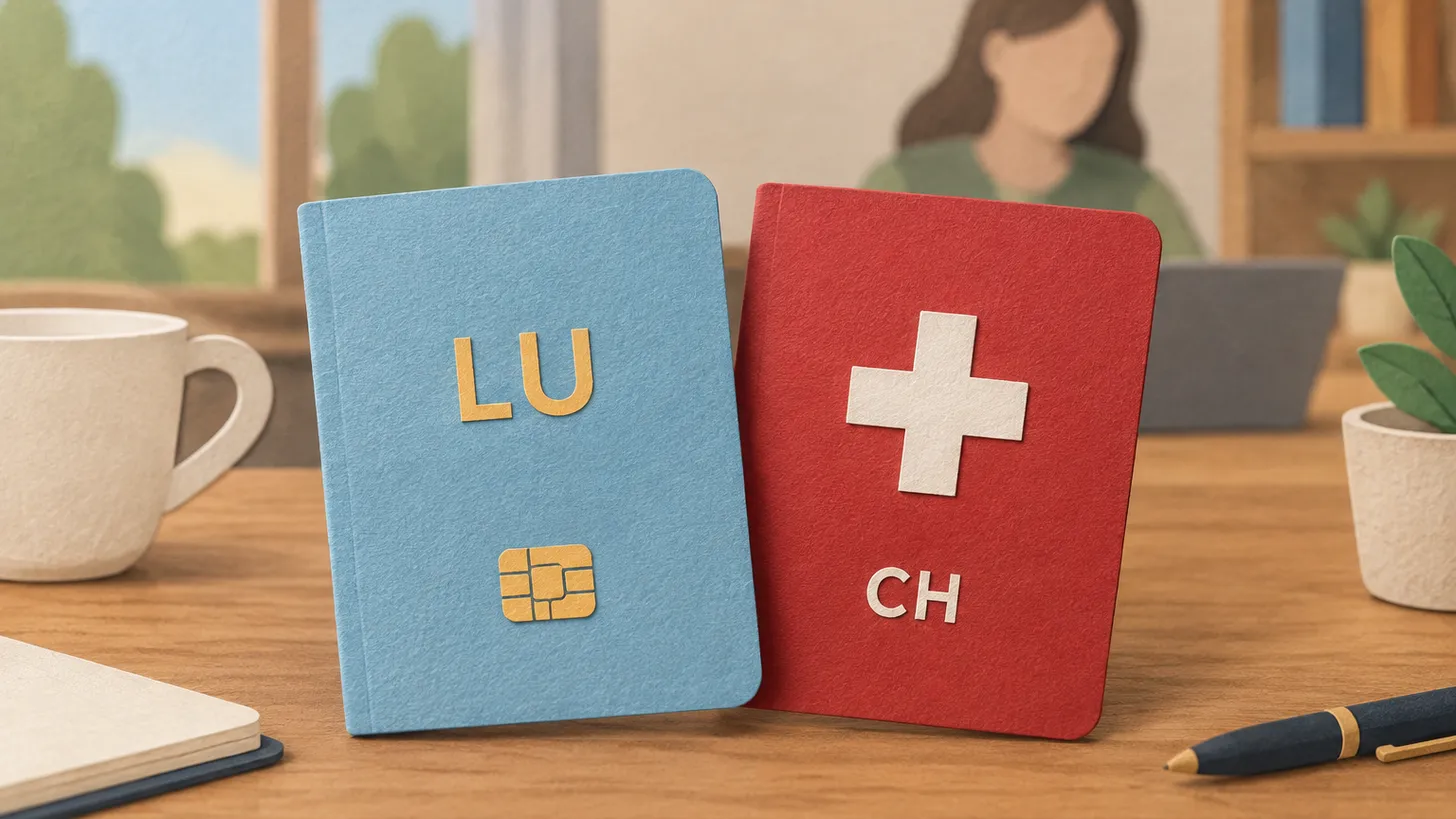
For a Luxembourg ID card, your own photo can be scanned only at the Guichet.lu reception desk. fedpol's requirements for paper photos apply to Swiss passports and to ID cards for Swiss citizens; whether they apply to B/C residence permits has not been confirmed.
Key points
5 points- Photos for a Luxembourg ID card are usually taken on the spot at Guichet.lu or at the commune, and your own photo can be scanned only at Guichet.lu.
- For Swiss passports and ID cards for Swiss citizens, the face height in the photo is 29 to 34 mm; for children under 11, the minimum is 23 mm.
- From 2 November 2026, applications can be made for the new Swiss biometric ID card with a chip containing a facial image and two fingerprints.
- The fedpol table for Swiss passports and citizen ID cards sets requirements for smooth photo paper with no perceptible texture, no rounded corners and no visible pixel structure; photos of people in uniform are not accepted.
- A Luxembourg ID card must be collected no later than 6 months after the application, otherwise the authorities may destroy it; the same deadline and the same risk apply to passports.
Short answer
In Luxembourg, ID card photos are most often taken on the spot at the Guichet.lu reception desk or at the commune where you live. If an applicant wants to bring their own photo, it can be scanned only at the Guichet.lu reception desk: the communal administration does not do this. For a Luxembourg residence permit, once the application is approved, the applicant is invited to an appointment to have their photo and fingerprints taken; the applicant may also bring a recent photo that meets OACI/ICAO standards. For Swiss passports and ID cards for Swiss citizens, fedpol publishes requirements for paper photos. Whether these requirements apply to Swiss B/C residence permits has not been confirmed in the sources checked. From 2 November 2026, applications can be made for the new Swiss biometric ID card with a chip containing a facial image and two fingerprints.
Comparison of paper photo requirements
Of the 241 document profiles in our database, 229 have a recorded print size; together they use 17 sizes. The most common format is 35x45 mm, listed in 148 profiles. Next come 51x51 mm (16 profiles), 30x40 mm (14 profiles) and 40x60 mm (11 profiles). These database figures do not establish a national requirement for Luxembourg: the Luxembourg pages checked do not publish a photo size in millimetres and instead refer to ICAO standards. For Swiss passports and citizen ID cards, fedpol specifies a size of 35 × 45 mm without borders. In the database, 53 of the 241 profiles require a white background, 23 name a specific non-white shade, and the rest specify a plain light background without fixing an exact colour. Only 32 of the 241 profiles set a maximum photo age: 3 months in 2 profiles and 6 months in 30. The absence of a time limit in the other profiles is a data gap, not evidence that no limit exists. Database figures as of 22 Sep 2026, the date of this article.
| Parameter | Luxembourg (residence permit, passport, ID card) | Switzerland (passport, citizen ID card) |
|---|---|---|
| Photo size | No national size in millimetres is published on the pages checked; the authorities refer to ICAO standards | 35 × 45 mm without borders |
| Face height | No national parameter is published on the pages checked | From chin to crown: minimum 29 mm, maximum 34 mm; for children under 11, minimum 23 mm |
| Maximum photo age | For the residence permit and ID card, no older than 6 months; no limit is given in the profile for the passport | No older than 1 year |
| Background requirements | No separate background rule is published on the pages checked | Uniform, single-coloured and neutral background without shadows |
| Where your own photo is scanned | For the ID card, only at the Guichet.lu reception desk | The source checked on paper photos for passports and ID cards does not specify the submission procedure |
LuxembourgResidence Permit · requirements · check a photo
LuxembourgPassport · requirements · check a photo
LuxembourgID Card · requirements · check a photo
SwitzerlandPassport · requirements · check a photo
What restrictions the sources checked set out
The sources checked contain specific photo requirements and particular consequences for certain situations. They do not establish a general rule on the consequences of any errors in documents.
Scanning limitations in Luxembourg
For a Luxembourg ID card, your own photo can be scanned only at the Guichet.lu reception desk; the communal administration does not scan photos. ID card photos are usually taken on the spot at the Guichet.lu reception desk or at the commune of residence.
A fee of 80 euros applies to the residence permit in Luxembourg. When the application is approved, the applicant receives a letter inviting them to book an appointment to have their photo and fingerprints taken; they may also bring a recent photo that meets OACI/ICAO standards.
The finished ID card must be collected within 6 months of the application date; after that, the competent authorities are entitled to destroy it. The finished passport must also be collected within 6 months of the application date; after that, it may be destroyed.
Physical paper defects and uniforms in Switzerland
The requirements in the fedpol table apply to photos for Swiss passports and ID cards for Swiss citizens; whether they apply to B/C residence permits has not been confirmed. The table sets requirements for the paper itself: the surface must be smooth and untextured, glossy or semi-matte. Texture that can be felt with a finger, including a “pearl” or “silk screen” effect, is not allowed; the corners must not be rounded, and no pixel structure may be visible.
For Swiss passports and ID cards, the photo must not be older than 1 year.
The fedpol table states that photos of people in uniform are not accepted.
Procedure for biometrics and document issuance
Steps for Luxembourg: residence permit, passport and ID card
If you are preparing your documents in advance, you can take a photo for a Luxembourg residence permit online, so that you bring a ready photo checked against the ICAO standard to your appointment at the immigration directorate.
- Paying the residence permit fee. The fee is 80 euros; it is transferred to the account IBAN LU46 1111 2582 2814 0000 (BIC: CCPLLULL). The beneficiary is the Ministry of Home Affairs, General Department of immigration.
- Waiting for the letter. Once the residence permit application is approved, the applicant receives a letter inviting them to book an appointment at the General Department of immigration.
- Biometrics. At the appointment, a photo and fingerprints are taken for inclusion in the residence permit. The applicant may also bring a recent photo that meets OACI/ICAO standards.
- Collecting the chip card. A few days after the biometric data are collected, the residence permit can be picked up in person at the General Department of immigration by appointment. The card contains biometric data and is valid from the date of the declaration of arrival at the commune.
Different rules apply to the Luxembourg passport. A new passport is being introduced from 11 May 2026; applications for a passport with the new period of validity can be made from that date. The standard procedure costs 50 euros and takes 7 working days; the express procedure costs 150 euros and takes 3 working days. The photo can be taken at the offices of the communal administration or at the Passport, Visa and Legalisation Office (BPVL); a photo by a professional photographer that meets ICAO standards is also accepted.
The express procedure for an ID card carries a fixed fee of 45 euros, regardless of where the application is made and the card's period of validity. If at the time of application it is temporarily impossible to take a fingerprint from any of the holder's fingers, the ID card is valid for 12 months. A photo that no longer matches the holder's current appearance is listed among the grounds for replacing the card.
Steps for Switzerland: new biometric ID cards and paper photos
On 26 August 2026, the Federal Council adopted an amendment to the identity documents ordinance (Ausweisverordnung, VAwG) creating the legal basis for a biometric ID card. The amendment enters into force on 1 November 2026; applications for the new ID card can be made from 2 November 2026.
- Submitting the application. The new biometric ID card with a chip containing a facial image and two fingerprints will be available from the cantonal authorities responsible for issuing identity cards and passports, as well as from Swiss representations abroad. In cantons where communes are authorised to issue non-biometric ID cards, such a card can still be requested. Non-biometric cards already issued will remain valid for travel to the EU until they expire; for adults, the validity period is a maximum of 10 years.
- Preparing the photo to the fedpol standard. For Swiss passports and citizen ID cards, the photo must measure 35 × 45 mm without borders. The face height from chin to crown is 29 to 34 mm. For children under 11, the minimum face height is 23 mm.
- Checking the hairstyle. For a person with voluminous hair, the face height must not be less than 29 mm. The guidance states that what matters is reproducing the size of the face correctly; in exceptional cases the hair may extend beyond the edges of the frame.
- Facial expression and glasses. For Swiss passports and citizen ID cards, a neutral facial expression with the mouth closed is specified; a friendly facial expression is expressly allowed (“freundlicher Gesichtsausdruck ist erlaubt!”). Tinted glasses or sunglasses are not allowed, except darkened lenses for people with visual impairments. Glasses pushed up onto the forehead and conspicuous headbands are not allowed.
The fedpol table states that young children and people with disabilities do not necessarily have to meet all the requirements. Deviations are acceptable in particular regarding looking into the camera, a neutral facial expression and head size. Both colour and black-and-white photos are accepted, but the photo in the document will be black and white.
From 2 November 2026, the term “provisorischer Pass” is replaced by “Notpass”; the Notpass is also introduced on that date. The press release states that fees will remain the same as for the current ID card without a chip and the current provisional passport; no specific amounts are given there.
What the authorities do not publish
Separate photo requirements specifically for the Swiss residence permit (B and C permits for foreign nationals) could not be confirmed in this review. The fedpol numerical parameters in this article apply to the passport and identity card for Swiss citizens; their applicability to residence permits has not been confirmed. On the pages checked, Luxembourg does not publish a photo size in millimetres for the ID card, passport or residence permit, and refers instead to ICAO standards. The fedpol announcement on the biometric ID card says fees will remain unchanged but does not give specific amounts. The Luxembourg passport page checked does not disclose the specific new period of validity from 11 May 2026.
05Questions
5 answers01Can I bring my own ID card photo to my local commune in Luxembourg?
No, the commune does not scan photos that applicants bring: this is done only at the Guichet.lu reception desk. As a rule, the ID card photo is taken when you apply, at Guichet.lu or at your commune.
02Is a black-and-white photo required for a Swiss passport?
The fedpol rules for Swiss passports and citizen ID cards accept both colour and black-and-white photos. The photo in the document will be black and white.
03Is smiling allowed in Swiss document photos?
fedpol expressly allows a friendly expression; the face must still remain neutral, with the mouth closed.
04What happens if I do not collect my finished document in Luxembourg in time?
Once 6 months have passed since the application, an uncollected ID card may be destroyed. A passport not collected within the same 6 months may also be destroyed.
05What requirements apply to children's photos in Switzerland?
For children under 11, the fedpol table specifies a minimum face height of 23 mm. For young children, deviations are allowed in particular regarding looking into the camera, a neutral facial expression and head size.
06Official sources
- Guichet.lu: conditions of stay in Luxembourg for private reasons for third-country nationals
guichet.public.lu - Guichet.lu: applying for a Luxembourg ID card as a resident
guichet.public.lu - Guichet.lu: applying for a Luxembourg passport as a resident
guichet.public.lu - fedpol: “Kriterien für die Annahme von Fotos für Pässe und Identitätskarten” — photo sample table (PDF)
fedpol.admin.ch - fedpol, press release of 26 August 2026: “Revision der Ausweisverordnung: Verabschiedung durch den Bundesrat”
fedpol.admin.ch
Author: Yevhen Kravchenko. Published . Checked against official sources on .
LuxembourgLuxembourg EU Blue Card photo: taken at the Immigration Directorate or bring an ICAO photo; card fee €80
The Luxembourg EU Blue Card photo is taken at the Immigration Directorate after approval; you may bring a recent ICAO photo instead.
 Luxembourg
 long-term resident permit photo: taken on site or bring an ICAO photo; card valid 5 years
After 5 years of legal stay in Luxembourg, the long-term resident card photo is taken at the Immigration Directorate, or you bring a recent ICAO photo.
 Luxembourg
 Schengen Visa Photo: White Background, and Your Paper Photo Is Scanned into the VIS
Luxembourg Schengen visa: bring a recent colour ID photo on white.
Make the photo for this document
Upload a selfie — we crop it to 35 × 45 mm, replace the background and check it against the document rules. Free preview.
Residence Permit · LuxembourgUpload