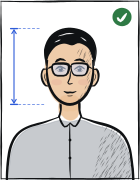
SourceFederal Office of Police fedpol (Swiss Confederation) and ch.ch
Verified
Quick answer: A Switzerland passport photo must be 35 × 45 mm. Uniform neutral background without shadows or foreign objects. Head occupies 64–76% of photo height (29–34 mm chin to crown). Neutral expression, glasses only if no glare. Last verified .
Switzerland passport photo: size in mm, cm, inches and pixels
Millimetres
35 × 45 mm
Centimetres
3.5 × 4.5 cm
Inches
1.38 × 1.77″
Pixels at 300 dpi
413 × 531 px
Pixels at 600 dpi
827 × 1063 px
Switzerland-specific things to know
The face-size rule is a band measured in millimetres, 29–34 mm from chin to crown on a 45 mm-high image — roughly 64–76 % of the height — and for voluminous hair the 29 mm floor wins over the full hairstyle: the hair may leave the frame.
A friendly expression is expressly allowed, as long as the mouth is closed — unusual among passport photo rules. The background need only be single-colour, uniform and neutral: the sheet does not name white.
The photograph is usually taken by the passport office together with the biometric data, so many applicants bring none; a few cantons accept your own photo or a USB stick under their own conditions, and for an identity card ordered at the home municipality a brought photo must match the sheet exactly.
How passport photos are verified
The Swiss passport photograph is set out on a sample sheet from fedpol, the Federal Office of Police: an image of 35 × 45 mm without a border, with the face measuring 29–34 mm from chin to crown (at least 23 mm for children under 11), not older than one year, on a single-colour, uniform, neutral background without shadows and with a clear separation between background and head. The expression is neutral with the mouth closed — a friendly expression is expressly allowed — both eyes open at the same height and clearly visible, the head straight with the nose on the vertical centre line, shoulders straight.
Read more
Glasses are allowed only if the frames do not cover the eyes and the lenses do not reflect; tinted lenses and sunglasses are not. Head coverings are not allowed except for proven medical or religious reasons, with the face visible from the lower edge of the chin to the hairline.
The photo must be on smooth, unstructured photo paper with no creases, no rounded corners and no visible pixel structure. In practice ch.ch says the picture is usually taken at the passport office together with the other biometric data, while some cantons let you bring your own photo.
Examples and mistakes
What makes Switzerland passport photos accepted
A photo that will be accepted, next to the six most common reasons Switzerland passport photos get rejected.
Accepted
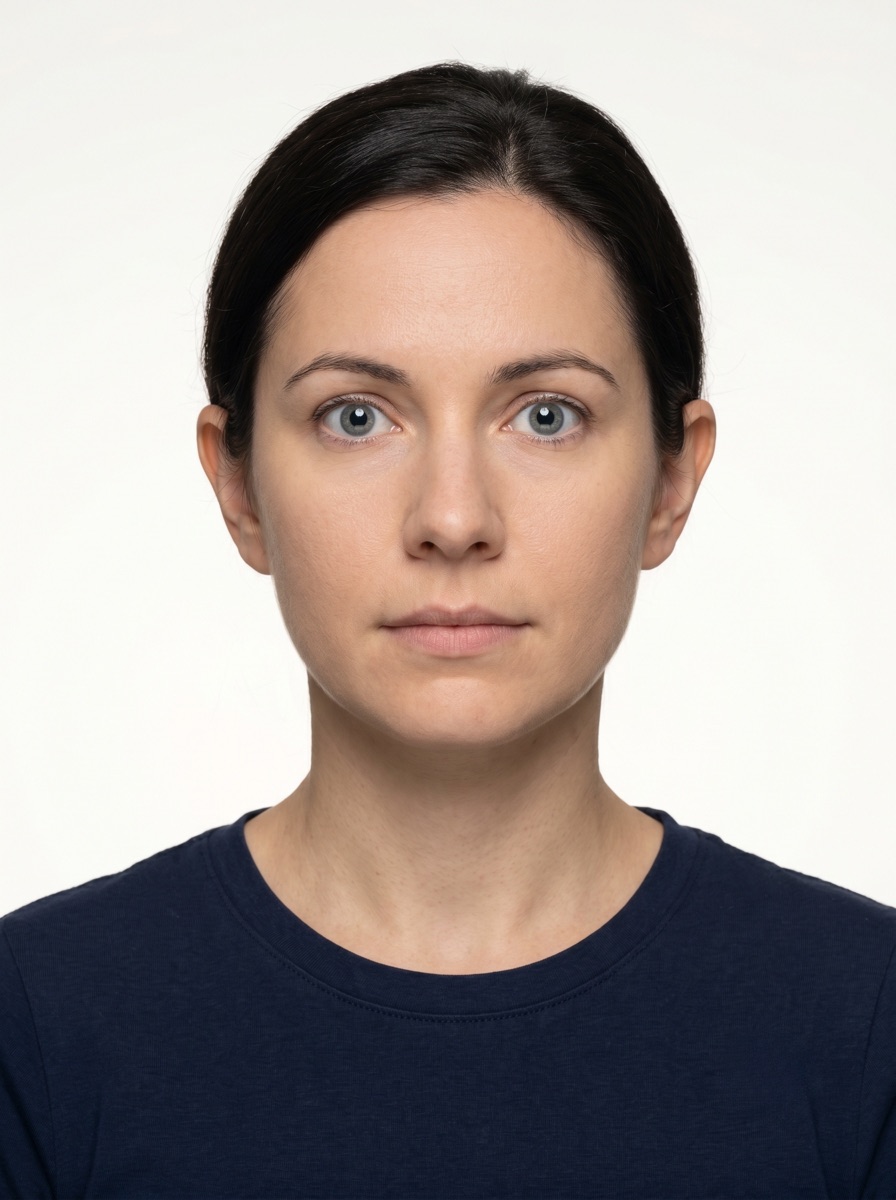
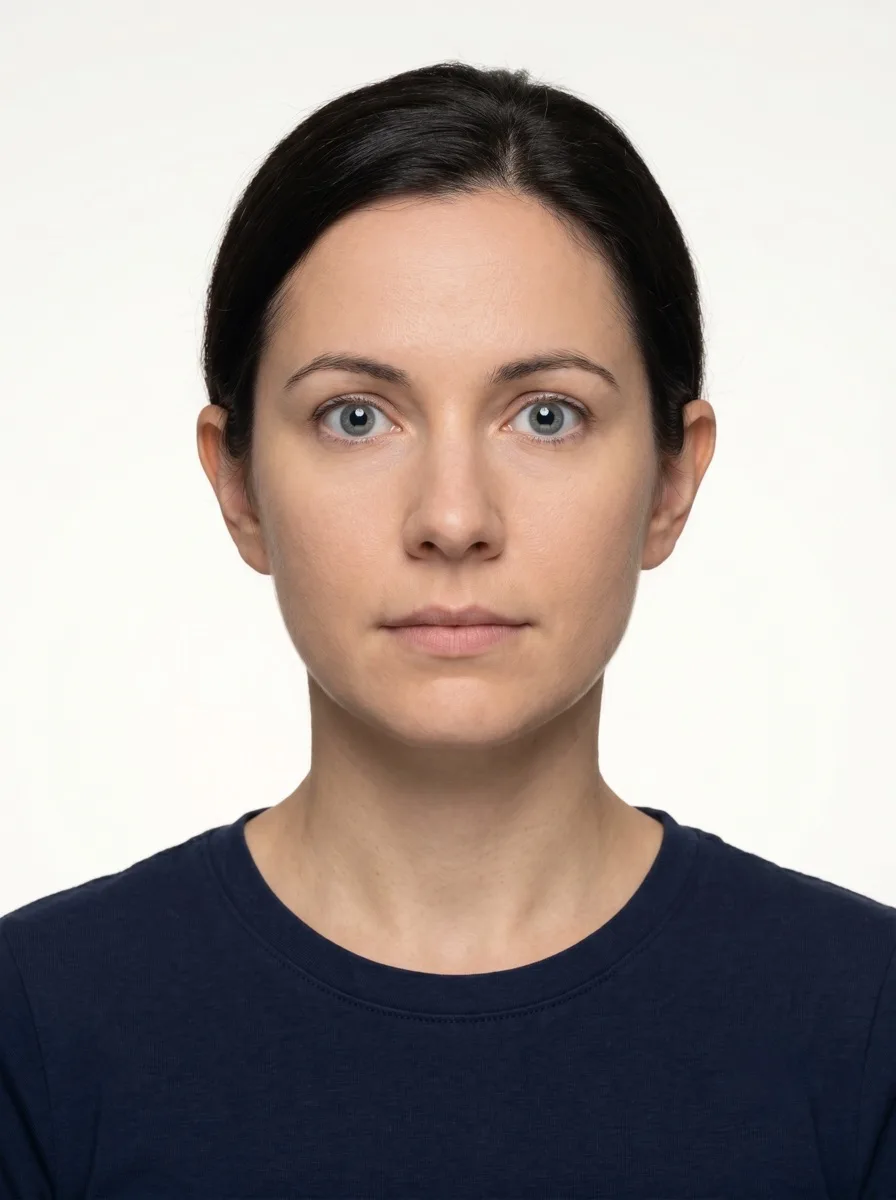
Compliant Switzerland passport example (35 × 45 mm)
Face centred, looking directly into the lens
Plain background — no shadow, pattern or texture
Neutral expression, eyes open, mouth closed
No glasses, no hair across the face
Top 6 Switzerland passport rejection causes
Background shadowShadow on the wall behind the head, or background with a visible pattern or gradient
Smile / open mouthVisible smile with teeth or open mouth instead of a neutral expression
Glasses with glareGlasses with a clearly visible light reflection covering part of the eye
Hair across the faceLoose hair strands covering the eyes, eyebrows or part of the face
Eyes off-cameraEyes looking to the side instead of directly into the camera lens
Head tiltedHead tilted so the eye line is no longer horizontal
Typical rejection reasons and how to fix them
Typical reasons a photo is rejected under the rules Federal Office of Police fedpol (Swiss Confederation) and ch.ch publishes: what is wrong and what to change.
Reason
Fix
Overexposure, lack of contrast, face too small
Use even, contrasty light and keep the face 29–34 mm high from chin to crown.
Open mouth or a non-neutral expression; hand in the face; eyes closed; gaze to the side; not frontal
Face the camera squarely, eyes open, mouth closed, nothing in front of the face.
Frames covering the eyes, reflections on the lenses, hair over the face
Keep the eyes clear of frames and reflections, or take the glasses off; tie the hair back.
Non-neutral background, shadows on the face or behind the head, a background too light
Stand in front of a single-colour neutral background with a clear contrast to the head and no shadows.
Head covering, headband or hair band; another person or an object in the picture
Remove head coverings (exceptions only for medical or religious reasons) and keep the picture to one person.
Rounded corners, creases or dirt, visible pixel structure, a textured paper surface
Print on smooth photo paper (glossy or semi-matt), cut square and keep it clean.
How to take your Switzerland passport photo correctly
Background and light
Background: plain neutral
The tool puts in the required background. Stand half a metre from a plain light wall, face a window and shoot without flash — then there are no shadows on your face or on the wall.
Framing
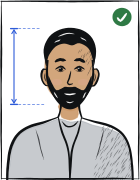
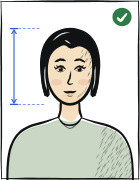
Head: 64–76 % of the photo height (29–34 mm)
Camera at eye level, about a metre away; head and shoulders in the shot. The tool crops it to 35 × 45 mm.
Glasses
Glasses only if no glare
If you wear glasses, check the shot: no glare on the lenses, eyes clearly visible.
Expression and gaze
Neutral expression, mouth closed, eyes open
Look straight into the lens with your head level; keep hair away from your eyes and eyebrows.
Print at 100% scale, borderless, and turn off fit-to-page so each photo keeps its exact size.
Where to submit your passport application
A Swiss passport is applied for at the cantonal passport office (or the Swiss representation abroad), where the biometric data and usually the photograph are taken; your own photograph is accepted only in some cantons, under their conditions.
Cantonal passport office / Swiss representation abroadappointment, in person
Book through your canton, listed on schweizerpass.admin.ch and ch.ch
Processing
See the validity and delivery page of schweizerpass.admin.ch
Cost
See the prices page of schweizerpass.admin.ch
Photo usually taken at the office; some cantons accept your own photo or a USB stick.
fedpol sample sheet — format: «Bildgrösse 35 x 45 mm (ohne Rand)» (image size 35 × 45 mm, without a border); the face height from chin to crown at least 29 mm and at most 34 mm; for a person with voluminous hair the face height must not fall below 29 mm — showing the face at the right size matters more than the full hairstyle (the hair may exceptionally exceed the edge); for children under 11 the face height is at least 23 mm.
Same sheet — age and print: the photo must not be older than 1 year; no creases, unevenness or impurities; no rounded corners; no visible pixel structure; the photo paper must have a smooth, unstructured surface (glossy or semi-matt) with no «pearl» or «silk raster» effect and only paper made for photographic images may be used; photographs of persons in uniform are not permitted.
Same sheet — pose and expression: the person sits straight in front of the camera (shoulders straight) and looks directly into it; the head is straight (not tilted, turned or leaning); the nose on the marked vertical centre line of the template; both eyes open, at the same height and clearly visible, also for glasses wearers; neutral expression, mouth closed («freundlicher Gesichtsausdruck ist erlaubt!» — a friendly expression is allowed); no hand or object (for example a pipe) in the face; no other person or object in the picture, also for children.
Same sheet — glasses: the eyes must not be covered by the frames; no reflections on the lenses; no tinted lenses or sunglasses; darkened lenses are permitted for the visually impaired. Lighting: sharp and contrasty, even lighting without shadows on the face, natural skin tones, no hot spots on the skin and no red eyes.
Same sheet — background and head covering: the background single-colour, uniform and neutral, no shadows, a clear separation between background and head. Head coverings are in principle not allowed (no headband on the forehead, no conspicuous hair band, no glasses pushed up on the head); exceptions only for proven medical or religious reasons, and then the face must be recognisable at least from the lower edge of the chin to the hairline with no shadows on the face. Black-and-white and colour photographs are accepted; the photo in the document will be black-and-white.
ch.ch: the biometric data (face image, signature and, for the passport, fingerprints) are recorded by the cantonal authorities or the Swiss representation abroad, and the picture is usually taken at the same time. In some cantons you may use your own photo under exact conditions; some cantons also allow a photo on a USB stick. If you order an identity card at your home municipality, the photo you bring must match the specification exactly. Passports of adults are valid 10 years, those of children and teenagers up to the 18th birthday 5 years.
Questions
Frequently asked questions
35 × 45 mm without a border, face 29–34 mm from chin to crown, not older than 1 year, a single-colour uniform neutral background without shadows, neutral expression with the mouth closed (a friendly expression is allowed), both eyes open and visible, no head covering except for proven medical or religious reasons, no uniform, on smooth photo paper.
35 × 45 mm without a border, according to the fedpol sample sheet; the face must measure at least 29 mm and at most 34 mm from chin to crown, and at least 23 mm for children under 11.
Yes, slightly: the fedpol sheet says the expression must be neutral with the mouth closed, but adds that a friendly expression is allowed. An open mouth is a reason to refuse the photo.
Yes, if the frames do not cover the eyes and the lenses do not reflect. Tinted lenses and sunglasses are not allowed, except darkened lenses for the visually impaired.
Usually not: according to ch.ch the picture is normally taken at the same time as the other biometric data at the cantonal office or the Swiss representation abroad. Some cantons let you use your own photo or one on a USB stick under their own conditions.
The Switzerland passport photo must be 35 × 45 mm. The head must occupy 64–76% of the photo height.
Uniform neutral background without shadows or foreign objects. Behind you there should be only a plain wall: no pattern, shadows or objects. Any light wall at home will do — the tool sets the exact background colour.
Yes. A phone and a light wall near a window are enough. The rear camera is sharper than the front one, so ask someone to take the photo or use a 3-second timer. The tool crops it to size, fixes the background and checks it against the Switzerland passport photo rules.
Most passport offices ask for a photo taken within the last six months. It should look like you today: after a new haircut or beard, take a new one.
We refund the payment in full. Email us within 14 days of purchase with your order number and the rejection notice from the Switzerland authority — the refund policy page has the details.
35 × 45 mm = 3.5 × 4.5 cm = 1.38 × 1.77 inches. At 300 dpi that is 413 × 531 pixels; at 600 dpi, 827 × 1063 pixels.
Religious reasons only; must not cover the facial oval. The face must stay fully visible from chin to forehead and on both sides, with no shadow across it.
Yes. The same 35 × 45 mm format and head size apply to: driver's license, national visa (Type D), Schengen visa, visa.