SourceImmigration Services Agency of Japan (ISA), Ministry of Justice
Verified
Quick answer: A Japan residence permit photo must be 30 × 40 mm. Even plain background without shadows. Head occupies 55–70% of photo height. Neutral expression, glasses only if no glare. Last verified .
Japan residence permit photo: size in mm, cm, inches and pixels
Millimetres
30 × 40 mm
Centimetres
3 × 4 cm
Inches
1.18 × 1.57″
Pixels at 300 dpi
354 × 472 px
Pixels at 600 dpi
709 × 945 px
Japan-specific things to know
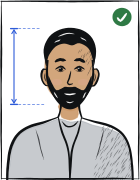
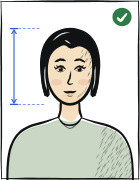
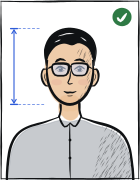
Japan measures the face from the crown including the hair to the chin on a 4 × 3 cm photo and publishes the figures in a drawing (25 ± 3 mm), and it measures the part without the border.
The ISA says «no background, including shadows» rather than naming a colour, and rejects a very dark background that hides the outline of the face.
Editing is rejected in every case — larger eyes, whitened skin, removed moles or wrinkles — and so is a mirror-reversed photo.
The standard page says six months before submission while an English procedure page says three months, and the name is written on the back unless the photo is printed into the form.
How residence permit photos are verified
The Immigration Services Agency of Japan (ISA) sets one standard for the photographs submitted with residence applications — status of residence, extension, change, residence card: 4 cm high × 3 cm wide (30 × 40 mm), «the applicant alone», bareheaded and facing forward, «no background (shadows included)», sharp, «taken within six months before the day of submission», with the name written on the back (unless the photo is printed straight into the photo field of the form). The dimensions must match the ISA drawing, measured without the border, the face from the crown including the hair to the chin — the drawing gives a face of 25 ± 3 mm, a top margin of 5 ± 3 mm and the face 15 ± 2 mm from the edge.
Read more
The ISA lists what it rejects: a face off-centre or turned, a tilted body, a shadow on the background, glasses frames over the eyes or very thick, light reflected in the glasses, a mask, a fringe over the eyes, a face covered with cloth that leaves a shadow, a very dark background, a blurred picture — and «image processing that makes the eyes look bigger, whitens the skin or corrects face parts, moles or wrinkles is unsuitable in any case»; a mirror-reversed photo is unsuitable too. If the face is covered with cloth for a religious or medical reason, you give a statement (free form); cloth that leaves the face sharp is no problem.
One English procedure page (Business Manager) says the photo must be taken within three months — check the page of your own application.
Examples and mistakes
What makes Japan residence permit photos accepted
One compliant example next to the six most common rejection causes for Japan residence permit applications. These are the differences that most often determine whether a document photo is accepted.
Accepted
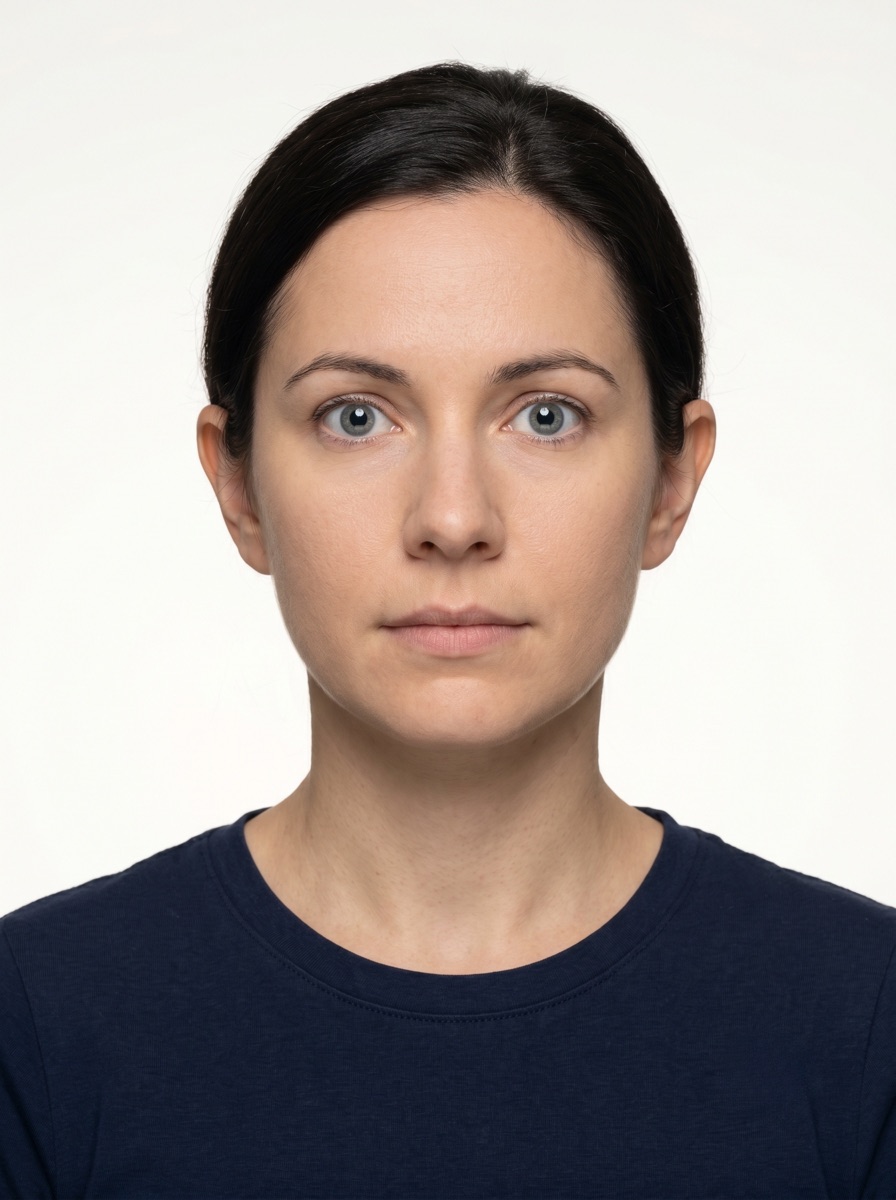
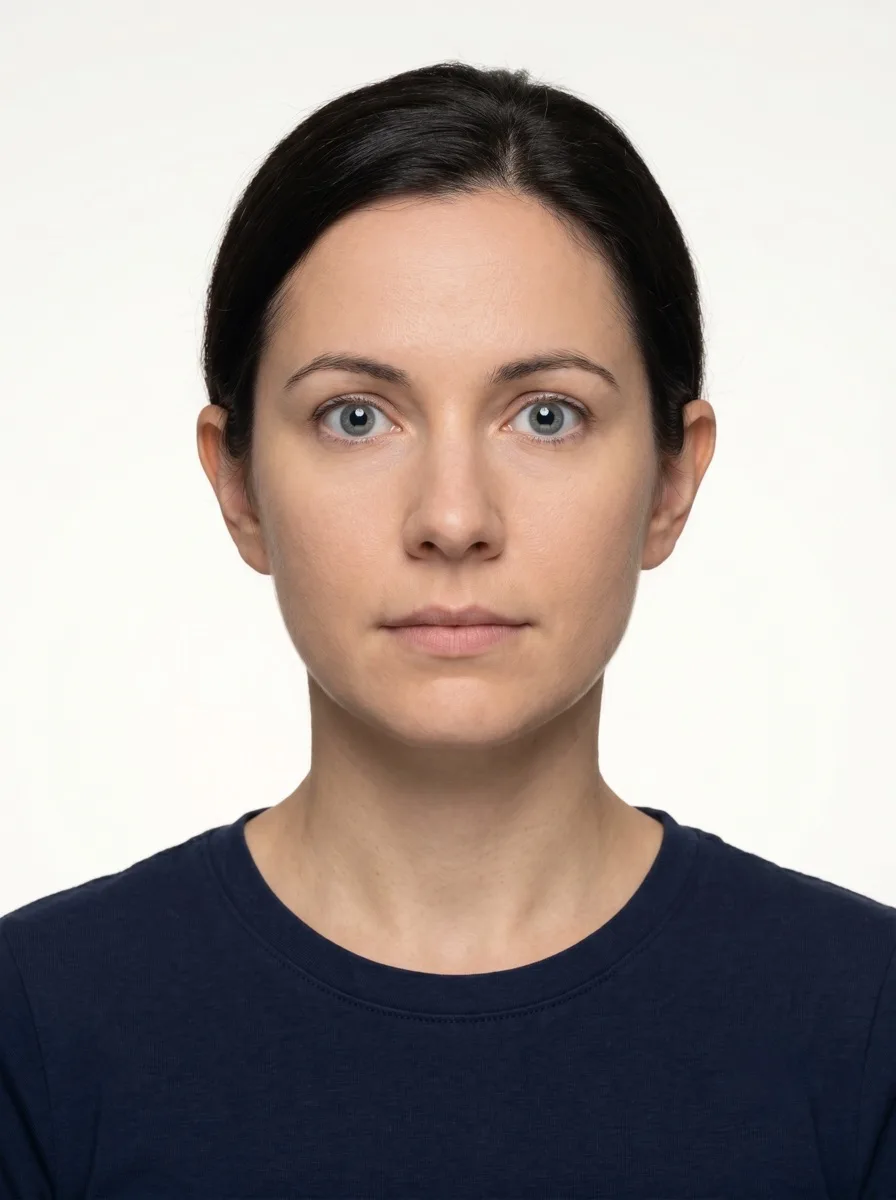
Compliant Japan residence permit example (30 × 40 mm)
Face centred, looking directly into the lens
Plain background — no shadow, pattern or texture
Neutral expression, eyes open, mouth closed
No glasses, no hair across the face
Top 6 Japan residence permit rejection causes
Background shadowShadow on the wall behind the head, or background with a visible pattern or gradient
Smile / open mouthVisible smile with teeth or open mouth instead of a neutral expression
Glasses with glareGlasses with a clearly visible light reflection covering part of the eye
Hair across the faceLoose hair strands covering the eyes, eyebrows or part of the face
Eyes off-cameraEyes looking to the side instead of directly into the camera lens
Head tiltedHead tilted so the eye line is no longer horizontal
Typical rejection reasons and how to fix them
Typical reasons a photo is rejected under the rules Immigration Services Agency of Japan (ISA), Ministry of Justice publishes: what is wrong and what to change.
Reason
Fix
A photo that does not meet the size or the dimensions of the drawing, or is off-centre, turned sideways or tilted
Print 4 × 3 cm with the face 25 ± 3 mm from crown to chin, centred and facing forward.
A shadow on the background or face, a dark background that hides the outline, a blurred or shaken picture
A plain background without shadows, an even light, a sharp picture.
Glasses frames over the eyes or very thick, reflections in the glasses, a mask, a fringe over the eyes, cloth that leaves a shadow on the face
Frames clear of the eyes, no reflection, no mask, forehead and eyes visible, no hat.
An edited photo (enlarged eyes, whitened skin, corrected moles or wrinkles) or a mirror-reversed one
Use an unedited photo that has not been flipped.
A photo taken more than six months before the day of submission (three months on some procedure pages) or without the name on the back
Take a new photo, and write the name on the back unless it is printed into the form.
How to take your Japan residence permit photo correctly
Background and light
Background: plain, one colour
The tool puts in the required background. Stand half a metre from a plain light wall, face a window and shoot without flash — then there are no shadows on your face or on the wall.
Framing
Head: 55–70 % of the photo height
Camera at eye level, about a metre away; head and shoulders in the shot. The tool crops it to 30 × 40 mm.
Glasses
Glasses only if no glare
If you wear glasses, check the shot: no glare on the lenses, eyes clearly visible.
Expression and gaze
Neutral expression, mouth closed, eyes open
Look straight into the lens with your head level; keep hair away from your eyes and eyebrows.
Print at 100% scale, borderless, and turn off fit-to-page so each photo keeps its exact size.
Where to submit your residence permit application
A status-of-residence application in Japan is filed at a Regional Immigration Services Bureau (or online for the procedures that allow it) with one photograph, the passport and the residence card.
Regional Immigration Services Bureau of the Immigration Services Agencyin person at the Bureau, or online where the procedure allows
isa.go.jp — procedures by status of residence; the Bureau that covers your address
Processing
See the ISA procedure page
Cost
See the ISA fee page
4 × 3 cm, no hat, no background or shadow, within six months (three months on some pages), name on the back.
ISA, standard for submitted photographs (translated from the Japanese): the size is 4 cm high and 3 cm wide; the applicant alone; the dimensions of the part without the border must match the dimensions of the drawing (the face is measured from the top of the head including hair to the tip of the chin); bareheaded and facing forward; no background including shadows; sharp; taken within six months before the day of submission; the name written on the back, except when the photo is printed directly in the photo field of the application (check the page of each procedure); if a photo that does not meet the standard is used, a retake is requested.
Same page, the drawing as checked on 2026-09-21: the face from the top of the head (hair included) to the chin 25 ± 3 mm (22–28 mm), the top margin 5 ± 3 mm, and the face centred 15 ± 2 mm from the edge of the 30 mm width.
Same page, unsuitable examples: not meeting the stated size or standard; off-centre; the face turned sideways; a shadow on the background; a tilted body; a part of the face hidden (glasses frames over the eyes, very thick frames, lighting reflected in the glasses, a mask, a fringe hiding the eyes, a face covered with cloth that leaves a shadow); hard to identify (an expression very different from the usual one, a dark background that hides the outline, a blurred or shaken picture, a shadow on the face); image processing or editing that enlarges the eyes, whitens the skin or corrects face parts, moles or wrinkles is unsuitable in any case; a left-right reversed photo is unsuitable.
Same page, cloth over the face: a face covered with cloth that is still sharp is no problem; if the face is covered for a religious or medical reason, a statement in a free form is requested.
ISA English procedure page «Business Manager», change of status of residence (Internet Archive copy): one photograph (4 cm long × 3 cm wide), a sharp, clear photo of the applicant facing forward with no hat, cap or head covering against a plain backdrop with no shadows, taken within three months prior to submitting the application, attached to the photograph section of the application with the name written on the back; the passport and the residence card are presented.
Questions
Frequently asked questions
4 cm × 3 cm, the applicant alone, bareheaded and facing forward, no background or shadow, sharp, taken within six months before the day of submission (three months on some procedure pages), the name on the back, and no editing.
4 cm high and 3 cm wide (30 × 40 mm), with the face from the crown including the hair to the chin 25 ± 3 mm on the ISA drawing.
No: the ISA says image processing that enlarges the eyes, whitens the skin or corrects face parts, moles or wrinkles is unsuitable in any case, and a mirror-reversed photo is unsuitable too.
The standard is bareheaded; if the face is covered with cloth for a religious or medical reason, a statement in a free form is requested, and cloth that leaves the face sharp is no problem.
The Japan residence permit photo must be 30 × 40 mm. The head must occupy 55–70% of the photo height. Submit the photo with your application file or online portal as required by the immigration authority.
Residence permit photos often have stricter recency requirements than passport photos because the permit is tied to an active legal status. Submit a photo taken within the last three months where possible, even if the authority allows up to six months.
Even plain background without shadows. The wall behind you must be evenly lit with no shadows. Patterns typically trigger automated pre-screening rejection at the immigration submission portal.
Usually no. Even when dimensions match, residence permit applications require a fresh photo that reflects your current appearance at the time of application. Reused passport photos are a frequent rejection cause.
If hair, beard, weight or facial features have changed noticeably, take a new photo. The immigration reviewer compares the photo to your current appearance during the in-person submission or biometric appointment.
Anfas.Pro provides a 14-day full refund if the Japan immigration authority rejects the photo and you supply the official rejection notice.
30 × 40 mm = 3 × 4 cm = 1.18 × 1.57 inches. At 300 dpi that is 354 × 472 pixels; at 600 dpi, 709 × 945 pixels.